Goodbye to Flat Tires?

Another use for composite materials has been discovered that I’d like for my personal automobile — the NeverFlat tire.  LoPresti Aviation Engineering is introducing a new tire technology for general aviation aircraft – with a 10 year guarantee against flats.  Apparently the secret is a layer of composite attached to the carcass before the tread is applied.  While the tires still use a bit of air – 10 to 12 pounds of pressure – the air is only for the smoothness of the ride — the tires really don’t need air to work.  An interesting video on this technology is available here.

Cirrus design will be the launch customer for this technology, with deliveries beginning in December.

How does MAX compare?

[UPDATE - Podcast with Scott Hamilton and Jon Ostrower]

We undertook an analysis based on the data available and have to say the Boeing 737MAX looks pretty good.  Indeed, by digging around the 2010 DoT data we were able to establish benchmarks using the 737-800 and A320.  Then we took the improvements promised by the engine makers. The table below illustrates what have been able to derive. A word of caution – the engine OEMs are reviewing our table, and may update our numbers, in which case we will update this post.

Additionally, Boeing and CFM haven’t yet settled on the diameter of the LEAP-1B that will power MAX–66-inches or 68-inches. The difference may be small, but according to Airbus, each inch accounts for about 0.4%  0.5% in fuel burn. (This does not take into account offsetting changes that would be designed into the smaller fan size.)

A key item to consider here is that CFM promises to keep their numbers at least at where they are now on CFM56 but offer better fuel burn and of course a better noise profile.  We see MAX doing over 7% better than the NG.  The A320neo is interesting because the LEAP alone drives down costs by nearly 8%, then throw in sharklets and a aerodynamic tweaks and the number should comfortably exceed 10% over the current A320.  The GTF powered A320neo does even better because PW promises that its new engine will offer significantly lower repair costs since it has a lot fewer parts.

Which of course only provokes the question – how much better would MAX be with a GTF?  We would estimate 1% better than it looks now, bearing in mind it too would be limited to a ~20% smaller fan.

But of course this all depends on the promises the OEMs are making.  CFM has a remarkable record for delivering what it promises and we are confident they will ensure MAX is optimized.  PW is betting its future on GTF and from what we hear the engine is beating goals – they are ahead in testing in Canada with the flying testbed by a lot. So there is reason to be confident in that engine, too.  We feel that engine OEM numbers are sound.  We also, at this stage, believe Boeing will stick to “keeping it simple” with MAX in order to avoid program stumbles. Airbus, from what we hear, is hitting its milestones on neo, too.

If everyone’s numbers are sound, based on our estimate, MAX will be about 2% better than neo in cost per hour.

787: Countdown to delivery Sept. 26

With certification of the Boeing 787 Friday, the countdown to delivery–now slated for September 26–is finally underway.

Aspire Aviation has a piece that for the first time anywhere as far as we know has the actual number of airplanes to be delivered this year (seven). Boeing has been ambiguous about the actual deliveries, including line numbers (only three from pre-20, which are the most challenging airplanes).

AirInsight continues to hear that deliveries could be as few as four; Boeing has yet to announce a number.

Flightblogger has an interesting piece with charts visualizing the 787 orders, cancellations and geographic distribution; and the engine orders.

What’s not there is the math showing the cancellations from the peak. At one time Boeing had slightly more than 950 orders for the airplane. There are now 821 orders.

Despite the program’s difficulties over the past 3 1/2 years, make no mistake: delivery will be a milestone in commercial aviation.

[Read more...]

AirInsight team OK after hurricane

For those who wonder, Ernie Arvai and Addision Schonland came through the hurricane Irene storm OK.

Ernie is in New England and had power outage and some trees come down, but no damage. Addison, now in Baltimore, still is without power but has no damage.

Addison recently moved to Baltimore from San Diego after 24 years and many earthquakes. Within two weeks he went through an earthquake and a hurricane. Ironic indeed.

For those who had damage and injuries or death, our thoughts go out to them.

787 Certified!

After multiple delays, the Boeing 787 has finally been certified, with both the FAA and EASA granting type certificates and the FAA granting a production certificate. Congratulations to Boeing on persevering through a series of difficulties and the “unknown unknowns” that can plague aircraft development program.  Boeing’s Jim Albaugh summarized the moment at the celebration ceremony as follows: ”Certification is a milestone that validates what we have promised the world since we started talking about this airplane. This airplane embodies the hopes and dreams of everyone fortunate enough to work on it. Their dreams are now coming true.” Delivering the airplanes is the next step, and ANA will take possession of its first 787 on 25 September, with ceremonies on 26 September.

As the first aircraft with a composite fuselage and main structure, all eyes will now be on how the 787 performs in service, and the reliability of its advanced technologies.  Some airlines are reluctant to be launch customers of aircraft, understanding that improvements are generally made within the first 100 or so units of production.  ANA has taken launch customer risk, and will carefully ramp up its service, first with special introductory charters, then domestic service, followed by regional service in Asia and then long-haul operations.

As the old saying goes, pioneers take arrows, and Boeing has taken a quiver full on this program.  We wish Boeing and its customers the best as the 787 enters service.

The Orphan Airplane

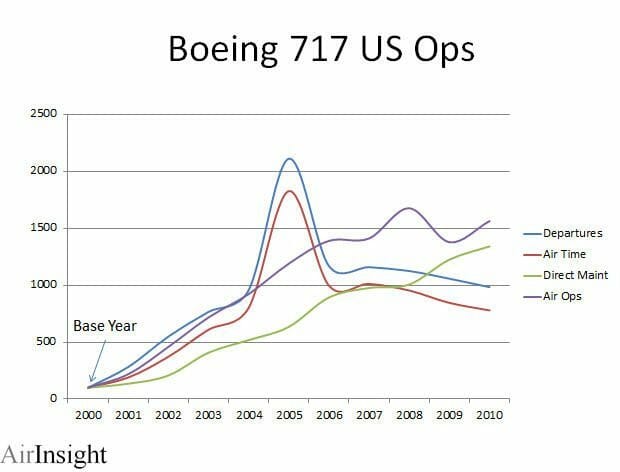
Possibly the airplane most qualified to go by this moniker is the Boeing 717.  It started life as the MD95 – and with it went much of the hopes of McDonnell Douglas. It made an early and crucial win at ValuJet which became AirTran.  There a few more sales here and there, but McDonnell Douglas had moved too little and too late.  Once it became clear that the firm was going to disappear into Boeing, the MD95 was going to become an orphan.  Boeing saw the airplane as a threat to its 737-600 and went about keeping it around halfheartedly – renaming it the 717 was a bit of an industry joke because there never officially was a 717 between 707 and 727. [Read more...]

Canada’s Discovery Air to Order HAV 366 Airships

Hybrid Air Vehicles, based in Cranfield, England, has received a launch customer order from Discovery Air in Canada to develop an airship with a 50 tonne payload that can land without an airport, or even on water.

Discovery Air serves the oil and gas and extraction markets, often operating in difficult terrain far from airports and ground service facilities.  It will partner with Hybrid Air Vehicles to develop and certify the aircraft, and plans to place an order for between 10 and 45 HAV 366 airships.  Each airship will be priced between $30 and $50 million.

The HAV 366 will be 358 feet long, 183 ft. wide and 107 feet high, with a maximum payload range of 1,250 nautical miles at an altitude of 9,000 feet.  Its payload deck will by 95 ft. long, 13 ft. wide and 11 ft. high, enabling it to accommodate large drilling rigs or mining machinery for delivery off airport, directly on site.  The airship will have a maximum airspeed of 104 knots.

Hybrid Air Vehicles re-examined the basic principles behind lighter than air science, and by applying modern technologies and materials won a recent competition partnering with Northrop Grumman for a $517 million US Army contract for a Long-Range Multi-Intelligence Vehicle (LRMV) that will be used in the Afghanistan theatre.  They will now transfer these technologies into the commercial market.

Technologies that HAV will incorporate include ultra large right construction hull technology with superheat buoyancy control, the ability to operate at altitudes as high as 20,000 ft. in the jetsteam for military applications, vectored thrust and composite structures, fly by light flight controls, laminated hull fabrics, turbine propulsion, lifting body hulls, and a hover cushion landing system.  This is a far cry from the Hindenberg and the Goodyear blimp we are all familiar with.


This company is not alone in thinking about airships. Even Boeing has been looking at this.

Not Your Father’s Turboprop!

ATR has delivered its first new model ATR-72-600 to Royal Air Maroc.  The new aircraft are more efficient that prior models, and compete with the Bombardier Dash-8 Q400 in the turboprop sector.

Perhaps the biggest change for ATR is the interior.  The new Armonia cabin, developed by the Italian design firm Giugiaro Design, provides a striking contrast to the somewhat utilitarian interiors in the earlier ATR-72s that I’ve flown.  With larger bins, and more modern seats, the ATR models have now moved from the 1980s into the 21st century, even to center and seat-back entertainment systems, bringing them in line with the jets and fleet standards for brand commonality.

Turboprops have always suffered from NVH – Noise, vibration and harshness.  But those drawbacks have largely been mitigated with newer designs, which utilizes noise cancellation technology and anti-vibration technologies to reduce vibrations cause by air from the propeller striking against the fuselage.  Today, modern turboprops provide a ride comparable to jets.  In addition to the interior, a full glass cockpit and new engines also provide significant improvements to the new -600 ATR models over their prior offerings.

More fuel efficient than jets for shorter regional routes, turboprops are making a comeback in the market, especially with the currently high fuel prices that are not projected to abate anytime soon.  With a new focus on interiors and comfort, rather than simply utility, this market is coming of age.

Pricing a Key to Initial LEAP-GTF Narrow-Body Battles

The battle for aircraft engines in the narrow-body market has increased dramatically with the introduction of the PW1000G geared turbofan, which has emerged as a strong competitor to the CFM International LEAP engine that will replace its existing market share leader, the CFM-56.  The LEAP-X prototype shown below illustrates the new technology composite fan blades that improve engine efficiency.

We’ve written several columns on the PW GTF, which we believe has stronger growth potential than the CFM LEAP based on its architecture, and will likely pull away in performance over the next decade.  But currently, both OEMs are promising significant reductions in fuel cost and noise, and in the case of the GTF, reductions in maintenance costs as well.

[Read more...]

Gary Scott and CSeries

Reading various reports on the retirement of Gary Scott would have you believe it was he alone that kept the CSeries program alive. Yesterday Bombardier announced his retirement for personal reasons. It came as a surprise for many, including us.

But even as we are aware the reason for the hasty retirement is really just what was announced – a personal reason–Scott should be commended for building the team he had at Bombardier.  The CSeries is no one-man show.  In discussing the matter yesterday with media and other analysts, we pointed out that Bombardier has a choice of successors.  For example Ben Boehm and Chet Fuller come to mind.  The company is going to look inside and out for an appropriate person to take the position vacated by Scott.

[Read more...]

Shopping Cart (0 Items)
Your cart is empty!


Subtotal: $0.00 USD
Total: $0.00 USD