Podcast – India Selects Rafale

After a long haul, the Indians appear to have selected the Dassault Rafale for their new fighter. Discussing the selection and implications with us are FlightGlobal’s Steve Trimble and G2Solution’s Michel Merluzeau.

The selection process took years. Virtually every fighter that could compete did. In the end it was a fight between Typhoon and Rafale. The lowest cost winner seems to be Rafale. As our guests explain, this selection could have implications for the outstanding deals in Brazil and UAE.

Play

Airbus to Enhance A330 Capabilities

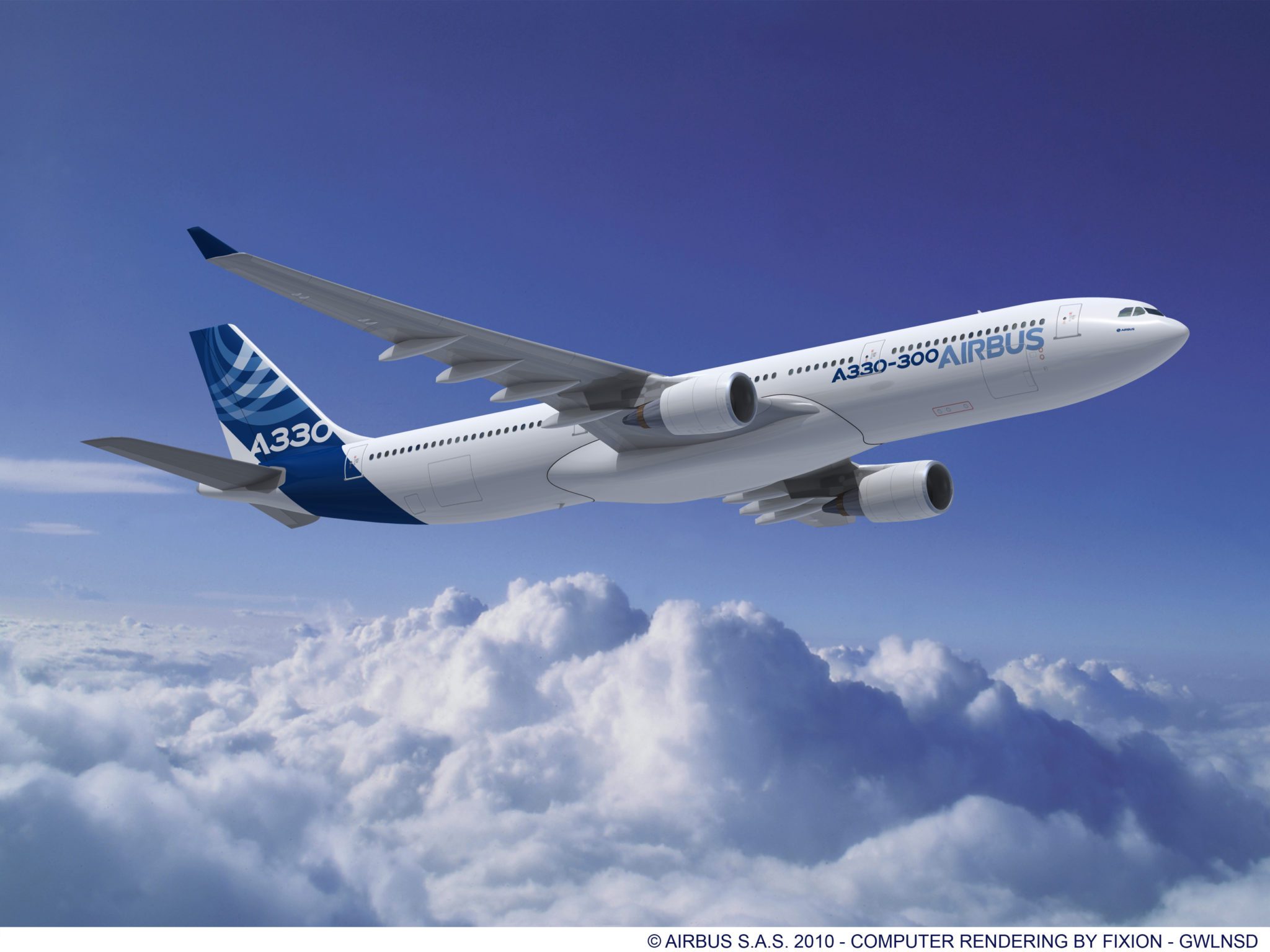
Today La Tribune reports that Airbus is going to increase the MTOW of the A330-300 by five tonnes to 240 tonnes.  This should enable the A330-300 to increase its range by 400 miles. The additional weight will be offset by weight reduction from the design where A340 requirements are no longer needed.  The A340 and A330 share a common fuselage.

The move is clearly not only to occupy the segment forgone by the elimination of the A340, it is also an attempt to close the perceived gap between the A330 as we know it and the Boeing 787, which offers longer range.

Airbus newest product, the A350, will be larger than the 787 and similar in size to the 777 series. Boeing has two models that bracket the A350; the 787 at the lower end and the 777 on the upper end.  By adding more capabilities to the A330 Airbus closes what many have thought to be a key gap on the smaller side of the market.

According La Tribune Airbus should be able to offer this enhanced -300 between three and four years from now.

The A330 is proving to be a remarkably resilient and flexible design. John Leahy, Airbus COO Customers, points out that since the announcement of the 787, Airbus has sold 740 A330s. Clearly writing off the A330 is premature, and Airbus enhancements should provide additional life to an already successful program.

As Airbus and Boeing’s production sells out

The NEO and MAX have taken the market by storm.  Customers seem to be willing to stand in line – even though the 787 and A380 programs taught that sometimes one can order too early.  Yet the desire for fuel efficient workhorses appears inelastic. [Read more...]

Al-Li an alternative to CFRP

Alcoa announced today that it is expanding its aluminum lithium (Al-Li) capacity and capabilities at three locations to meet growing aerospace demand for its newest alloys.  These alloys, introduced last year and now patented, allow OEMs to build dramatically lighter and lower-cost airplanes compared to composite alternatives.

This news is important when looking at what OEMs are doing developing ever lighter airplanes.  Airbus (A350) and Boeing (787) have selected the CRFP route whereas Bombardier has gone the Al-Li route for its CS. Alcoa believes its product offers less risk to OEMs than CFRP.  While CFRP is well known in military use, it has been used less on commercial airplanes until quite recently.

ALCOA further states that its new technologies:

  • lower the weight of an airplane by up to 10% vs. composite-intensive planes;
  • lower the cost to manufacture, operate and repair planes by up to 30% vs. composite-intensive planes, and at significantly lower production risk;
  • allow for a 12% increase in fuel efficiency, on top of the 15% from new engines; and
  • deliver passenger comfort features equivalent to composite-intensive planes, such as higher cabin pressure, large windows and higher humidity.

The last two items deserve special attention. Offering this much in fuel savings is highly significant and then being able to allow for larger windows (like on the 787) and better cabin pressure/humidity is compelling.


Big airplane sales mean big engine sales

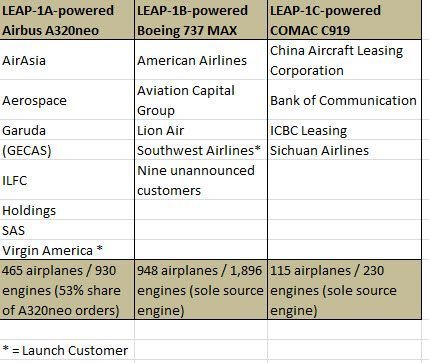
This morning CFM provided the following PR: “CFM International (CFM) had a record year in 2011, logging orders for 1,500 commercial, military and spare CFM56 engines and commitments for 3,056 LEAP engines for a combined value of $51.7 billion at list price.

As the company logs record commitments, CFM is also achieving record production rates for the CFM56 product line. The company has built more than 1,000 engines per year since 2006, and the rate has grown steadily. In 2011, CFM delivered more than 1,300 engines, the highest rate in the industry, compared to 1,250 engines built in 2010.  Current plans are to reach more than 1,600 engines per year by 2014.”

This is what a great year looks like.


Cathay Pacific Adds to its A350-900 order

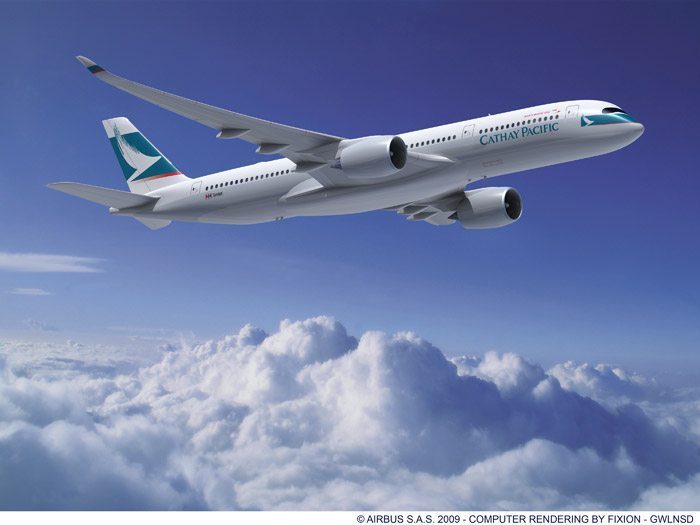
Cathay announced it was adding to its existing A350XWB order by committing for six additional -900s.  The airline now has 36 A350s on order plus two more committed via pre-arranged 12 years leases.  These six aircraft are scheduled for delivery in 2016-17.

The selection of this airplane is important because Cathay Pacific is also a significant 777-300ER customer.  The A350-900 falls between the 777-200 and 777-300 in size, with 314 seats, falling between the 301 and 365 capacities of the competing 777 models.  The forthcoming A350XWB-1000, at 350 seats, will be closer to the 777-300ER, and could represent a potential replacement for that aircraft in the future.

This is certainly an interesting development, given that Boeing will be introducing its revised 777-8 and 777-9 shortly after that timeframe, although it is not expected that the re-engined version of the 777 will fully match the economics of the much lighter, heavily composite A350XWB.

Airlines that operate the 777 are typically very pleased with the airplane, which has been among Boeing’s best products.  Cathay has been a particularly happy customer of the 777-300ER.  Boeing’s revised 777-8 and -9 models will no doubt continue to build on the success of their -300ER, and we expect the 777-9 to be larger than the existing 777-300ER to improve seat-mile economics.

Cathay has ordered 71 777s so there is no doubting its current commitment to the airplane. But ordering the new technology A350XWB could mean a key conquest for Airbus in the large wide-body twin segment.  It appears Cathay is planning on standardizing on the A350-900, and possibly the A350-1000 in the future, for the 300-350 seat segment.

Bombardier CSeries gets another sale

Bombardier Aerospace announced today that Geneva-based PrivatAir has placed a firm order for five CS100 airliners and has taken options on an additional five CS100 aircraft.  PrivatAir was founded more than 30 years ago and operates a large fleet of commercial and business aircraft to provide private charter and private airline services. Its specialized services include exclusively business class flights on behalf of several major network airlines.

PrivateAir has experience with both the A320 and 737 families in all business class service for various airlines.

The capabilities of the CS100 to use short runways, like London City, opens up intriguing possibilities of what this news might entail.

UK to look at Thames Estuary Airport plan

An airport at the Thames Estuary has moved a step closer with confirmation the UK government would hold a consultation into the proposals. Having ruled out expansion at the existing airports in the south of England, the government is seeking ways to ensure the UK maintains its position as an aviation hub.  London’s airports have been forbidden to grow by adding runways. Anyone who has flown through Heathrow knows how crowded it is.

The estuary idea, first championed by London mayor Boris Johnson, faces many hurdles.  The fact the idea is being given any consideration after being dismissed at first is good news.  UK deputy prime minister Nick Clegg is thought to be opposed to the idea and environmental campaigners have attacked the plan, claiming local birdlife would be endangered.  Chancellor of the exchequer George Osborne did not rule out the plan in 2011 during his Autumn Statement.

There is more information on the estuary proposal here.

Airbus claims Top Spot for 2011

Sending out this chart today, Airbus claims to be the winner in the annual orders race once again.  When taking a more detailed look at the numbers, note that just over 85% of these sales are for the A320.  The A330 is another bright spot at 6.3% of orders.  The A380 accounted for 1.3% of annual sales – a number that understates the value of these sales.

Overall single aisle sales accounted for 91% of sales. The A321 saw a good jump in orders of 109 – but this is only 7.4% of single aisle orders. The A318 saw a net -3 while the A319 scored 19 orders. Clearly the big story here is the success of the neo. Without doubt 2011 was the year of the neo.

In the twin aisle segment (A330, A340 A350) the A340 had no orders, and while the A330 did well, the A350 had a net loss of 31.  Among the A350 cancellations the A350-900 saw 61% of the cancellations.  The increase in A380 orders should have been much better – there were 29 orders but ten cancellations.

Airbus has 12 new customers on its list. That’s a 19% growth in customer base.

When looking at deliveries Airbus provided the following chart.

Of the deliveries, 78.8% were single aisle – compare this to the 91% among the orders.  The A320 accounted for 73% of deliveries compared to 85.9% of orders. Clearly the A320 is Airbus’ “bread and butter” program. The A330 generated 87 deliveries (16%) and the A380 26 (5%).  We anticipate Airbus will at least match the A320 and A330 deliveries in 2012, but do better on A380 deliveries.

ETS deployment spurs carbon credit sales

Reuters reports EU airlines are buying up carbon credits on the cheap. Recently carbon credit prices have dropped to about half what they were trading at a year ago.  This move is quite different from other non-EU airlines; whose reaction has either to join the lawsuits or, in the case of China, to refuse to pay them.  The most extreme case has been AirAsia X which simply withdrew from the market because the ETS, fuel prices and other costs were too much.

Interestingly Ryanair announced it would charging customers €0.25 per leg to offset the ETS fee.  The airline thinks its 2012 ETS bill will be around €20 million – equivalent to just under 80 million passengers for 2012.  Meanwhile Lufthansa said it would need to pass on €130 million in ETS costs to its customers. In 2011 Lufthansa carried 90.2 million passengers (group figure).  This means the airline needs an ETS offset of approximately €1.44 per passenger assuming they carry the same numbers in 2012.

As EU airlines move on the slump in carbon credit prices, hedging much as they do on fuel, prices are likely to firm.  In the meantime we are now able to define with more clarity what the impact will be for travelers.  Certainly, given some of the onerous taxes and levies (the UK APD being the worst), the ETS offset fee is not going to be high enough to hurt air travel. At the moment at least.

Which makes the current non-EU airline position seem more about fighting EU laws than anything else.  Given the EU’s determination to enforce the new rule, airlines may have to simply swallow their pride and buy credits to offset ETS charges.  Of course ETS costs per passenger are low now.  As soon as the airlines start to get on board, we suspect the EU will increase the ETS to test how much revenue they can squeeze out of travelers. No government can resist seeing how hard it can squeeze any gold egg laying goose. And in doing so, the EU risks getting the airline industry even more irritated. But the EU has demonstrated its deaf ear before.

Shopping Cart (0 Items)
Your cart is empty!


Subtotal: $0.00 USD
Total: $0.00 USD