The world’s largest independent aerostructures supplier no longer exists. How does that change who gets to build airplanes? If Spirit is gone, how does anyone new get in?
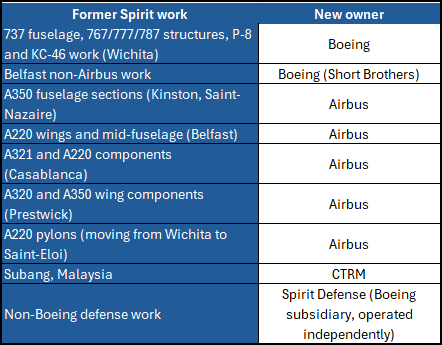
First, what happened? Boeing closed its $4.7bn purchase of Spirit AeroSystems on December 8, 2025. Including debt, the enterprise value was $8.3bn. Airbus closed on its carve-out the same day. Boeing took roughly 15,000 workers and Airbus about 4,000, per Aviation Week.
Boeing spun out Spirit in 2005. Twenty years of outsourcing ended in a buyback. No surprise, the OEMs called it control.
AirInsight
Spirit paid Airbus $439m to take the loss-making sites. Airbus also extended $200m in interest-free credit to keep parts flowing during the transition. That tells you what the work was worth to an independent. These sites had been losing money on both OEMs’ contracts, as we noted then.
The consensus read is that this fixes quality. Boeing’s Kelly Ortberg said in October 2025 that Spirit fuselage quality was already improving. Maybe. The other effect gets less attention. The single biggest open-market node in the aerostructures supply chain is now captive.
The deal sheets tell you who owns what. They don’t tell you which doors are still open to a newcomer, or what each one costs.
Behind the break: the four ways into aerostructures now, ranked, and the one route that no longer exists. Everything above is public. The analysis below is what AirInsight subscribers pay for.
Unlock the full AirInsight analysis
Get instant access to proprietary KPI models, production and delivery forecasts, market intelligence, and the complete subscriber archive.
We use cookies to optimize our website and our service.
Functional
Always active
The technical storage or access is strictly necessary for the legitimate purpose of enabling the use of a specific service explicitly requested by the subscriber or user, or for the sole purpose of carrying out the transmission of a communication over an electronic communications network.
Preferences
The technical storage or access is necessary for the legitimate purpose of storing preferences that are not requested by the subscriber or user.
Statistics
The technical storage or access that is used exclusively for statistical purposes.The technical storage or access that is used exclusively for anonymous statistical purposes. Without a subpoena, voluntary compliance on the part of your Internet Service Provider, or additional records from a third party, information stored or retrieved for this purpose alone cannot usually be used to identify you.
Marketing
The technical storage or access is required to create user profiles to send advertising, or to track the user on a website or across several websites for similar marketing purposes.