

Nothing links the week’s outages except how they were built. A router took 17 of the FAA’s 22 en route centers offline. A United app took away takeoff weights. Each system had one point of failure. The timing on all of this was, to say the least, awkward.
The Week
Five IT failures hit the US in six days. Two were in aviation.
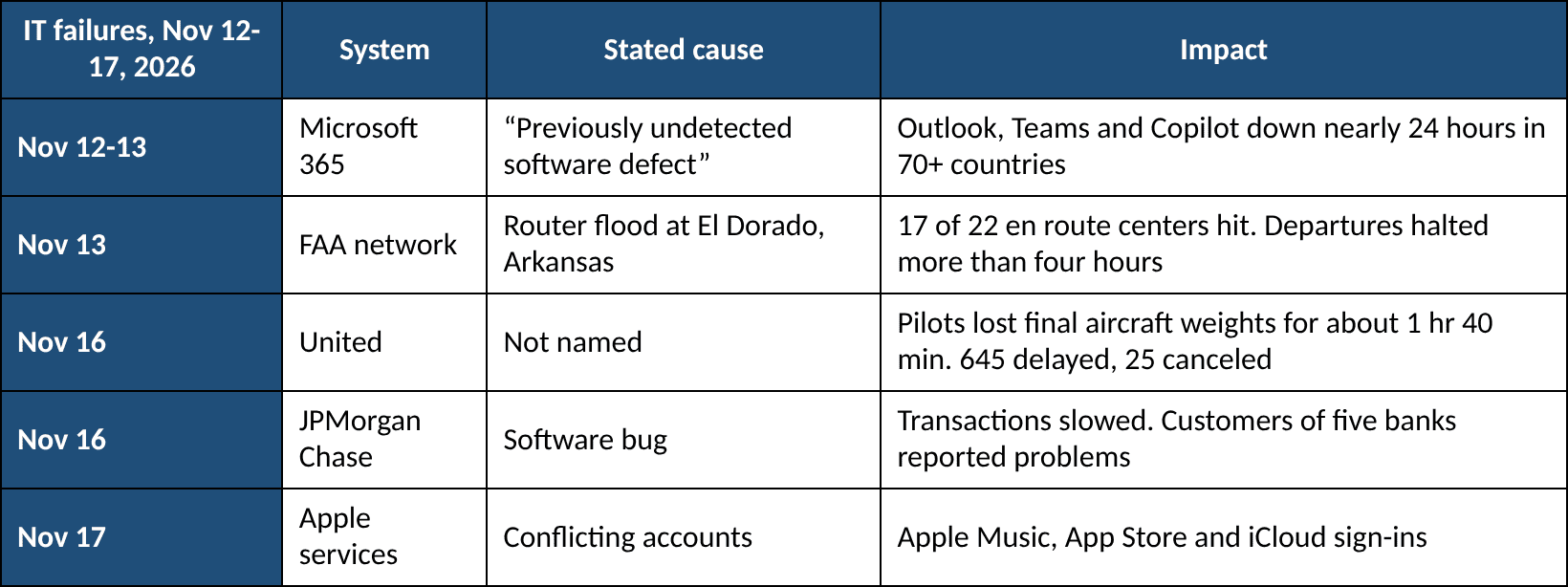
The table combines items from Patch, AeroTime, and the Inquirer. Apple’s cause is unclear in coverage.
Transportation Secretary Sean Duffy said on November 13: “You will have more of these. You will have more of them unless the American people and the Congress tell us to build.” He asked Congress for $50bn. The question is whether money is the whole answer.
The Finding
No cause connects them. Microsoft blamed a software defect. The FAA blames a router. United has not named a cause. Chase blames a software bug. The Inquirer notes that nothing ties Microsoft’s outage to United’s.
That is our finding, and it is the reassuring part. We found no sign of a shared trigger.
The thread is design. Microsoft said its protective measures “did not isolate the failure as intended.” The FAA’s fault left one remote site and reached 17 centers. United lost one data feed, and pilots could not compute takeoff performance.
In each case, a small fault grew beyond its trigger, and nothing contained it.
One Router
L3Harris, the FAA’s network contractor, was replacing equipment at El Dorado, Arkansas, on Friday afternoon. A new Juniper router began sending data too widely, per the Wall Street Journal, as relayed by Make Tech Easier. A second site in Amarillo, Texas, added to it.
Make Tech Easier reports about 1,000 connection attempts every 4 to 5 seconds. That figure is single-sourced. The fault hit the FAA’s legacy telecommunications network, which carries radar and voice. L3Harris blocked both sites and the network settled. The FAA then disabled broadcasting on about 60 similar routers.
HPE says its router “operated as configured by the installer.” Administrator Bryan Bedford says the cause is open. It could be the installation, the configuration or the technology. Nobody has explained why one site reached 17 of 22 centers, or 77% of them. That is the finding that matters.
What California Saw
LAX had more than 600 flights delayed and more than 280 canceled by Friday evening. Patch relayed the Los Angeles Times count. Nationwide, about 12,462 flights were canceled. Not all of those were directly caused by the stop.
This was not California’s first hit. On September 21, an aging telecom circuit failed in the Northeast. A construction crew had cut the backup fiber. That rippled west, with more than 1,000 delays at LAX, San Diego, and San Francisco, per Reason Foundation. Reason is an advocacy group, and that figure is its own.
On September 14, LAX had its own ground stop. That one was staffing at Southern California TRACON, not IT. Spectrum News counted 102 delayed LAX flights, per Deep Arrival. Three failures in ten weeks, with three different causes. California sits at the end of the chain. A fault in Arkansas or Philadelphia reaches it within hours.
Only in the US?
Not entirely. Microsoft’s outage hit more than 70 countries. FlightGlobal reported that NATS in the UK had outages in September.
What was US-specific was the consequence. The US had one national ground stop, with about 3,500 aircraft landing safely. We have no source that compares architectures, so we cannot claim the US is uniquely fragile. We can say a fault at two remote sites briefly halted the country’s commercial aviation industry.
How to Avoid a Repeat
This is our read, not the FAA’s. We opined on this issue before.
- Do not change the live network at peak. The FAA says it will reconsider daytime remote-site replacements. A Friday afternoon install is a choice.
- Prove the new meets the old. A router feature broadcasts too widely into legacy equipment. That needed a test before the install.
- Test the backup. On September 21, the backup line was already cut. A backup nobody has checked is not a backup.
- Cap the blast radius. 17 of 22 centers should not share one fault.
- Airlines need an offline fallback for takeoff data. United’s fix took about 100 minutes.
Funding is real but not sufficient. Congress gave the FAA $12.5bn for modernization. Duffy wants $50bn more, or 4x that. Money does not fix an install policy.
An Orphan With Many Parents
The ATC update program looks like an orphan. It has parents in both parties.
The 1982 plan, the 1984 automation program, and NextGen in 2003 span 44 years and many administrations. The 2021 infrastructure law gave $1bn a year for five years. About $3bn was spent by the end of fiscal 2024. A $9bn facilities proposal for fiscal 2025 never got funds from Congress. The 2025 reconciliation act then supplied $12.5bn.
Each side claims the other’s work as a failure. Pete Buttigieg said President Trump was passing off a Biden-era plan as his own. Trump has said billions were wasted on copper wire. He said, she said. Everyone’s finger pointing somewhere else. And nothing gets fixed.
GAO’s list of recurring causes does not name one party. It names five. They are poorly defined requirements, too little stakeholder involvement, weak contractor oversight, partial funding, and overly optimistic estimates, per GAO. The FAA owns the first and last. Contractors share the third. Congress owns the fourth.
The stated price keeps moving. Duffy put the total at $31.5bn in December. On November 13, he asked for $50bn. What changed?
An effort with that many owners has no one who has to explain the next failure.
What We Would Ask
- Why did one router reach 17 centers?
- Was the install a mistake, or the design?
- What did L3Harris test first?
- Why was the work done on a Friday afternoon?
- What did the $12.5bn buy?
- What was United’s single point of failure?
Duffy says there will be more of these. He wants $50bn to prevent them.
AirInsight subscribers get full access to our proprietary fleet utilization tracking, OEM production rate models, and US DOT capacity databases.
Explore Subscription Plans & Test Flight ($29)Views: 7