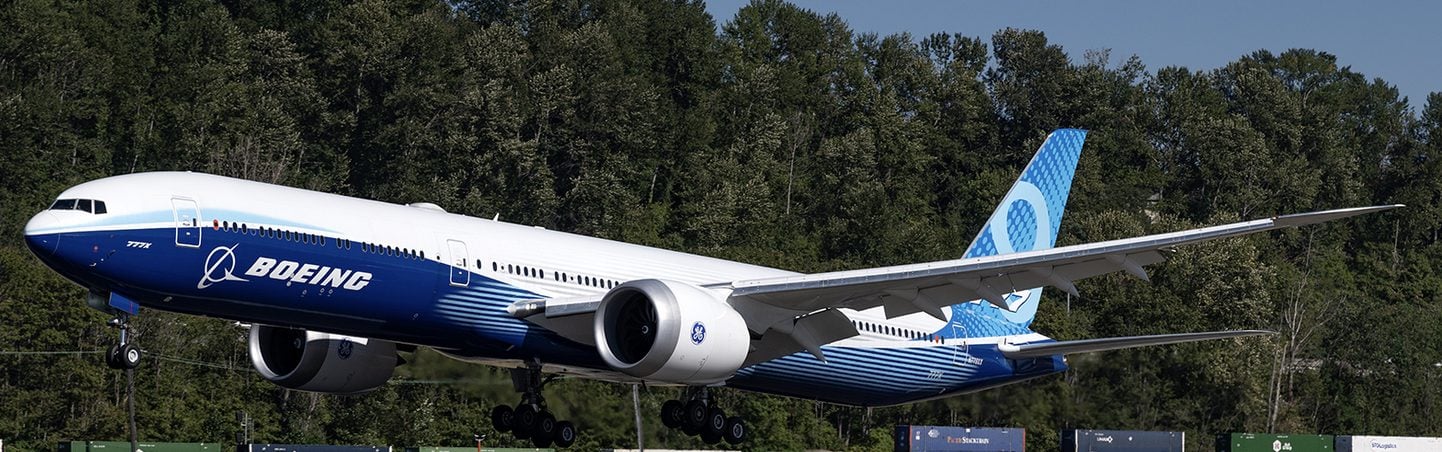
. The latest delay, which began in the third quarter of 2024, involved cracked thrust links on engine mounts in multiple test articles. In its final configuration, Boeing has developed a fix and resumed certification flight testing of the 777X aircraft.
The 777X underwent extensive test flying during its development. The 777X may become the most flown aircraft at the time of certification, as Boeing’s internal flight tests were not official FAA test flights. However, they performed many of the same tests and proved the aircraft’s reliability. That test flying should make the official certification test flights easier, as Boeing now knows the aircraft and its characteristics.
source Boeing
Certification Requirements
Under the FAA certification protocols, a new aircraft typically requires about 2,500 flight hours. Boeing began its formal certification program before the technical issue stopped testing last year, and reports indicate that it completed about 107 hours before the stoppage. They resumed testing with a 3.5-hour flight, bringing the total to about 111 hours after that first certification flight.
Boeing needs nearly 2,400 hours of test flying to complete the testing and documentation required by the FAA to certify the aircraft. However, the company’s delivery target for the aircraft has now been pushed back to the second half of 2026. That means Boeing will need to average more than 141 hours per month in the 11 months remaining in 2025 and the six months beginning in 2026 to complete the process by July 1st, 2026.
With a fleet of multiple test airplanes, is 141 hours per month feasible?Yes, if Boeing prioritizes getting these aircraft into service quickly.That would translate to about 4.7 hours of test flying daily, including weekends, or 6.4 hours per day on a weekday-only schedule.This is certainly doable. While most test flights last 2-3 hours, more than one flight per day would likely need to be scheduled. However, with multiple aircraft, that remains feasible if well-planned and executed.
737 MAX Complications
A problem Boeing faces is that it also has two other certification programs in process, the 737 MAX 7 and 737 MAX 10, both of which are in their final stages.The latest delay in certifying these aircraft resulted from the need to correct an engine nacelle issue, albeit very low in probability, that could result in an un-contained engine failure.Boeing had obtained an FAA waiver for MAX 8 and MAX 9 certifications with a delayed retrofit timeframe but decided not to pursue an additional waiver for the MAX 7 and MAX 10 after the door plug blowout incident. A redesign is now being tested and should be the final piece necessary to complete the required testing. The MAX 7 will be first to certify, followed by the MAX 10, in the order scheduled with the FAA.
source Boeing
Both programs must complete their flight testing with the new nacelles, which requires more time from test pilots and certification testing crews. Boeing has the resources to work on multiple certification programs at a time, and we don’t believe this should result in a major scheduling problem. However, given Boeing’s cash crisis, completing certifications quickly to deliver 25 737 MAX 7 aircraft already built and in inventory is critical to financial performance.
The Bottom Line
Completing the 777X certification by mid-2026 will be challenging but not insurmountable. Multiple simultaneous flight tests with their test fleets require an all-out effort, but they’re out of slippage room to introduce the aircraft before the end of 2026.
This will take a concerted effort from Boeing and be a test for Kelly Ortberg as he implements cultural change. The balancing of speed, cost, and quality must change at Boeing to favor quality, speed, and cost, respectively. This will place Boeing in a position to generate additional cash flow from delivering the new models. Hopefully, the flight test program will proceed smoothly, and no further delays from “unknown unknowns” will occur from here on in. We wish Boeing success in completing its certification priorities as quickly and smoothly as possible.
We use cookies to optimize our website and our service.
Functional
Always active
The technical storage or access is strictly necessary for the legitimate purpose of enabling the use of a specific service explicitly requested by the subscriber or user, or for the sole purpose of carrying out the transmission of a communication over an electronic communications network.
Preferences
The technical storage or access is necessary for the legitimate purpose of storing preferences that are not requested by the subscriber or user.
Statistics
The technical storage or access that is used exclusively for statistical purposes.The technical storage or access that is used exclusively for anonymous statistical purposes. Without a subpoena, voluntary compliance on the part of your Internet Service Provider, or additional records from a third party, information stored or retrieved for this purpose alone cannot usually be used to identify you.
Marketing
The technical storage or access is required to create user profiles to send advertising, or to track the user on a website or across several websites for similar marketing purposes.