

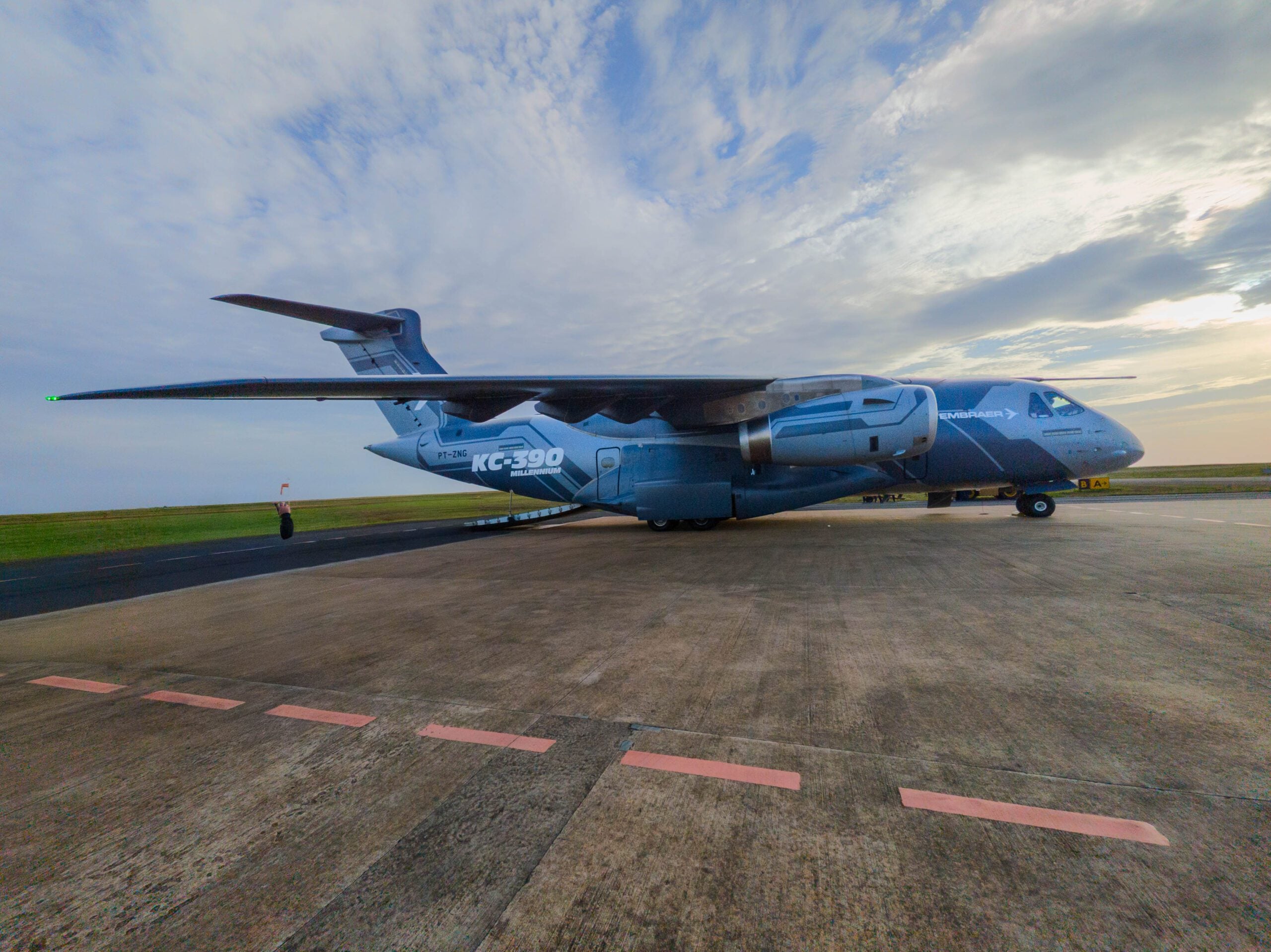
PR: The Hellenic Ministry of National Defense today signed a contract to acquire three KC-390 Millennium with options for an additional three aircraft, produced by Embraer (NYSE: EMBJ/B3: EMBJ3) through a government-to-government agreement between Greece and Portugal.
As part of this landmark agreement, the Hellenic Air Force will receive its first KC-390 Millennium in 2027, enhancing its airlift and air-to-air refueling capabilities while strengthening interoperability with NATO (North Atlantic Treaty Organization) and allied forces. Greece will also benefit from European synergies in training, support, and logistics.
“We are honored by Greece’s decision to acquire the KC-390 Millennium. This choice underscores the trust and confidence that leading NATO members place in our aircraft. This very important milestone further solidifies the aircraft’s position as a preferred solution for military airlift among NATO allies. The KC-390’s proven performance, reliability, and cost efficiency make it an ideal choice for nations seeking to enhance their operational capabilities” said Bosco Da Costa Junior, President & CEO of Embraer Defense & Security.
Greece becomes the seventh European nation to select the aircraft, joining Portugal, Hungary, the Netherlands, Austria, the Czech Republic and Sweden. The acquisition reflects a growing trend among EU/NATO member states recognizing the aircraft’s effectiveness in addressing current and future defense needs.
Beyond the European air forces, the KC-390 Millennium has also been acquired by the air forces of Brazil, the Republic of Korea, the Republic of Uzbekistan, the United Arab Emirates and Colombia. This next-generation multi-mission aircraft delivers unmatched capability, reliability, versatility and performance, with seamless interoperability, to enhance air forces’ operational capabilities worldwide.
The KC-390 Millennium is a next-generation military aircraft designed in the 21st century with interoperability as a key requirement, integrating advanced communications, mission systems, and modern digital architecture into a single platform to enable seamless joint and coalition operations.
It can carry more payload (26 tons) compared to other medium-sized military transport aircraft, flying faster (470 knots) and farther. It can perform a wide range of missions, including cargo and troop transport, equipment and personnel airdrops, medical evacuation, search and rescue (SAR), firefighting, and humanitarian missions, operating from temporary or unpaved runways. The aircraft, when configured with quick-installation air-to-air refueling equipment (AAR), can operate both as a tanker and as a receiver.
Notes:
Another crucial NATO-based win for Embraer. This follows a series of KC-390 wins across Europe.
The most recent confirmed order for C-130 aircraft by an EU-based NATO ally came from Germany and France (through a joint procurement), with the order placed around 2016 and 2018. Germany ordered 3 C-130J-30 and 3 KC-130J, and France ordered 2 C-130J-30 and 2 KC-130J. The final aircraft from this order was delivered in April 2024.
It seems the EU NATO market has moved to a new standard, and Lockheed Martin has lost the market to Embraer. The venerable C-130 has been eclipsed by the KC-390.
This win doesn’t come with big volumes, but it does affect Embraer’s overall corporate financial situation. The C-390 Millennium program is reported to have required an investment of approximately US$4.5 billion (roughly R$22 billion at the time) for development. Multiple Brazilian media reports consistently cite this figure.
While a direct ROI number is unavailable, several signals point to a solid financial return:
- Strong Unit Pricing: Analysts estimated the unit price for the UAE’s order of 10 C-390s at approximately US$180–190 million per aircraft. This pricing level is seen as a sign of “solid profitability” for these orders and a significant tailwind for defense margins.
- Improving Segment Margins: The Defense & Security segment, driven by KC-390 revenue recognition, has shown strong margin improvement. In 1Q26, the segment’s adjusted EBIT margin rose to 17% (from -1.6% a year earlier). In 2Q26, the margin was 11.9%, up from 9.2%.
Growing Backlog: Embraer’s defense backlog surged from US$4.4 billion to US$6.1 billion after the UAE order, with a book-to-bill ratio of 2.6x, indicating strong demand relative to deliveries.
Every KC-390 deal generates ROI for the program that initially depended on the Brazilian Air Force. That first customer proved disappointing. But others have come through, demonstrating the program vision was spot on.
With each KC-390 deal, Embraer gains more financial flexibility. Many see that flexibility as ‘harvesting.’ But a company that developed and delivered so many aircraft models over the past decade is most surely investing. Only they won’t talk about it. We’ve tried several times, only to be given a warm smile and a shrug.
The question isn’t whether Embraer is working on its next program. It’s not even what that program is most likely to be. Everyone knows, with some degree of confidence, what it is. The market requirements are clear to anyone. The key question is: when do they finally talk about it? As Embraer’s financial condition continues to improve, that day gets ever closer.
Views: 0