almost everywhere one looks in commercial aviation. For wide-body and narrow-body airplanes the key players are Airbus and Boeing, with limited competition. For cross-over jets, the players are Embraer and Airbus. For regional jets, it is now down to Embraer and COMAC after Bombardier ceased CRJ production and sold the program to Mitsubishi.
In wide-body engines, it is Rolls-Royce and General Electric. For narrow-body engines, the duopoly is Pratt & Whitney and CFM International, a GE-Safran joint venture. While that provides the majority of the cost and value added for the aircraft, other subsystems such as avionics, landing gear, and others tend to also have two major competitors.
It is difficult to break into a duopoly market to turn it into an oligopoly.
China has a long-term plan with COMAC, but finds increasing production to be challenging, as has United Aircraft in Russia, which pulled together the various design bureaus under one roof, but is struggling with economic sanctions. While both can compete effectively on a domestic basis, neither can reach the levels of global sales and support that Airbus or Boeing can provide.
Even within an industry with four airframe manufacturers and four major engine manufacturers, the competitive aspects tend to move to no more than two competing manufacturers. Moving down the supply chain, the preference for two choices also leads to mini duopolies for many components, many because the OEMs want a second source in their supply chain.
What’s Wrong with Duopolies?
The short answer is that duopoly tends to limit competition and raise prices, negatively impacting their consumers. Duopolies also tend to limit innovation, and in the worst case, develop complacent or arrogant attitudes that can hold back technological change. Duopolies might collude and set prices to maximize margins, or utilize cut-throat competition to prevent new entrants from gaining market share. We’ve seen a bit of everything in commercial aviation over the years.
The anti-trust movements earlier in American history worked hard to eliminate duopolies and regulate competition. But since the 1980s, lax antitrust enforcement and approval of anti-competitive mergers have exacerbated the situation as the larger aircraft oligopoly (Airbus, Boeing, McDonnell-Douglas, and Lockheed) turned into today’s Airbus-Boeing duopoly.
The last two decades provide strong examples of how duopolies can fail and bring about tragic consequences. Those failures can be traced to corporate culture and attitudes within those industry participants. While the aircraft duopoly has focused primarily on updating older models rather than innovate in the narrow-body segment, the anti-trust literature is full of historic abuses, success and failure, and societal impacts that need no further discussion here.
History tends to repeat itself, and the new robber barons are the billionaire tech bros and the industries with high barriers of entry and limited competition. That includes the big two in commercial aviation and the big four in aircraft engines.
Competing with a Duopoly is Different
Duopolies tend to prefer the status quo and not rocking the boat when the industry is profitable, just as Game Theory suggests. Commercial aviation has seen strong demand over the last two decades. Order books have been increasing dramatically and today, the most popular narrow-body models have 11-year backlogs at today’s production rates. That’s a level of commercial demand that is unprecedented in the history of the industry.
But the big two in commercial aviation operate without fear, as they are the results of many years of operation and have substantial barriers to entry that include finance, regulation, and global service and support requirements.
With a duopoly, however, customers have only two choices, and often choices that aren’t optimal. There are no checks and balances with only two players. Let’s look at wide-body aircraft as an example.
At the high end of the market, Boeing has the 777-9 and Airbus the A350-1000. The former is seven years behind schedule for certification, while the latter has been limited in production due to supply chain issues impacting near-term availability. There is no good alternative for an airline that needs large size new lift in the short-term.
The net result is the same — aircraft aren’t coming on time, so airlines need to change their fleet plans moving forward and keep operating older models until new aircraft are available. Of course the older aircraft utilize spare parts to keep running, which tend to have high mark-ups and strong aftermarket profitability for airframe and engine OEMs and their supply chain.
The same situation exists for narrow-bodies. Boeing designed a flawed aircraft with a single point of failure, the 737 MAX. That resulted in two fatal crashes, another near crash due to “quality escapes,” and production well short of demand. Meanwhile Airbus, with a chance to gain sustainable market share, failed to raise production due to supply-chain constraints and engine problems. The net result for customers is a shortfall for new aircraft, the need to keep older aircraft longer, and 11-year backlogs.
The last decade has resulted in a cascading set of problems for Boeing and Airbus, with little or no accountability. With both OEMs having problems, where could an airline turn for aircraft deliveries that are on time, on-budget, and perform with the reliability that airlines need? The answer is nowhere, as neither can deliver airplanes on time, on schedule, and on budget.
Duopolies tend to price similarly with one of two options. The first is tacit competition, in which both parties can enjoy high margins without discounts below cost when competing for orders. The second option is destructive competition, in which prices are driven down to unprofitable levels in an attempt to limit the success of the competitor. In aviation, we’ve seen the former. For aircraft, where a lot of revenue comes up front, discounting is commonplace but within a tacit framework where competitors are not making rash or unprofitable decisions. In that scenario neither player rocks the boat significantly.
For engines, where profit is typically made on aftermarket spares rather than the initial engine, competitors price the initial engine at a loss in order to gain the spares revenue stream over a 25-30 year life of the engine. The lowest price we’ve ever seen is zero, revealed publicly in litigation between two parties. That’s pretty destructive price competition, and would make things difficult for a new entrant trying to gain market entry. Nonetheless, the engine companies all seem to have similar pricing for aftermarket programs, where the real competition, and high margins, live.
Duopolies have Little or No Accountability
Tim Clark at Emirates has complained about delays and performance issues with Boeing and Airbus for many years, and has just rejected early 777-9s due to the high costs of bringing early production models up to current specifications. When the only accountability you have is to not take aircraft that are potentially of dubious quality, that impacts fleet plans and route networks. But turning to the competing A350-1000 is not the solution, as Airbus is producing at about half of the capacity it aspires to produce, ostensibly due to supply-chain constraints. The result: fuel-efficient wide-body aircraft remain a scarce resource in 2026, and certainly don’t arrive on time.
Southwest is in a similar position as Emirates with the 737 MAX 7, as 25 early build aircraft are now about 7 years old, and need modification to the final certification standard. Southwest is reluctant to take these early built aircraft that have been sitting for a long period of time. History tells us that aircraft that have sat for years, even if well maintained by the OEM and stored in the desert, tend not to perform as reliably as aircraft that regularly fly from right after they were built. Nobody likes being forced into buying potential hangar queens, especially when they are extremely delayed.
Complacency
Perhaps the best adjective to describe the Airbus and Boeing duopoly is complacency. Both Airbus and Boeing have displayed complacency in recent years — Airbus with respect to managing its supply chain and Boeing in design failures that resulted in two fatal crashes and significant “quality escapes” in two programs. “Quality escapes” is the industry’s euphemism for a lack of quality control and manufacturing errors. A quality escape sounds better than the true description — an airplane with defective design or components.
It is easy for complacency to set in, particularly when backlogs are at record levels and airlines have no alternative than to wait for delayed airplanes. Unfortunately, Airbus has been consistently missing production guidance since the global pandemic, and Boeing is still slowly rebuilding its quality as it changes its culture away from the complacency that nearly killed the company’s reputation for building safe airplanes.
Too Big to Fail?
An attitude of complacency leads to companies believing they are too big to fail. Even after the two fatal crashes and multiple safety groundings for the 737 MAX and 787, the company remained complacent, and frankly somewhat arrogant. It took an incident that almost resulted in a third fatal crash that could be traced directly to manufacturing incompetence at Boeing in early 2024 that awakened a complacent Board of Directors to take corrective action.
Another five minutes of a door plug missing screws hanging on to the airframe would have resulted in a much different and more catastrophic ending. That incident resulted in forceful regulatory action, extreme measures from the FAA, a new CEO at Boeing, and the introduction of new production constraints and quality metrics to ensure regulatory compliance and safety.
Boeing’s board finally recognized that it had a cultural problem, and brought in a proven aerospace leader, Kelly Ortberg, to turn around the company. The near-fatal quality escape incident, regulatory actions, and management change have all combined to begin changing the culture of complacency at Boeing back to one of performance and engineering excellence, as it was in its “golden years.” The good news is that it is now working with respect to manufacturing quality. The bad news is that Boeing will now find it difficult to invest in a new program without a “bet the company” risk profile, given its high debt levels after the 787 development delays and 737 MAX crashes and quality crisis.
The problems at Boeing were long-standing and will likely take a decade to fully overcome. Two attitudes emerged — one that Boeing was too big to fail, and second, an attitude of arrogance building on the decades of engineering excellence that fell victim to cost-cuts and the Jack Welch GE-trained executives who focused on finance rather than the product. Repairing Boeing’s broken balance sheet will come about slowly over the next decade, and only as a result of design excellence and manufacturing execution, rather than financial engineering.
Similarly, Pratt & Whitney had a major problem with its flagship GTF engine, as some internal engine parts were built using contaminated powdered metal. The result was the potential for parts to fail earlier than they should, with a regulatory mandate to replace those parts. Unfortunately, the replacement parts were not readily available, due to supply chain limitations that couldn’t handle both new engine and aftermarket replacement volumes simultaneously.
The location of the affected parts deep within the engines required a complete tear-down to reach, essentially an engine overhaul that takes several months to complete. While the good news is that the fix worked, and improved the reliability of the engine, the bad news was limited capacity to provide both additional spare parts while continuing to deliver new engines to OEM production lines.
The result was a rolling grounding of aircraft as their engines came due for maintenance. Pratt & Whitney GTF customers found that MROs that could address the problem were full and ran out of maintenance slots, forcing airlines into 3-6 month waits with their aircraft grounded, an intolerable situation for the airlines involved. With roughly one-third of the GTF fleet grounded over the last three years, that “quality escape” cost the company billions. Just what airlines with large fleets of the most fuel-efficient engines didn’t need — a long AOG situation.
Duopolies Stifle Innovation
The mainline narrow-body market, the largest by size, is currently dominated by updated models that initially entered service in 1967 and 1989, respectively. The Boeing 737 program was launched in 1963 and the fundamental design of the aircraft has been stretched and re-engined three times, culminating in the MAX 10 that can carry more than twice the number of passengers than the initial model. Given the two fatal crashes and one near-fatal incident, one must question whether the MAX was a stretch too far. We believe it was.
But as often happens in duopolies, the 737 MAX was a reaction to the A320neo re-engining from Airbus. If Boeing did not match it, Airbus’s use of innovative new engines with 15% better fuel economy would have changed the competitive dynamics of the industry in Airbus’s favor. That was unacceptable for Boeing, who quickly pulled out a previously shelved re-engining concept to match the Airbus new program launch, and again even the playing field.
Of course, the outcome for the 737 MAX was tragic, with two fatal crashes and 346 lives lost. The fault was technically due to a system engineered with a single point of failure that produced trim forces pilots could not manually overcome, denying them the ability to recover the aircraft. But the true cause was a Boeing culture that included arrogance and a lack of accountability.
The irony of the situation is that the airplane itself was not unstable, and only needed the software system to emulate the behavior of the previous model to avoid simulator training for the existing pool of 737NG pilots. Southwest Airlines’ contract for a massive order of roughly 300 aircraft stipulated that if the aircraft ended up requiring simulator training, the airline would receive a $1 million discount per airplane above and beyond the purchase price. So Boeing developed the flawed MCAS system.
Unfortunately, Boeing failed to inform the FAA that a single angle of attack indicator failure could trigger actions that pilots had only seconds to identify and react to. The second problem was that Boeing never informed the pilots of the existence of the system, let alone how to shut it off.
Later, even with knowledge of the system, the pilots of the second crash had only a few seconds to make the right decision before it was too late. The arrogance that “Boeing knows best” has now cost the company a relationship that was based on trust with the FAA. The agency is now reviewing certification programs with the regulatory equivalent of a fine-tooth comb, making certification a much more difficult, time-consuming, and costly process. Regaining trust doesn’t happen overnight.
This same dynamic — complacency and arrogance born of too-big-to-fail status — is why duopolies more broadly tend toward limited innovation. It is simply human nature. When you become a player considered too big to fail, complacency can set in, and complacency often leads to poor quality. Major industry players also often become arrogant. Such arrogance often leads to missing delivery deadlines, but with little or no accountability and no recourse for customers, who have to take what the OEM is offering.
Duopolies Try to Stay Within Market Share Regulatory Triggers
Once the MAX was grounded for 20 months, between March 2019 and November 2020, Airbus had a clear runway to increase production and take a dominant share in the narrow-body market. But Airbus was unable to capture that advantage, in part due to the global pandemic from April 2020 that restricted production after decimating the supply chain. But even afterwards, with Boeing’s production restricted by the FAA to low production levels, Airbus failed to achieve its production goals and missed guidance for four consecutive years.
Had they been successful, Airbus would have gained a significant market advantage over Boeing that would last for a decade or more. But that didn’t happen as fully as it should have, due to complacency at Airbus. One goal of a duopoly is to maintain less than a legally defined dominant market position to avoid regulatory actions, typically staying below 66.7% of the market.
A share between 40-60% is ideal for a duopoly, as neither player has such a share advantage that they would engender a regulatory break-up action to increase competition. Airbus and Boeing try to remain within those parameters, and actions by one player often lead to a corresponding action by the other.
The Boeing 787 program is a good example. The 787 introduced the use of composite materials for structural application on an aircraft, enabling lighter-weight airframes and fuel savings. While the 787 was innovative, it was also years late and well over budget, giving Airbus the time it needed to come up with a competitive design after the market rejected its initial low-technology design. After their false start, they designed the current A350XWB, an effective competitor, but several years later. A move by one duopoly player will typically generate a counter-move, and keep things on an even keel. The good news is that it takes a decade to develop a new aircraft, and that leaves plenty of time for counter-moves, and maintaining a status quo.
One move that did not create a counter-move was Boeing’s “no more moonshots” mandate after the 787 development, which endured significant delays and massive cost overruns. Boeing vacillated about a new middle-of-the-market aircraft, the NMA, and ended up not replacing the 757 and 767 in the middle of the market. Boeing ended up paying a price in market share once the A321neo entered service and filled the role of aging Boeing 757s.
Boeing’s lack of a viable alternative aircraft resulted in the A321neo becoming the best-selling aircraft in Airbus history, with more than 5,600 firm orders in its current backlog. Boeing’s indecision about launching the new middle-of-the-market aircraft left a hole in Boeing’s product line with no replacement for the two successful Boeing programs that initially built the segment Boeing later abandoned. Certification delays tied to the two MAX crashes set the program back nearly a decade, and by the time Boeing brings a competitive MAX 10 to market, Airbus will already be sold out on the A321neo for the next 11 years — making the MAX 10 arrival look like too little, too late, even if it ultimately still succeeds on the strength of that Airbus backlog.
Airbus, for its part, after failing with the A380 did not respond to the 777-X, which is larger than the A350-1000 and provides Boeing a similar monopoly at the top of the market. But given the 777X was announced a decade ago, Airbus has wasted a lot of time before developing an A350-2000, which could be launched in the next couple of years. It is not particularly difficult to read the market and determine the critical gaps that need to be filled. In a duopoly, competition is often more cautious and “relaxed” rather than intense.
Engines are Another Battleground with Monopoly and Duopoly Competition
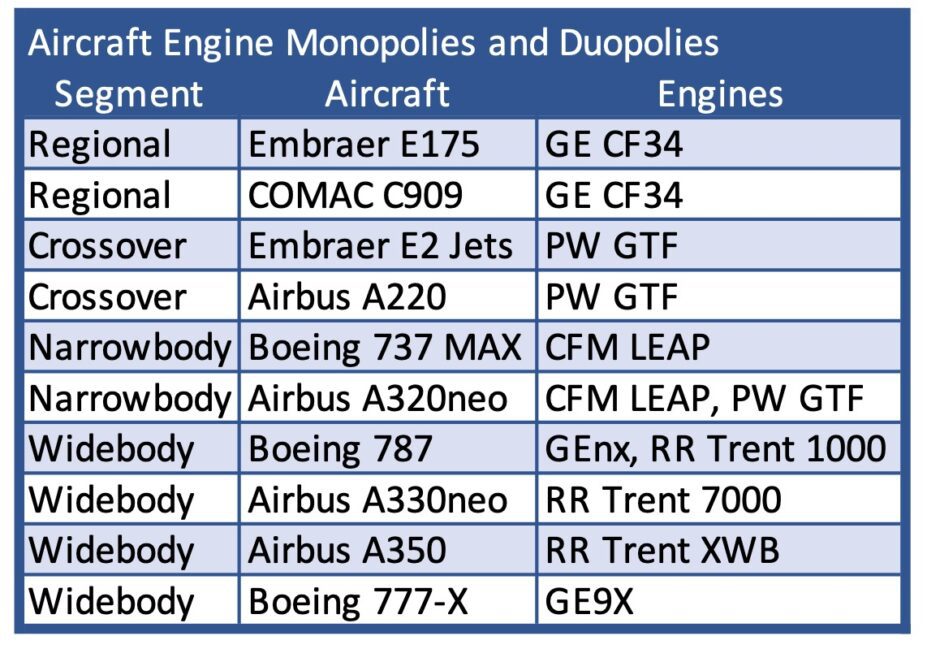
There are four major engine players in the market: Pratt & Whitney, General Electric, Rolls-Royce, and CFM International, a JV of GE and Safran. Many applications are now sole source, with one engine type owning a segment of the market. The engine monopolies and duopolies line up as follows:
sourceAirInsight
Only two current aircraft programs offer engine choices — the Airbus A320 family (CFM LEAP or Pratt & Whitney GTF) and Boeing 787 family (GEnx or Rolls-Royce Trent 1000). The remaining programs offer only one engine, including the COMAC C-909 (GE CF34), Embraer EJets (CF34), Embraer E2 jets (Pratt & Whitney GTF), Airbus A220 (Pratt & Whitney GTF), COMAC C-919 (CFM LEAP), Boeing 737 MAX (CFM LEAP), Airbus A330 (Rolls-Royce Trent 700), Airbus A350 (Rolls-Royce Trent XWB), and Boeing 777-X (GE9X). Interestingly, the programs with an engine choice are the market leaders in their segments.
The recent trend to sole-source engines for programs saves development costs, but eliminates competition that tends to keep maintenance costs down over the life of the aircraft, since engine companies make money from spares and MRO and lose money on their engine sales to OEMs. Those by-the-hour fixed-price maintenance contracts benefit the OEM, which pays out less for the same revenue. With about 70-75% of new engines sold with maintenance contracts, independent MROs have a more difficult time competing for MRO activity unless affiliated with the OEM. Engines are a classic razor-and-blade business from a competitive standpoint, giving away the razor to earn money on the blades.
Airlines prefer a choice in engines, when possible. It is in this area that new players could be pursued. Pratt & Whitney’s Geared TurboFan (GTF) is a scalable engine and could be up-sized to accommodate wide-body applications. But after the maintenance grounding of the engines due to reliability problems, Pratt & Whitney’s tagline — “Dependable Engines” — has taken a hit.
Rolls-Royce’s scalable UltraFan design could also find its way onto an all-new narrow-body program, or a mid-market wide-body. However, the economic decision to enter a new market is not one to take lightly, as at least a 35% market share is needed to make program participation viable. While customers like an engine choice, for an OEM it is cheaper to have only one choice.
Future Technologies and Programs are Well Known
Engine technology is typically the pacing factor for new aircraft development. OEMs and airline customers are already anxiously awaiting the next generation of engines, not long after the introduction of the current generation in the 2010s. With engines historically providing most of the savings from new models, the next generation of engines is already under development and key development programs are well known.
GE and CFM are working on the RISE engine, which is being developed with both open rotor and enclosed designs. Pratt & Whitney is working on a more advanced version of its GTF engine, which is scalable for a potential wide-body offering. Rolls-Royce is working on the UltraFan engine, which is also scalable, aimed at wide-bodies, but also having the potential for future narrow-body applications.
The decision as to whether Rolls-Royce re-enters the narrow-body market is a difficult one economically, since new programs are expensive, and engine companies lose money on new engines but make their money over the life of an engine program through “power by the hour” maintenance programs and spare parts sales for MRO activities. It would likely require $10 billion in free cash to fund the development and introduction into service of an UltraFan for narrow-body in addition to wide-body programs — a “bet the company” commitment. Senior management has to evaluate whether that bet is worth the associated risk.
With three new engine technologies scheduled for the 2030-2035 time frame, new technology engines could engender either re-engining programs or new program development. It is unlikely that either Airbus or Boeing would re-engine their existing narrow-body programs. This is particularly true for Boeing, given the history of the MAX. We would expect a higher likelihood that the FAA would require an all-new type certificate were Boeing to further stretch or modify the 737 MAX.
The question is who will develop an all-new aircraft first, and how quickly will the other player respond? Airbus has the lead in the narrow-body market, with Boeing leading the wide-body market, and we would expect market leaders to be the first movers to protect their leadership.
Can a Newcomer be a Change Agent
The “spanner in the works” for a duopoly is a new competitor, particularly one that introduces new technology that needs to be matched. While barriers to entry are extremely high for commercial aviation, it is not impossible for a new competitor to arise.
In aviation, there is such a competitor today: JetZero, which is currently building a blended wing body prototype transport aircraft for the military. That prototype is also a proof of concept aircraft for its commercial Z4 model, a 200-250 seat “middle of the market” aircraft that sits right at the top of the narrow-body market and the bottom of the wide-body market.
image JetZero
The differentiation with JetZero is aerodynamics and a move away from the classic tube-and-wing design. Aerodynamic studies show that blended wing aircraft can gain a 20-25% advantage in fuel economy over conventional tube-and-wing designs of similar capacity.
With new engines emerging in the market, the right engine on a very different aircraft could provide a 30-45% advantage in fuel burn over today’s models. That’s enough of a differential to obtain the necessary financing to break into the club and transform the duopoly into an oligopoly.
JetZero has government funding for its prototype and has arranged economic development funds to construct new manufacturing facilities, so it certainly has enough capital to complete the proof of concept aircraft. If that aircraft is successful, it will turn heads and likely find receptive investors to provide the massive capital needed for market entry as an innovative aircraft company. From design to service and support, JetZero has hired industry veterans to develop its organization and partner with existing industry players to quickly establish a supply chain for the Z4.
Even so, it is a stretch to think that JetZero will sail through its development and organizational growth without significant issues. But this is the first potential competitor in a long time that has a real shot at successfully breaking into the market. If it does, its first order of battle may be to fend off takeover offers from one of the duopoly players.
The Arrogance Factor
When an organization grows as large as a Boeing or Airbus, it develops a culture of its own. Senior management, whether purposefully or inadvertently, sets the culture based on their focus, and what attributes contribute to success in being promoted. At Boeing, a culture of engineering excellence was a dominant factor dating from the 1950s through 1980s, when the company first defined itself as the leader in jet aircraft. Moves away from that culture were replaced by the McDonnell-Douglas culture after the 1997 merger.
That merger led to the development of attitudes that combined arrogance and complacency, which nearly killed the company after two MAX crashes and 787 safety groundings. Boeing demonstrated how duopolies, when management focuses on the wrong priorities, can lead to cultural rot within a company. Boeing came very close to failing.
Can the Industry Solve its Problem Organically?
Today, neither of the two major duopoly competitors is doing particularly well in all areas, even though both are highly profitable. In airframes, Boeing and Airbus continue to add to backlog and have been unable to ramp production quickly enough to satisfy customer demand. They cannot seem to manufacture the number of aircraft needed to deliver on their promises without pushing delivery timelines to the right.
Boeing is finally building safer airplanes, after multiple problems with the 787 and MAX quality, and has finally had elements of its production certificate restored by the FAA. Airbus is still struggling with its own supply chain to ramp up production, and continues to miss production guidance for several consecutive years.
Boeing, with a focus on quality, is rebuilding the company the right way. Airbus is focusing on improving its supply chain, but not making headway quickly enough to solve its production shortfalls. Airbus may need to focus its key performance indicators on production timing to ensure it can deliver on time for its customers, much like Boeing had to refocus on quality.
What could shake up the industry? An innovative new competitor with a “better mousetrap.” JetZero fits that bill with a likely 20%-plus improvement in fuel efficiency and operating costs over the legacy duopoly aircraft. Facing superior competition is an incentive to innovate and more effectively compete.
The Public and Regulatory Role
Duopoly situations are subject to anti-trust regulations, but in recent years, government focus on enforcement has been quite lax. This is particularly true in the United States, where lax regulatory enforcement has enabled oligopolies and duopolies to thrive. When companies become “too big to fail,” regulators often find themselves with unpleasant choices. Traditionally, companies are “broken up” when they become too dominant.
But with key players located in different countries, with different laws and enforcement processes, traditional remedies are often infeasible to break up duopolies without secondary impacts on the balance of trade. Today, trade is a major issue for the current US administration.
In the interim, the lack of meaningful innovation has left the environment behind. The aerospace industry’s stretch goals of a 50% carbon reduction by 2035 and 100% by 2050 have now been pushed 5-10 years to the right. This is where innovation comes in. The advances proposed by JetZero are about 20% better for the environment than currently proposed options from Airbus and Boeing. If JetZero succeeds, the question is whether it will force the duopoly into further action on climate. We believe the answer is yes.
Environmental Regulation Can Spur Innovation
Enforcing new environmental standards that require either meeting requirements or carbon trading to achieve an equivalent level could change the economics of the industry. By positioning regulations to force the industry to invest in environmentally beneficial technologies, incentives to reach environmental goals can be put in place.
But currently, it is much more likely that Europe, rather than the United States, will lead those efforts. Given the recent heat waves globally, combined with massive forest fires on several continents, it is clear that climate change impacts are real. The question now turns to the political will of regulators to enforce difficult goals for the industry.
Given the energy needed for high-speed operations, aviation burns more fuel than other, slower methods of transportation, and has a disproportionate environmental impact. Meaningful change in this area, including the ability to cost-effectively manufacture Sustainable Aviation Fuel, will be critical to the industry going forward. But we haven’t seen the level of investment necessary to solve the production and cost issues associated with SAF production and distribution. As they say, “necessity is the mother of invention.”
Environmental regulators need to be tougher with duopolies that have considerable political clout and influence. While the world gets hotter, regulators seem to be sitting on their hands. Regulators need to be stronger and push harder. JetZero may provide a demonstration of just what they need to get tougher time frames implemented. Proof of improved environmental performance from the proof-of-concept aircraft would provide the ammunition they need.
Entrenched Competitors are Often Not Scrutinized
The Federal Aviation Administration proved itself to be ineffective during the initial certification of the Boeing 737 MAX, during which Boeing purposefully hid details of systems from FAA regulators, resulting in two crashes and 346 deaths. While the agency acted appropriately after the crashes, it was among the last to ground the 737 MAX, which created an unfavorable “home town” bias image. The shortcomings of its certification oversight were significant, and the agency recognized the need to more closely supervise Boeing activities after the crashes.
Since then, the FAA has established new processes to ensure a full review of every aircraft system and to independently verify the claims of an OEM during the certification process. But a more rigorous process is beneficial to existing players, rather than new players. The certification barrier to market entry is now higher and more rigorous, making it more difficult to compete in an industry that already has among the highest barriers to entry. High capital cost, specialized expertise, unique manufacturing challenges, certification challenges, and global support and service are not inexpensive to develop and deploy.
While it would be beneficial to have regulatory incentives to assist new entrants and to expand the industry, the other side of the coin requires an absolute focus on safety and quality. But helping a new entrant establish the proper systems, measures, and culture to ensure safety would be beneficial for the industry.
Are There Really Market Opportunities for New Players?
JetZero will tell us a lot about whether the high barriers to entry in aviation can be scaled by an innovative new competitor. So far, JetZero has obtained both Federal and State of North Carolina funding to help it through the proof-of-concept stage and beyond. With successful test flights of its low-risk prototype, the company can then turn to the development and certification of its Z4 middle-of-the-market aircraft.
The question is whether it’s enough. It takes billions of dollars, literally, to develop, industrialize, manufacture, and support a new commercial aircraft. Capital markets appear to be receptive, contingent on the demonstrable success of the prototype and the benefits of a blended wing design. We are now at the “prove it” point of development for the aircraft. Wind tunnel simulations are one thing; scaling up to real-world size is another. The company is at the point where the rubber meets the runway, testing whether the 20% reductions in fuel are real. If the tests are successful, which we believe they will be, the next steps entail the capital markets, an IPO, and moving toward certification of the Z4 design.
From what we’ve seen, JetZero has the best chance of breaking into the duopoly of any design we’ve seen in the last three decades. Shaking up the duopoly is something that is needed every few decades, and we are overdue for a new player in aviation.
The Bottom Line
If the industry is to break out from the lack of accountability by the major players in both airframes and engines, new competition is needed. COMAC entering the market is a positive event, but international sales and high volumes remain years away. JetZero provides innovation to leap-frog the duopoly, set new environmental and performance standards, and change the fundamental design of commercial aircraft for the first time since the dawn of the jet age.
If airlines want on-time deliveries and quality builds, they need to support a new competitor and assist in moving it forward to push positive change in the industry. JetZero may be the best hope for breaking into the duopoly and providing innovative and more cost-effective alternatives than would be available from the duopoly. It is important that the industry rally behind them to send a strong message to Airbus and Boeing. United and Delta are already on board, and it is time for others to step up and commit to innovative technology.
Duopolies can become complacent and uncompetitive. Boeing became complacent about quality and safety, and Airbus became complacent about the supply chain and delivery time frames. The net result has been chaotic for fleet planners. If JetZero succeeds, the industry will fundamentally change, with Airbus and Boeing forced to innovate and maintain competitiveness. That would be a good thing, and break the status quo that we often find in duopoly situations. Let’s hope they are successful.
There are duopolies almost everywhere one looks in commercial aviation. For wide-body and narrow-body airplanes the key players are Airbus and Boeing, with limited competition. For cross-over jets, the players are Embraer and Airbus. For regional jets, it is now down to Embraer and COMAC after Bombardier ceased CRJ production and sold the program to Mitsubishi.
In wide-body engines, it is Rolls-Royce and General Electric. For narrow-body engines, the duopoly is Pratt & Whitney and CFM International, a GE-Safran joint venture. While that provides the majority of the cost and value added for the aircraft, other subsystems such as avionics, landing gear, and others tend to also have two major competitors.
We can run a focused 15–20 minute walkthrough on the implications for your specific programs or risk exposure — or put together a custom subscription proposal.
We use cookies to optimize our website and our service.
Functional
Always active
The technical storage or access is strictly necessary for the legitimate purpose of enabling the use of a specific service explicitly requested by the subscriber or user, or for the sole purpose of carrying out the transmission of a communication over an electronic communications network.
Preferences
The technical storage or access is necessary for the legitimate purpose of storing preferences that are not requested by the subscriber or user.
Statistics
The technical storage or access that is used exclusively for statistical purposes.The technical storage or access that is used exclusively for anonymous statistical purposes. Without a subpoena, voluntary compliance on the part of your Internet Service Provider, or additional records from a third party, information stored or retrieved for this purpose alone cannot usually be used to identify you.
Marketing
The technical storage or access is required to create user profiles to send advertising, or to track the user on a website or across several websites for similar marketing purposes.