Delta’s Ed Bastian made a comment during the recent earnings call that caused a bit of a flutter: “The premium consumer is candidly immune or becoming more immune to the headlines and not delaying their investment in the experience economy, waiting to see what the next headline’s going to be on the margin. … I think, as difficult as it is to see what’s going on with the conflict in the Middle East, I’m not sure that our premium customers are feeling affected by that.”
The premium customer? That customer can be expected to show relatively inelastic demand curves for most items.
But how about the ‘Regular Joe’?
It looks like air travel has a relatively inelastic demand curve in general.
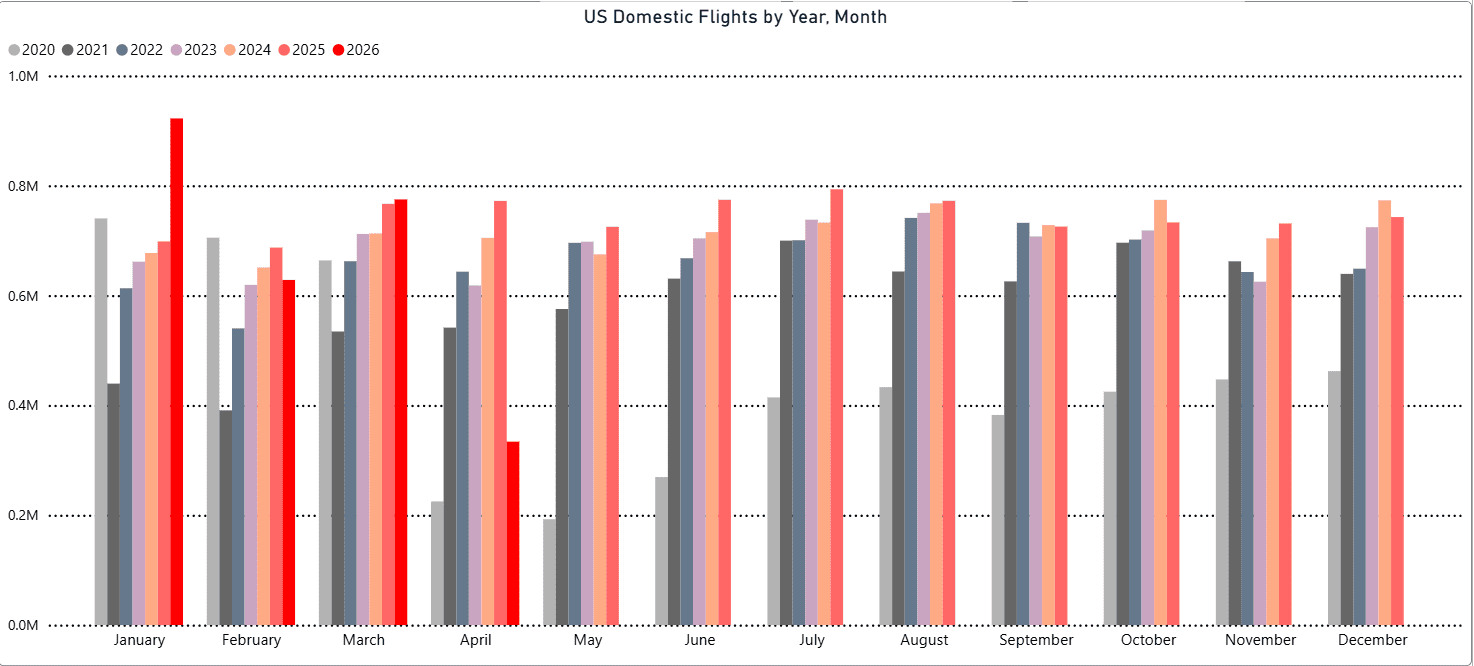
January 2026 was special, and February 2026 was only slightly off the previous year; March 2026 was also a new high. Bear in mind, this was a tough winter.
Let’s look at another view to see how the industry has been performing. The recovery from the pandemic is now complete, and the number of flights exceeds that of 2019, the last ‘normal’ year.
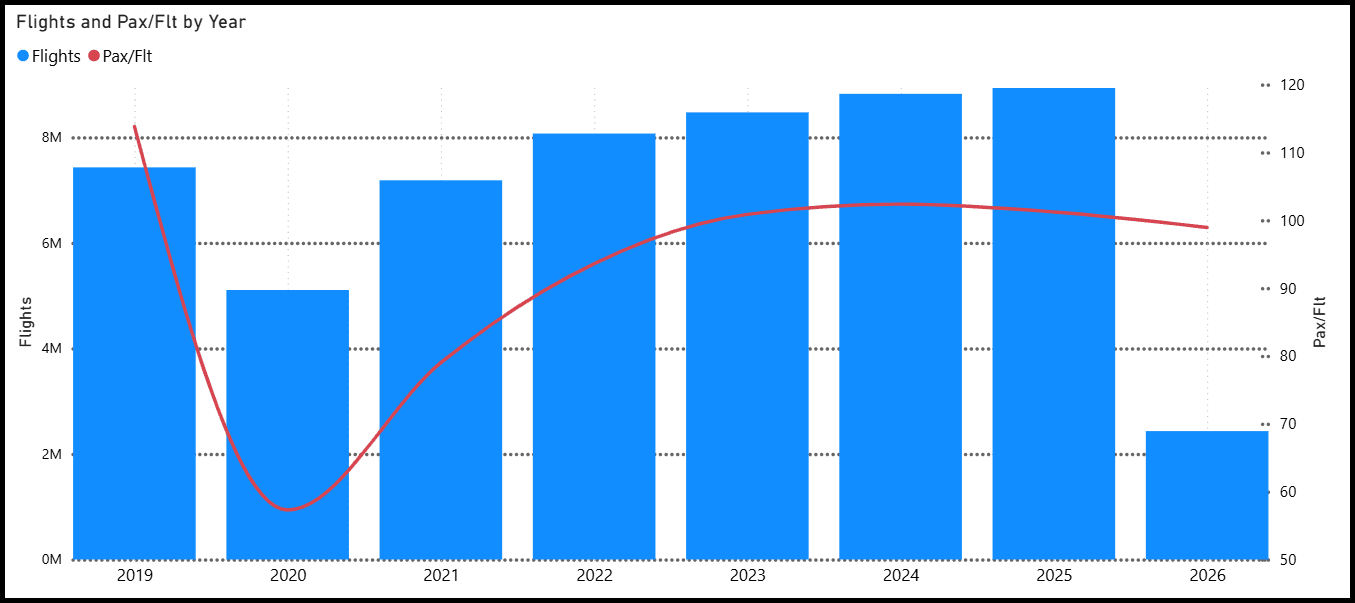
But take a look at the pax/Flight curve. That number is still below 2019 and now looks to be going down. This suggests that the elasticity of demand may not be as firm as thought. Has the market started to turn?
Here’s a third look at the numbers, with 2019 as the base year. That base year is the red dashed line at 100.
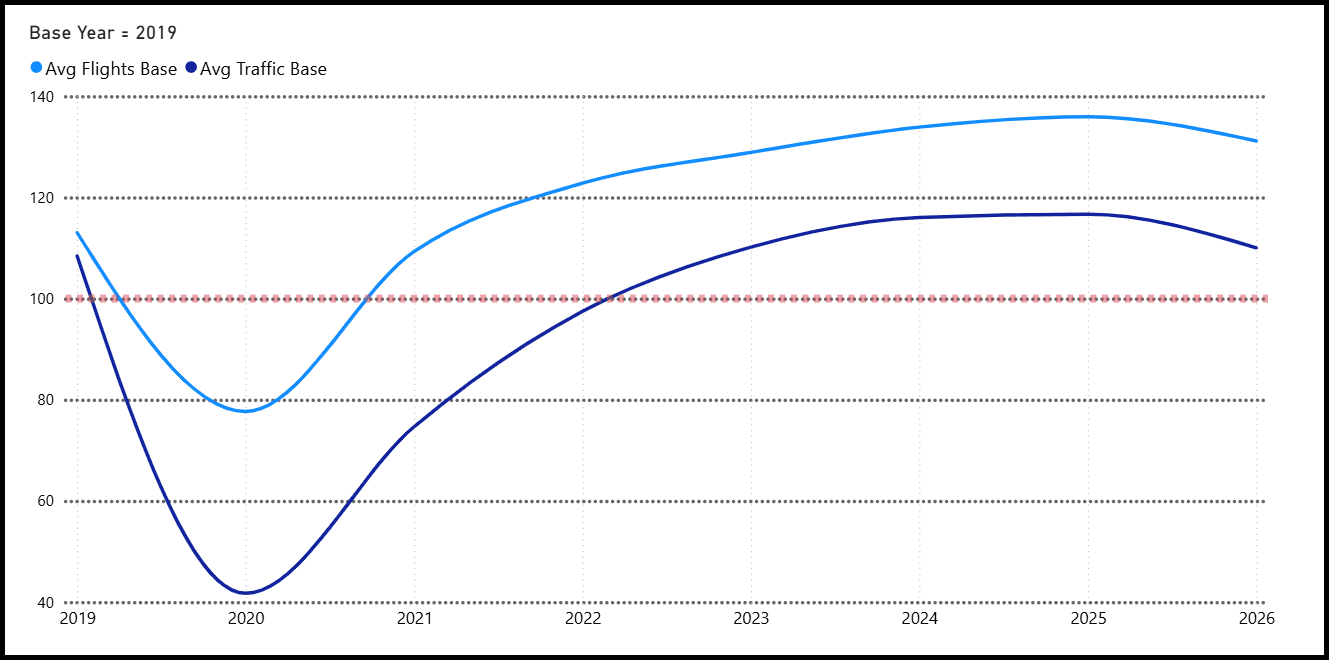
It appears that traffic growth has indeed softened, and it has done so faster than flights.
On standard short- or medium-haul US domestic or regional configurations, premium seating is about 5–10% (e.g., 8–16 premium seats out of 150–180 total seats). Mr. Bastian’s ‘immune premium’ customers are a fraction of the volume. But those premium customers account for 20–40% of total passenger revenue on a given flight, even though premium seats usually make up only 5–15% of the total seating.
Even at the best ratio, 5% of the passengers generate 40% of the ticket revenue. Among the ‘great unwashed’, there’s ancillary revenue that moves the needle some away from premium. If premium load factors are strong and fares are high, the front cabin can generate enough surplus to offset losses or low margins in the back — or even make the whole flight profitable on its own.
Airlines (American, Delta & United) are actively reconfiguring aircraft to add more premium seats because they deliver disproportionate profits relative to space and marginal cost. This is why the industry trend is toward ‘premium-ization’ (more premium seats) rather than all-economy or all-premium extremes.
The cabin reconfiguration costs might be worth it. For now.
Views: 144