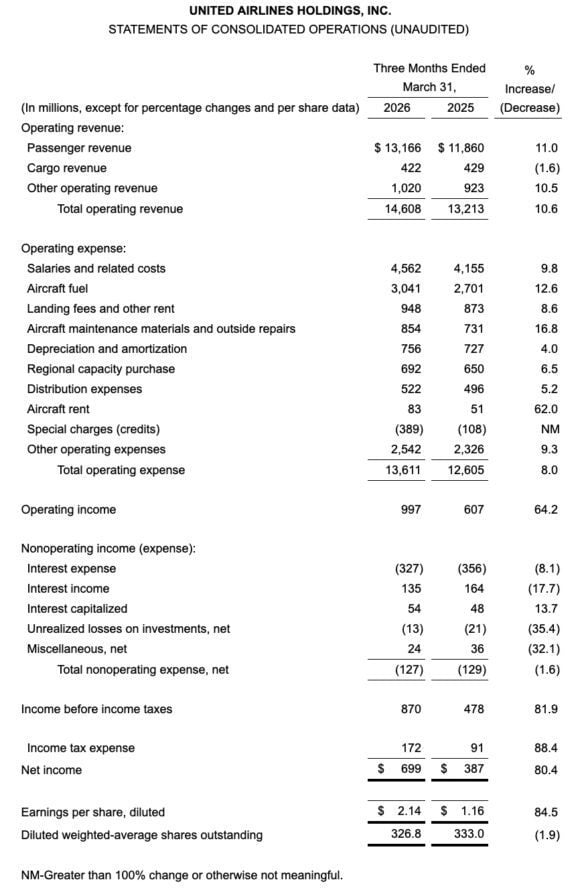
United Airlines reported a Q1 adjusted diluted earnings per share of $1.19, within the initial guidance range of $1,00 to $1.50. Total operating revenue was up 10.6% year-over-year, and TRASM was up 6.9% from Q1 in 2025.
Amidst the fuel price uncertainty brought on by the Iran War, the carrier plans to reduce capacity growth by 5 points. That will result in net capacity in Q3 and Q4 being flat to 2% higher than prior-year levels. The carrier remains focused on executing its strategy for premium-cabin growth and economy-cabin segmentation to improve margins.
The carrier had adjusted pretax earnings of $0.5 billion, with an adjusted pretax margin of 3.4%, up from 3.0% last year. CEO Scott Kirby stated, “Our strong financial position and success in winning brand-loyal customers enabled United to quickly make tactical adjustments to higher fuel prices while maintaining our long-term focus. Moments of uncertainty for the airline industry may also create opportunities for United. We have demonstrated quarter after quarter that we are built to withstand disruptions, and this moment is no different. We’ll stay nimble in the short term while continuing to grow the airline and invest in our customers, product, and people.”
United’s positive results come despite a $340 million increase in fuel expense compared to the first quarter of 2025. United’s revenue streams remained resilient, with 14% growth in premium revenue, 13% growth in loyalty revenue, and 7% growth in basic economy revenue. 2026 had record first-quarter revenues, with positive PRASM growth in every geographic region.
Detailed Financial Results
Operating financial results are summarized in the statement below:
source United Air LinesProduct and Service Innovations
During the quarter, United introduced the Relax Row, a set of economy-class seats that transform into a couch for long-haul international flights, making it the first airline in North America to offer that innovation. The carrier also announced the introduction of new configurations for the A321neo “Coastliner” and the CRJ-450 in the second half of the year as part of 250 new aircraft scheduled for delivery by April 2028. Starlink Wi-Fi installations for 327 United Express aircraft have been completed, with the remaining fleet expected to be installed by year-end 2027. The carrier has also enhanced its Mileage Plus program to benefit credit card holders with additional miles, 10% off award tickets, and access to special inventory.
image United
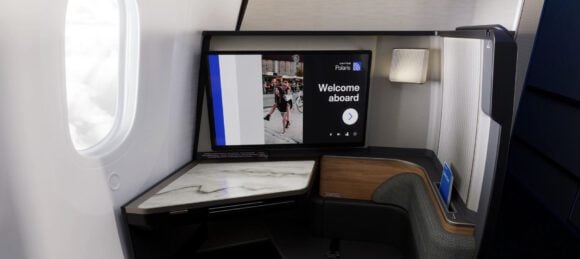
The carrier has begun selling tickets from San Francisco to Singapore on a new, elevated interior featuring 64 Polaris seats, including the United Polaris Studio product. This new product has differentiated seating and amenities within the premium cabin.
Guidance and Outlook
During the earnings conference call, CEO Scott Kirby provided guidance for Q2 and full-year 2026. The company is managing through jet fuel prices that have doubled. United’s goal is to recover 100% of the cost increase through pass-through by 2027. As yields increase, there will be an impact on elasticity, and the company will reduce capacity on marginal routes. The view for 2027 targets a pre-tax margin of over 10%. Realistically, there likely won’t be time to recover 100% of the fuel price increase in 2026, but United expects to recover 50-60% by Q3 and Q4, with the goal of recovering 100% in 2027.
The Bottom Line
United continued to roll along profitably in Q1 2025, as it refined its product and focused on its strategy centered on its Polaris product and premium revenues. The company has been competing with Delta, as the two legacy carriers have separated themselves from the pack in premium products and services. Both are demonstrating higher margins and resilient traffic in uncertain times and are the two carriers best positioned to ride out industry turbulence and high fuel costs. United is well-positioned for success in 2026 despite higher fuel costs.
We use cookies to optimize our website and our service.
Functional
Always active
The technical storage or access is strictly necessary for the legitimate purpose of enabling the use of a specific service explicitly requested by the subscriber or user, or for the sole purpose of carrying out the transmission of a communication over an electronic communications network.
Preferences
The technical storage or access is necessary for the legitimate purpose of storing preferences that are not requested by the subscriber or user.
Statistics
The technical storage or access that is used exclusively for statistical purposes.The technical storage or access that is used exclusively for anonymous statistical purposes. Without a subpoena, voluntary compliance on the part of your Internet Service Provider, or additional records from a third party, information stored or retrieved for this purpose alone cannot usually be used to identify you.
Marketing
The technical storage or access is required to create user profiles to send advertising, or to track the user on a website or across several websites for similar marketing purposes.