honda evtol
After four years in “stealth mode,” Honda revealed at the Dubai Airshow 2025 that its hybrid eVTOL program is far more advanced than anyone outside the company knew, with over 400 flight tests already completed.
Design
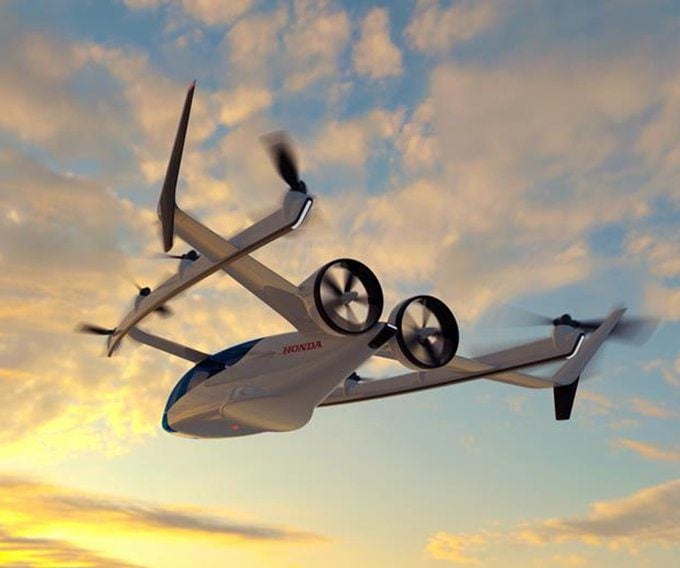
Honda’s full-scale concept demonstrator measures ~50 feet in length and wingspan. It uses eight boom-mounted lifting propellers for takeoff and landing and two rear pusher propulsors for forward flight, with forward-swept wings in front, aft-swept wings at the rear, and vertical stabilizers at the wingtips.
The Hybrid Propulsion Bet
The most distinctive aspect is the powertrain. Unlike other eVTOL concepts built around all-electric power, Honda is pursuing a hybrid-electric aircraft from the start, saying battery energy density is still insufficient to deliver the 400 km (249-mile) intercity range it wants to offer. To bridge that gap, Honda has designed a compact turbogenerator sized between 250 and 300 kW, and weighing under 100 kg.
The hybrid system enables a 249-mile range — nearly 10 times that of most battery-only eVTOLs. For comparison, Archer’s Midnight offers 20–50 miles for typical operations, while Joby targets around 100 miles.
First Flight Timeline
Once the full-scale prototype is assembled, Honda intends to begin remotely piloted flight testing in the United States this month. Full FAA type certification remains a longer-range target, with Honda expecting entry into service in the early 2030s. As of today (March 10, 2026), that first flight window has just opened — though no confirmation of an actual flight has surfaced yet in search results. Honda has been cleared by the FAA to begin eVTOL demonstration flights.
Not Racing to Market
Honda is targeting FAA type certification in the early 2030s and is not seeking to be first to market. SMG Consulting VP Mashio was direct about this: “We need to decide what kind of real benefit we can offer to potential customers.” It is interesting to see an established OEM entering the market now, with several eVTOL programs stumbling. The stumble was expected. The emergence of Honda was less expected, but it makes a lot of sense.
Certification Complexity
The hybrid approach introduces more complex certification work, as no hybrid-electric eVTOL has yet been fully certified by the FAA. Honda is leaning on HondaJet experience here — Atsushi Ogawa of Honda R&D told The Air Current: “We have a long experience from HondaJet around the testing campaign for a type certificate, and we know that it’s very hard.”
Bottom Line
Honda’s hybrid-first strategy is a direct challenge to the “battery-only now, fix range later” approach that has burned capital across the eVTOL sector. If the first flight proceeds as scheduled this month, it would be a notable signal from the OEM. Like Embraer, Honda has credibility that many other startups lack.
The biggest challenge remains: what problem does eVTOL solve? And once you define the problem as congestion, recognize that the congestion will move (somewhat) from roads to very low orbit. Then let’s talk about exactly how this market really is.
This is where the Honda approach is actually interesting. Focusing on the range takes its vehicle out of the taxi arena into regional aviation. Now there’s a case we can see and find very interesting.
Views: 802
About The Author


Take AirInsight for a Test Flight
7 days full access — premium analysis and the complete data model library — for $1. No commitment.
Start My Test Flight →