DHS logo
The DHS APIS (I-92) for February has been released. Here’s what we see in the data. Spoiler alert – it’s following the pattern. Politicians do what they do, and traffic seems to ignore the noise.
US Hub Airports
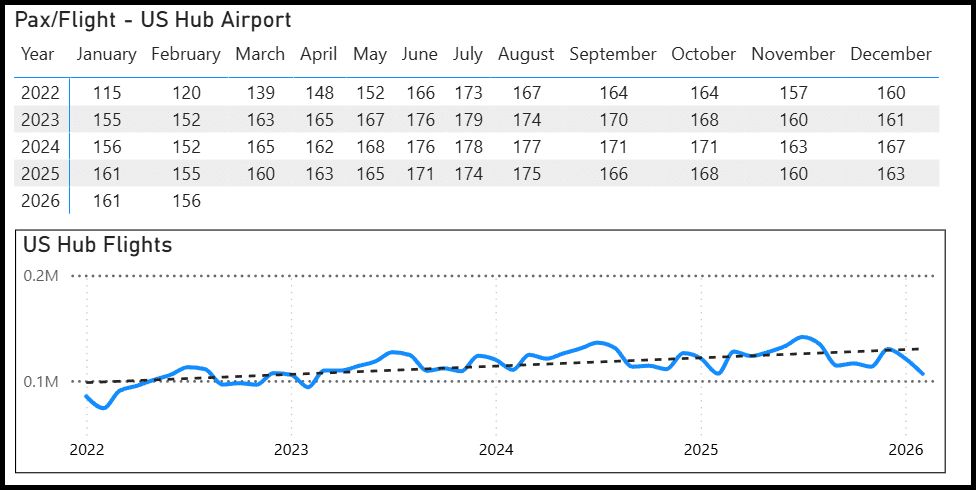
- The winter traffic dropoff is back in the cycle.
- The trend line is intact with predictable, steady growth.
- PAX/Flight increases slowly, but surely.
- Flights are fuller, and larger aircraft are inevitable.
Non-Hub US Airports
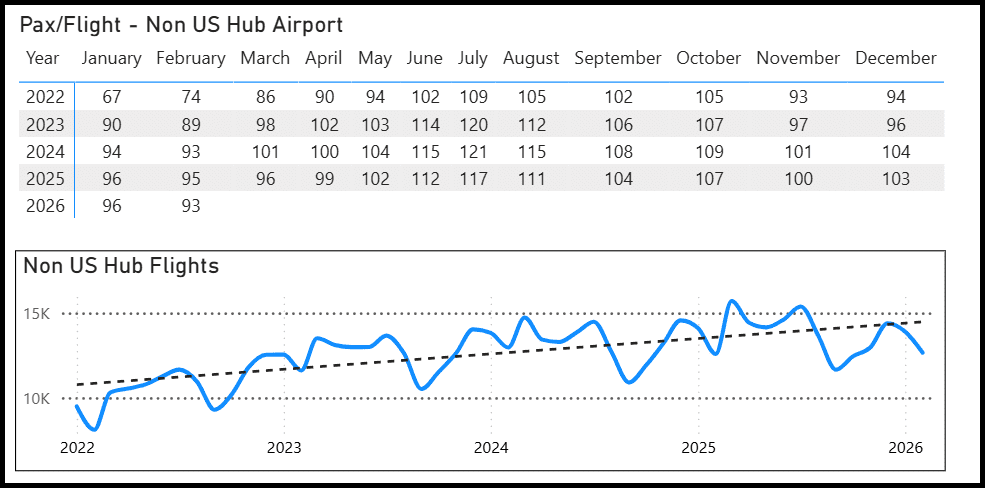
- Overall, the traffic pattern remains consistent.
- Despite the political chatter, the trendline is clear. Moreover, it’s rising faster for non-hub airports than for hub airports.
- This is the signal for airports (like BWI) trying to attract international traffic.
- It is also a signal that aircraft such as the 737 MAX and the Airbus A321neo can impact these markets.
- The pax/flight ratios suggest an average load factor of 56% for an 180-seater.
- Hub busting is alive and in rude health.
Top Ten Airports
Here we see the average loads per flight for the top ten US Hubs and Non-Hubs.
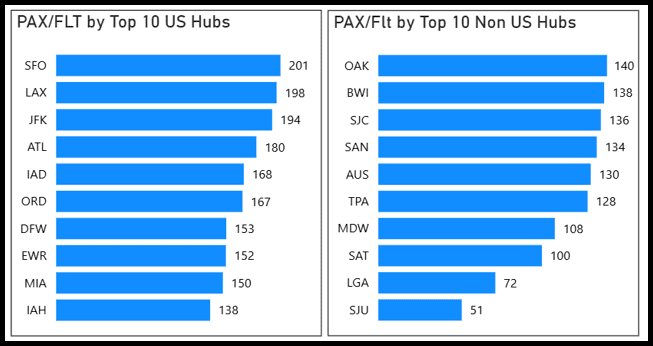
The hubs are straightforward to understand. Houston and Miami are impacted by high volumes of flights from the Caribbean and Latin America, i.e., smaller aircraft.
The non-hubs are far more interesting. BWI (Baltimore) is picking up attractive new markets, and it is now at #2. Another airport picking up a new service is San Diego (SAN). Non-US flag airlines can serve these cities with efficient aircraft in ways that were not possible before.
For example, San Diego is a case in point. When British Airways ordered the 767-300ER, a route requirement was LHR-SAN. The airline never flew the aircraft on that route. But the interest was signalled that long ago. For long hauls, the 787 now accomplishes the role with much lower fuel burn.
Views: 71
About The Author


Take AirInsight for a Test Flight
7 days full access — premium analysis and the complete data model library — for $1. No commitment.
Start My Test Flight →