
runway
What do the tea leaves suggest is happening with US air travel traffic data? A quarter into the year, here’s what we see. The 1Q26 data present a classic case of “the trend is your friend, until it isn’t.” While the surface-level charts show a market in reasonable health, the forensic details—particularly the lag between capacity and demand—suggest the industry is currently walking a tightrope.
Domestic
The US domestic air travel market is the largest. 1Q26 saw a healthy jump over last year’s activities. There has been a steady rise since the pandemic, and this year saw a substantial jump over 1Q25.
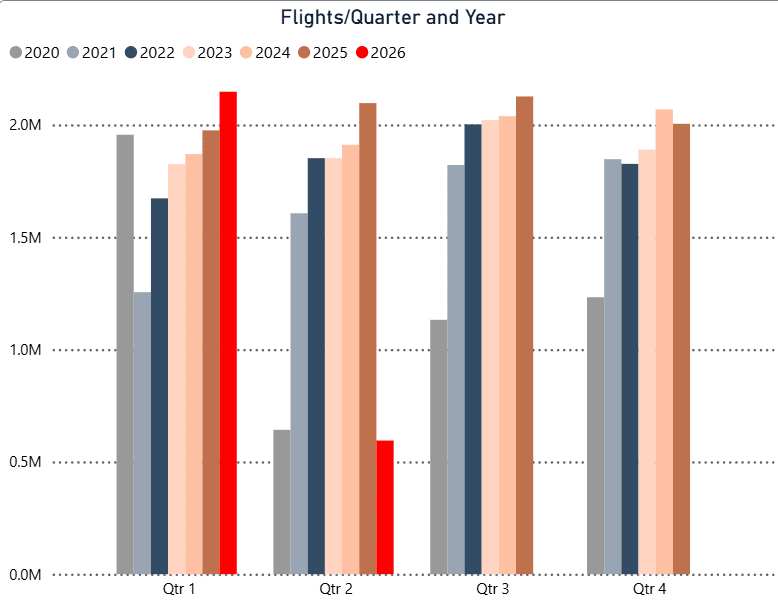
Airlines adding to schedules is one thing; the traffic being there to support is another. As the arrows show, the loads look good not only through 1Q26 but also in April.
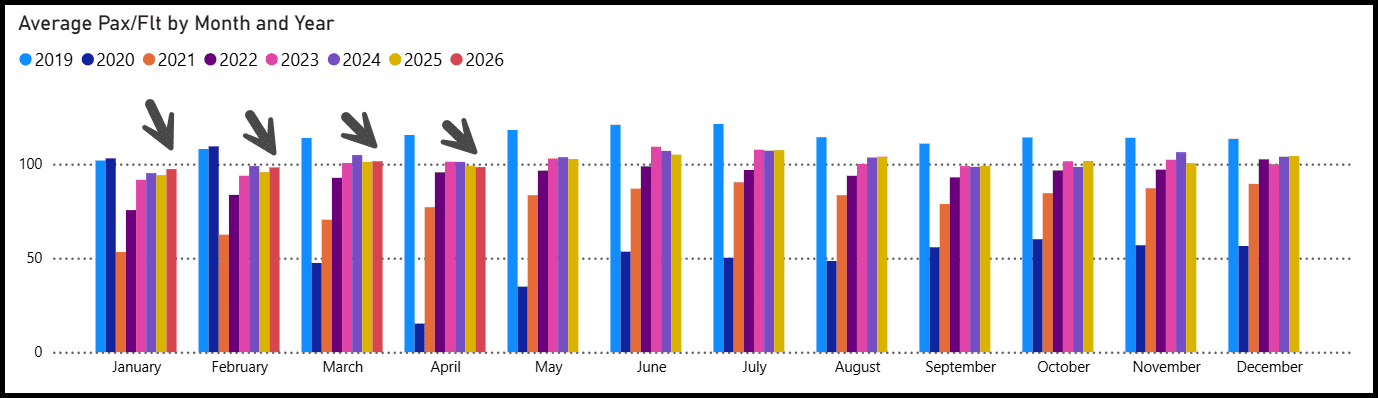
- Load Factor Paradox: While load factors remain stable (around 81–82%), this is increasingly driven by airlines trimming capacity rather than a surge in new demand. For instance, January 2026 saw domestic capacity actually drop by 0.4% while traffic remained essentially flat (+0.1%).
- “Schedule vs. Reality” Delta: The “substantial jump” in 1Q26 activity over 1Q25 – while true in absolute volume, the RPMs (RPK) for North American carriers are growing at a slower clip (approx. 3.4%) compared to the aggressive 5.2% global expansion in seat capacity expected by mid-year. This confirms the “tidbit” that growth has eased relative to the schedules’ ambitions.
However, another view on the first few months suggests a closer look is apropos. Is there any growth? The data suggests not much over the past few years. Certainly not as much as the growth in the schedule. This tidbit is interesting and suggests that even as the market looks robust, growth might have eased some.
International
Here we also have a nuanced view of the market. At first glance, the market for travelers to the US is off slightly from last year. Nowhere near as bad as the headlines would suggest. The lower-left curve shows 2026 starting off at the lower end of previous years, but not dreadfully.
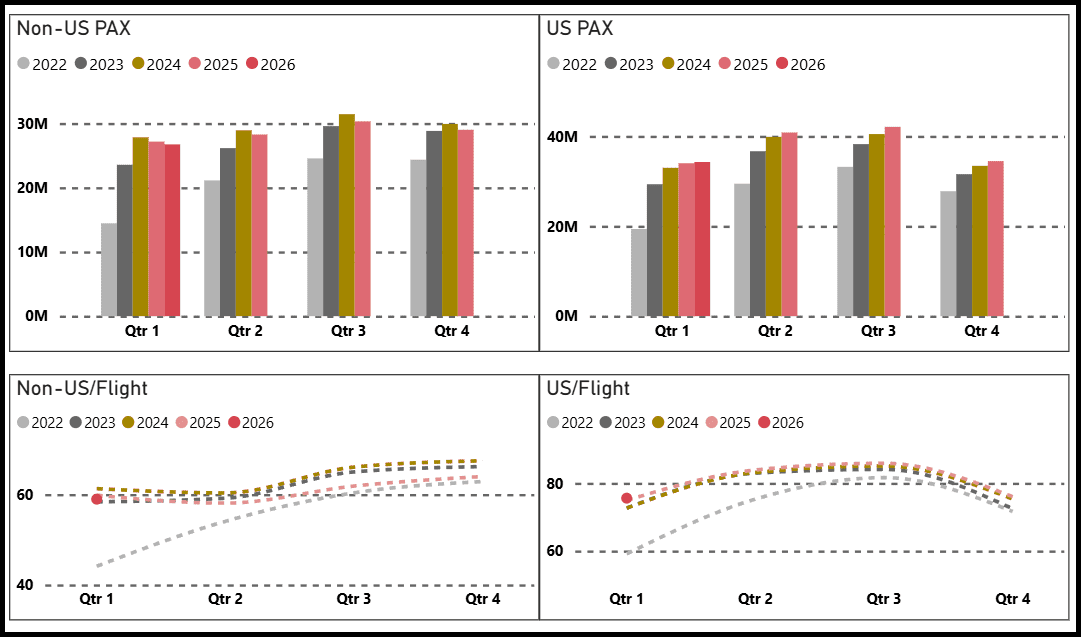
The right-hand size charts are for US residents traveling abroad. 1Q26 looks a tad better than last year, and the red dot for 1Q26 shows an upward bump from previous years. Loads coming to the US may be lighter, but departing flights look busier.
We have more details on this international traffic, which will provide a more definitive view. Net traffic is defined as arrivals-departures.
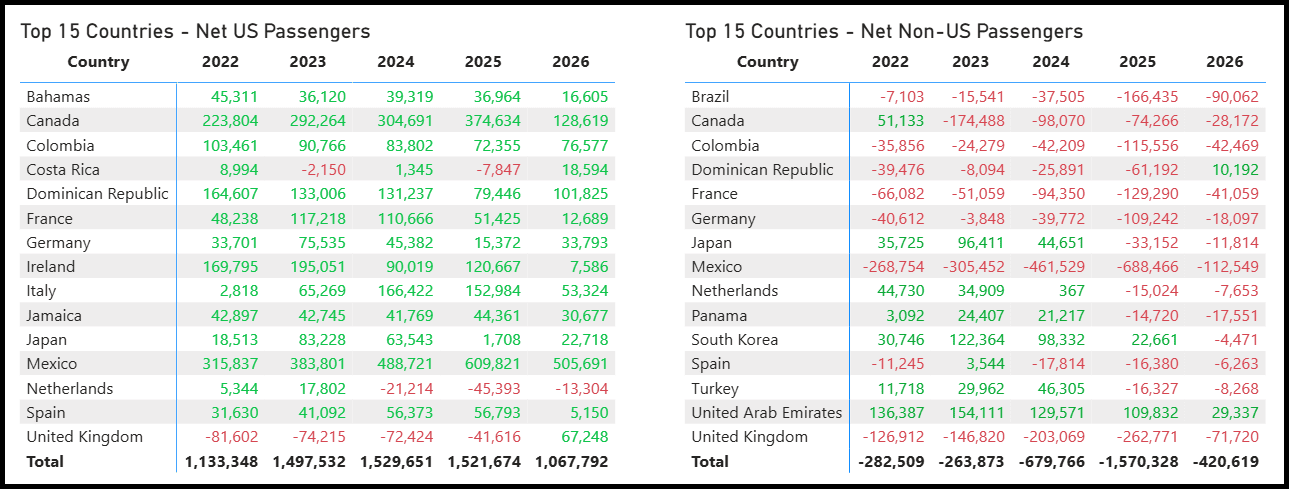
Note where tables show red. That means departing traffic exceeded arriving traffic – a net outflow from the US. While it is early in 2026 to make any definitive statements, note that the red pattern has been consistent for some time. This is important to note because there could be a knee-jerk response to look to politics. The data suggest it is not from a single US administration.
- Outbound Strength: US travel abroad remains the market’s primary engine. March 2026 data shows U.S. citizen departures up nearly 20% over 2019 levels, even as they dipped slightly year-over-year.
- Inbound Friction: Non-U.S. citizen arrivals are still struggling to find their 2019 baseline, hovering around 85–88% of pre-pandemic levels.
- The Net Traffic Deficit: The trend of departing traffic exceeding arriving traffic has been a structural feature of the U.S. market for the better part of two years, largely influenced by a strong dollar and shifting global tourism patterns rather than domestic policy shifts.
Bottom Line
The tea leaves suggest a “Maturity Phase.” The post-pandemic surge has finally leveled off. Airlines are betting on growth (adding to schedules), but if traffic doesn’t accelerate to match that capacity by 3Q26, we should expect a correction in yields or more aggressive “right-sizing” of schedules heading into the winter. The signals are indeed mixed, but the consistency of the patterns suggests we are seeing the “new normal” for the decade rather than a temporary blip.
Views: 89