

There is a fascinating story that captures the messy realities of cost, geopolitics, and corporate rivalry for India’s new aerial tanker fleet.
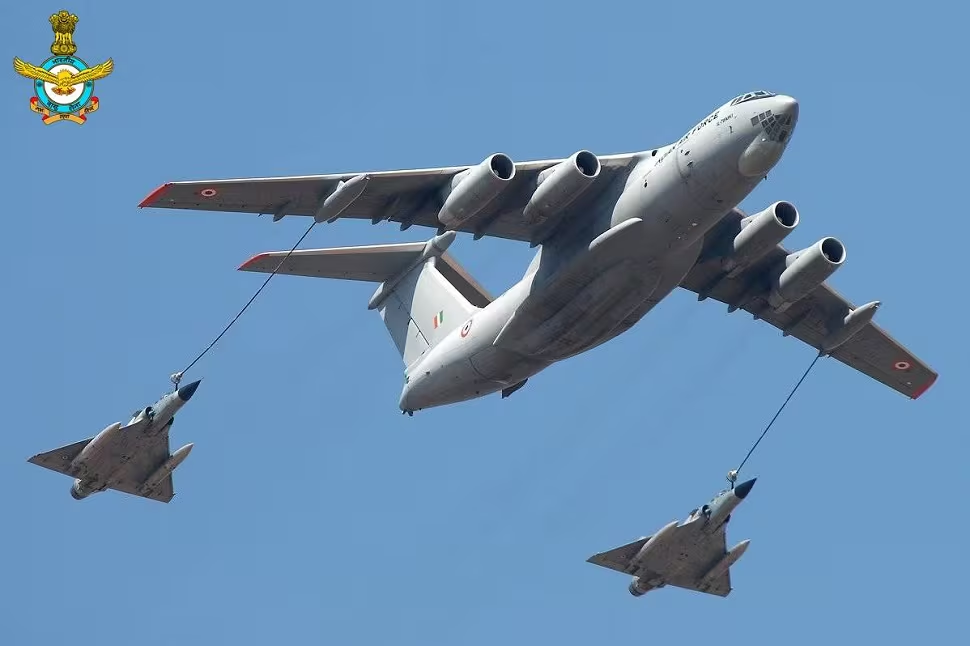
For over two decades, the Indian Air Force struggled with aging Russian Il-78MKI tankers. Multiple attempts to buy new Western tankers — including the Airbus A330 MRTT (selected twice) and serious interest in Boeing’s KC-46 Pegasus — collapsed under the weight of high prices, lengthy negotiations, and India’s insistence on technology transfer and local workshare.
India selected the A330 MRTT twice in global tenders, but both deals collapsed:
- 2009–2010: Airbus won the competition, but the Indian Finance Ministry scrapped the ~$1.6 billion deal over pricing concerns.
- 2013–2016: Airbus was selected again after flight trials and life-cycle cost evaluations. The deal (valued around $2 billion) was canceled in 2016 due to escalating costs, disputes over life-cycle expenses, and the platform being deemed “economically unviable” by the Ministry of Finance and MoD.
By early 2026, India’s patience ran out.
In January 2026, India’s Defence Acquisition Council approved a pragmatic solution: converting six pre-owned Boeing 767 airliners into Multi-Mission Tanker Transports (MMTTs) through a partnership between Israel Aerospace Industries (IAI) and Hindustan Aeronautics Limited (HAL). The deal, valued at roughly $900 million–$1.1 billion, gives India capable hose-and-drogue tankers at a lower cost and in less time than buying new aircraft. HAL will perform a significant portion of the work in India, aligning with “Make in India” goals.
The KC-46
Why not just buy the new KC-46 Pegasus? The reasons were practical. The new KC-46s are expensive, ~$160m per aircraft. At the time, the KC-46 program was grappling with technical issues (Remote Vision System delays, boom problems, and lower readiness rates).
A direct U.S. purchase would deliver less industrial offset for Indian companies. So India chose a proven, lower-cost 767 conversion on the same basic airframe family — a “good enough, now” solution that could potentially allow future KC-46 purchases for commonality.
And this decision breathed new life into a program that Boeing had once tried to kill.
The Israeli Angle
IAI’s Bedek Aviation Group pioneered affordable 767 tanker conversions years earlier. Their MMTT first flew in 2010 and entered service with Colombia.

Colombia also had previously bought several Israeli-made Kfir fighters, as seen in the image. Brazil also considered this as a potential solution. When Israel decided to replace its aging Boeing 707 tankers around 2018, IAI planned to bid its 767 MMTT conversions. That did not go as planned.
Boeing says No
Citing its control over the 767 type certificate, Boeing refused the necessary conversion approvals and royalty arrangements. The move was widely seen as protecting the more expensive KC-46 from cheaper competition in Israel’s tender. IAI was sidelined. Israel ultimately ordered four new KC-46s (later expanded) directly from Boeing.
The irony is rich: Boeing blocked IAI’s cheaper conversion path in Israel to safeguard KC-46 sales — only for that same conversion approach to win a major export order in India years later.
Full Circle in May 2026
The circle is closing. Israel’s first KC-46, named “Gideon,” is in flight test in the United States and is scheduled for delivery to the Israeli Air Force at the end of the month. It marks a major leap in capability for Israel, while India prepares to convert its first 767s with IAI’s help, aiming for deliveries around 2030–2031.
In the end, both countries get modern tankers based on the 767 — one through the expensive, factory-fresh KC-46 route, the other through an arguably smarter, more affordable conversion. Boeing gets its Israeli sale and some indirect involvement in India, while IAI gets a significant export win.
It’s an illustration of how defense procurement works: rarely about the perfect aircraft, but rather about cost, timing, politics, and industrial offsets. The tanker wars continue, and both India and Israel are moving forward.
Views: 407