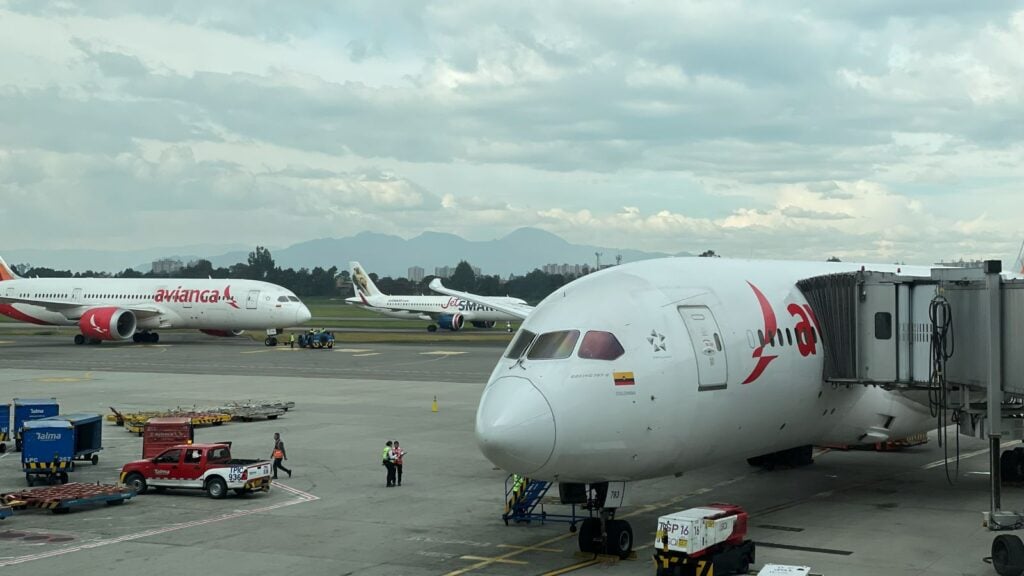
Avianca JetSMART at Bogota
A high-altitude battle is unfolding over the future of the Aeropuerto Internacional El Dorado (BOG), Latin America’s second-busiest aviation hub. At the center of the storm is a controversial proposal by Colombia’s Civil Aviation Authority (Aerocivil) to overhaul the system for assigning slots, threatening to pit government “democratization” efforts against international standards and industry giants.
El Dorado handled a record 45.8 million passengers in 2025, cementing its role as a regional powerhouse. However, its “Level 3” congestion status means demand far outstrips infrastructure. As Aerocivil moves to redistribute these slots to favor smaller players and newcomers, the industry warns that Colombia risks isolating itself from the global aviation ecosystem.
The “Democratization” vs. International Standards
Aerocivil’s initiative seeks to break what it perceives as a concentration of infrastructure. Currently, the flag carrier Avianca holds approximately 51% of total slots and 50% of “prime time” windows. Edgar Rivera, Aerocivil’s Secretary of Aviation Authority, argues that infrastructure is a public good and that there are no “acquired rights” over flight schedules.
Industry leaders, spearheaded by the International Air Transport Association (IATA), view this as a dangerous departure from the Worldwide Airport Slot Guidelines (WASG), the “gold standard” used by over 300 congested airports globally . Deviating from these rules, IATA warns, could lead to fewer flight options, higher ticket prices, and weakened trade links for exports like flowers .
Avianca: “Infrastructure First, Regulation Second”
Richard Galindo, Chief Legal Officer at avianca, has emerged as a vocal critic of the reform. He argues that the government is trying to solve a technical problem with an administrative pen.
“We are the first to sponsor the growth of El Dorado, healthy competition under clear rules, and the efficient use of infrastructure,” Galindo stated. “But for that, the first thing the authority should do is work on solving the existing infrastructure issues. For example, making the runways work independently and ensuring that technological airworthiness instruments function correctly” .
Galindo’s concern is echoed by the IATA study from 2023, which identified 23 technical measures that could boost capacity by 47% to 100 operations per hour. To date, only three of those recommendations have been fully implemented .
JetSMART: The Disruptor’s Vision
The ultra-low-cost carrier (ULCC) JetSMART has positioned itself as a “third voice” in the dispute, supporting a more dynamic and equitable allocation system. The airline argues that the current WASG-based framework is insufficient for the structural saturation of Bogota.
JetSMART points to Brazil’s Congonhas Airport as a success story, where the regulator (ANAC) capped slot concentration at 45% and prioritized “new entrants” to foster competition . “The discussion isn’t theoretical; it’s about enabling effective competition in the time slots most valuable to users,” the airline stated in a recent report.
In reality, while ANAC did limit concentration at Congonhas (45%), it is a domestic-only airport. For Brazil’s main international hub, Guarulhos (GRU), the country maintains high compliance with WASG to protect international connectivity. Experts argue applying a domestic-style cap to an international hub like El Dorado could disrupt global “open skies” agreements .
Galindo alleges that JetSMART is selling tickets for flights it has no authorization to fly. Specifically, he cited 4,900 flights published for the Summer 2026 season without confirmed slots. JetSMART maintains that 100% of its flights have proper authorization and that it never cancels flights due to lack of slots.
What is not being said is that there is a documented discrepancy in commercial systems. While JetSMART may be technically compliant with current operations, the practice of selling future itineraries before the final slot coordination conference is a point of legal friction that Aerocivil has yet to formally sanction.
Both companies -and another significant actor on the market, LATAM- agree that there are infrastructure gaps that need to be solved way before a redistribution or major overhaul of slot assignation procedures need to be changed. Real-time monitoring of slot usage and improved runway operating infrastructure is paramount and more urgent than a review of a bureaucratic disposition.
Global Benchmarks: A Region Divided
How El Dorado’s crisis is resolved will determine its standing against regional peers. Sao Paulo’s Guarulhos (GRU) maintains high WASG compliance and is moving toward a digital slot-trading market by 2027, prioritizing transparency.
In contrast, Mexico City’s Benito Juárez (MEX) has been criticized for unilateral slot reductions and “non-transparent” allocation used to force traffic to secondary airports.
With the Colombian Attorney General’s Office (Procuraduría) now monitoring Aerocivil’s moves, the industry is calling for the creation of an independent, neutral slot coordinator—similar to Spain’s AECFA—to remove politics from the cockpit.
For now, El Dorado remains at a crossroads. As Galindo warns, “improvising” with the rules of the game during a year of major runway maintenance could “isolate El Dorado from the world’s airport ecosystem”.
Views: 131
About The Author

Take AirInsight for a Test Flight
7 days full access — premium analysis and the complete data model library — for $1. No commitment.
Start My Test Flight →