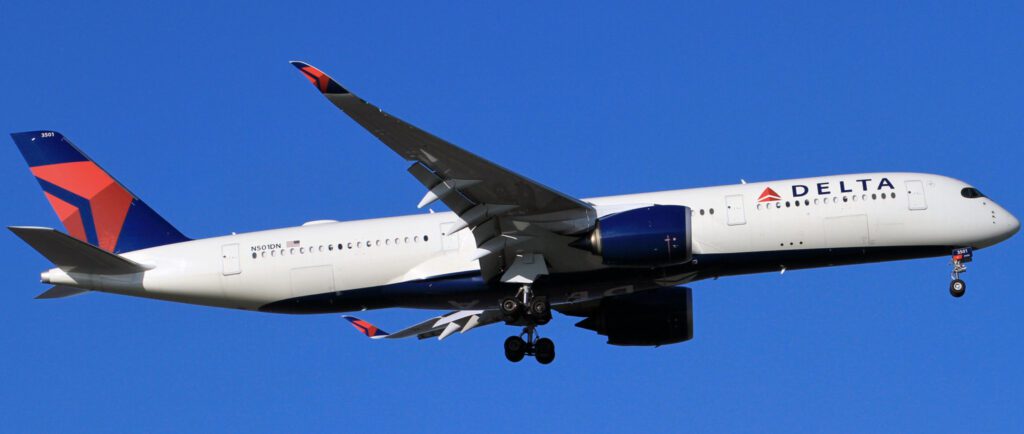
The deployment of the Amazon Leo low-Earth orbit (LEO) satellite network across Delta’s fleet is set to begin in 2028, with an initial phase involving 500 aircraft. According to a statement from Delta Air Lines, the system will provide internet access for SkyMiles members at no additional cost, utilizing Amazon Web Services (AWS) infrastructure for in-flight data management.
Ed Bastian, the airline’s Chief Executive Officer, noted that this agreement provides technology to connect the world and deepens the company’s work with a global provider to develop new ways of connection for both staff and customers.
The decision to migrate to a LEO network addresses the physical limitations of GEO (Geostationary) satellites, which operate at an altitude of 22,236 miles. This distance creates a latency of 600 to 900 milliseconds, hindering the use of real-time applications or large file transfers. By positioning its constellation at approximately 370 miles above Earth, Amazon reduces latency to under 25 milliseconds.
Andy Jassy, President and CEO of Amazon, explained that the Leo system was designed to provide high-speed connectivity in areas where traditional networks lack coverage, and that the service’s reliability will directly affect the travel experience.
Unlike GEO satellites, which are positioned over the equator and experience signal loss at high latitudes, the LEO network ensures uniform coverage on polar and transoceanic routes. This architecture is necessary to maintain service stability on long-haul flights to major international hubs, where traffic density often saturates traditional satellite beams.

Leo Ultra System Specifications
The selected hardware for the aircraft consists of a phased array antenna known as Leo Ultra. This terminal supports download speeds of up to 1 Gbps and upload speeds of up to 400 Mbps. This technical configuration enables video conferencing and large data uploads to the cloud—functions currently restricted on most commercial in-flight connectivity systems.
Integration with AWS infrastructure extends beyond entertainment. The airline will use this bandwidth to optimize its MRO (Maintenance, Repair, and Overhaul) processes.
Aircraft systems will be able to transmit continuous telemetry data to engineering centers, facilitating fault detection before landing. This technical data flow is key to improving flight scheduling efficiency and reducing technical delays.
This deployment places the company in direct competition with operators that have already implemented Starlink Aviation. While other solutions focus on raw bandwidth, Amazon’s proposal relies on integrating cloud services the airline already uses for over 600 operational applications.
In the Latin American context, the system will strengthen the offering on flights operated under the Joint Venture with LATAM. Routes connecting to Buenos Aires (EZE), São Paulo (GRU), and Santiago (SCL) will have a stable connection over the South Atlantic and the Caribbean.
These geographic areas often present challenges for legacy satellite providers due to the lack of nearby ground stations, an issue that LEO technology mitigates through inter-satellite links.
Views: 0
About The Author

Take AirInsight for a Test Flight
7 days full access — premium analysis and the complete data model library — for $1. No commitment.
Start My Test Flight →