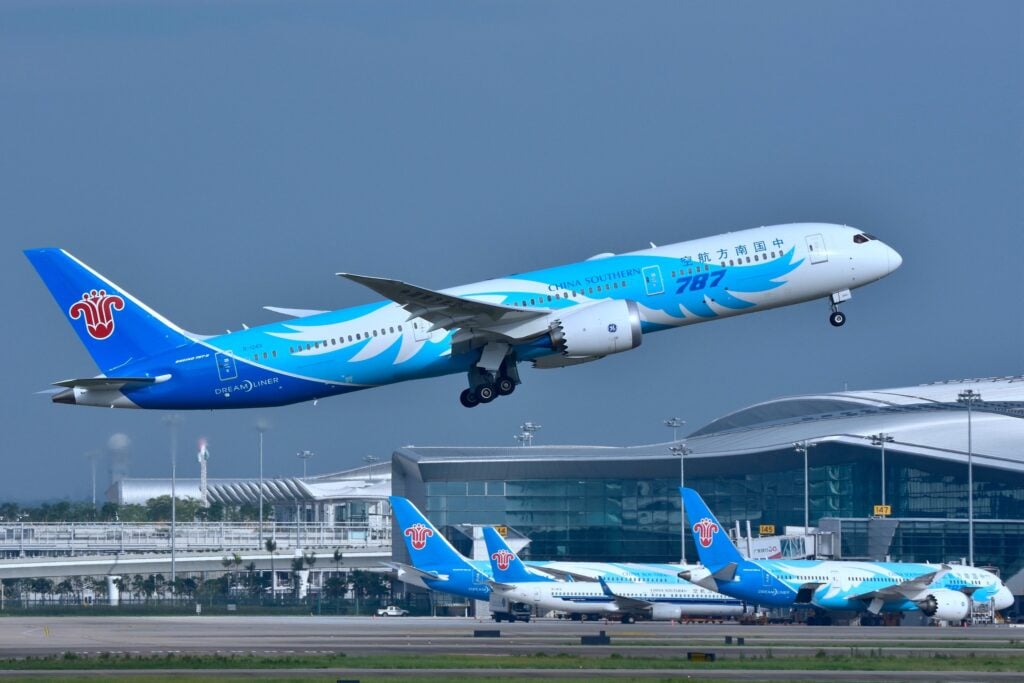
China Southern Boeing 787-9
China Southern Airlines is the only one of the Big Three that has reported a net profit for 2025. Air China and China Eastern Airlines both reported full-year losses and have been unable to build on profitable third quarters.
China Southern reported a net profit of RMB 2.7billion compared to a very small RMB 25 million in 2024. Total revenues improved to RMB 182.3 billion from RMB 174.2 billion, while operating expenses were down to RMB 177 billion from RMB 171.8 billion. The airline recorded a RMB 9.6 billion operating profit, up from RMB 8.3 billion in the previous year.
During 2025, China Southern carried 174 million passengers (151 million domestic, 1,8 million in Hong Kong, Macau and Taiwan, 21,1 million international) and carried almost two million tonnes of cargo and mail. The airline benefited from China’s continued growth of air travel, which saw passenger numbers increase by 10.5 percent to 770 million and cargo to 10.2 million tonnes. This upward trend was abruptly halted in November, when diplomatic tensions arose between China and Japan over Taiwan, and air travel between the two countries plummeted.
Instrumental to China Southern’s profit have been strict cost controls and better operational performance, which translated into a 5.75 percentage point increase in punctuality. The number of transit passengers at its Guangzhou hub increased by 19.2 percent and by 3.8 percent in Beijing.
China Southern’s 2026 outlook mainly mentions strategic initiatives, like: “The Group will comprehensively enhance its passenger operation capabilities, build core competitiveness in logistics, and deepen lean cost control. We will increase capacity deployment in the international passenger market and strive to secure additional flight slots.” However, it doesn’t make any predictions of the impact of higher jet fuel prices and inflation caused by the geopolitical tensions in the Middle East, although these might be partially offset by increased demand and capacity between China and other regions.
By December 31, China Southern operated 972 aircraft, but this was down to 963 by the end of February. That same month, the airline sold 10 Boeing 787-8s to lessor Avolon. The airline hasn’t disclosed its fleet renewal plans for this and the next two years.

Air China
Air China reported the 2025 results late last week, including a RMB 3.5 billion net loss compared to RMB-2.4 billion in 2024. Revenues were higher at RMB 176.8 billion from RMB 174 billion, with operating expenses up to RMB 177 billion. That’s not that much different from China Southern, but Air China saw a change from a RMB 2.2 billion operating profit to a RMB 389 million loss. Air China also made RMB 575 million in asset and credit impairments.
Passengers carried were up by 3.4 percent to 160.1 million, of which 136.9 million flew on the domestic network, 4.9 million to Hong Kong, Macau, and Taiwan. International grew pax numbers by 15.3 percent to 18.9 million. Cargo was up by 3.9 percent to 1.538 million tonnes. The airline worked hard to improve productivity: “The Group steadfastly advanced its hub network strategy and made dedicated efforts to increase the scale of effective capacity deployment, achieving 367,600 million available seat kilometres for the year, representing a year-on-year increase of 3.24 percent.”
Air China had a fleet of 964 aircraft by December 31 after introducing 45 new aircraft and phasing out 11 older ones. It expects 40 new aircraft this year, 61 in 2027 and 70 in 2028, while phasing out 43 in the same period. In total, 68 Airbus A320neo family, 53 Boeing MAX, 15 787s, and 35 COMAC C919s are to join the airline.
For 2026, Air China upholds its four directions of “hub network, balanced passenger-cargo development, cost leadership, and brand strategy”. It identifies market fluctuations, exchange rates, competition, oil prices and risk factors.
China Eastern
China Eastern Airlines also failed to produce a profit last year, reporting a RMB 1.95 billion net loss compared to RMB-4.8 billion in 2024. Revenues improved to RMB 139.9 billion from RMB 132.1 billion, while expenses grew to RMB 143.5 billion from RMB 137 billion. China Eastern still booked a RMB 274 million operating profit, but this compares to RMB 3.9 billion in 2024. Like China Southern, cost control and budget management were key priorities for the Shanghai-based airline.
The carrier grew the number of passengers carried by 6.7 percent year-over-year to 149.9 million. China Eastern domestic was up 4.69 percent to 125.3 million passengers, regional by 2.62 percent to 3.8 million, and international by 21.4 percent to 20.8 million. Cargo grew by 7.7 percent to 10.2 million tonnes.
In the earnings release, China Eastern says: “Adhering to the guidelines of “more long-range flights, more international flights and more flights in emerging markets”, the Company continued to strengthen its routes in major hubs and improve the layout of domestic and international aviation networks. For international aviation networks, the Company opened 24 new international routes, bringing the total number of international (regional) routes to 249, covering 40 countries and 93 overseas destinations, and became the domestic airline covering the most international destinations.”
China Eastern operated 826 aircraft by December 2025, introducing 48 aircraft and retiring 26. The airline had 14 C919 in the fleet that “completed more than 45 thousand hours of safe flights and transported over 2.6 million passengers, achieving large-scale and routine operation.” This year, China Eastern expects to introduce 51 aircraft and retire 22, in 2027 71 and 18 respectively, and in 2028 25 and 19. Over these three years, 35 C919s, four C909s, 67 A320neo family, 9 787s, and 32 MAX will be delivered. The airline disclosed an order for 101 Airbus A320neo aircraft last week.
Looking forward to 2026, China Eastern says that “the global economic growth will remain resilient in the short term. However, the rise of trade protectionism has exacerbated the vulnerability of the economic structure. The impact of geopolitical conflicts will persist, and the overall momentum of global economic growth will remain insufficient.” The earnings report includes scenarios for jet fuel prices, but they are out of sync with reality.
Views: 10
About The Author

Take AirInsight for a Test Flight
7 days full access — premium analysis and the complete data model library — for $1. No commitment.
Start My Test Flight →