hormuz crisis
Oil is trading a coverage shock, not just an emotional one. The weekend spike in crude and jet fuel prices is rooted in the sudden withdrawal and repricing of war risk insurance around the Strait of Hormuz, even if the flat price now looks as if it’s discounting a near-term total shutdown of flows. Roughly 20% of global daily petroleum liquids consumption (and approximately 25–27% of all seaborne oil trade) transits the Strait.
Insurance Premiums
Marine war risk premiums in and around the Gulf jumped severalfold, and some leading P&I clubs suspended cover for tankers entering the highest risk zones. That has left owners, charterers, and their banks scrambling: without affordable cover, a fully laden VLCC simply cannot sail, no matter where spot Brent crude is marked. The immediate effect has been a sharp drop in available tonnage, soaring day rates, and a visible slowdown in crude and product liftings through Hormuz.
Who’s Hurting?
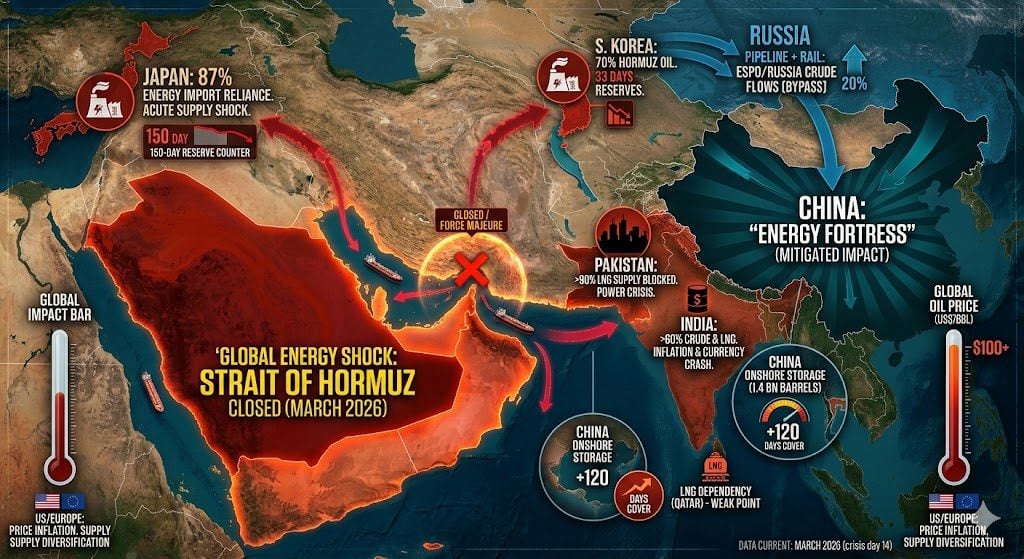
- Japan: Perhaps the most vulnerable. It sources ~87% of its energy from fossil fuel imports, with roughly 75-80% of its crude passing through the Strait. Even with 150+ days of reserves, its industrial sector is facing massive cost spikes.
- South Korea: Ranks second in vulnerability. It imports ~70% of its oil via the Strait and has significantly lower reserve cover than Japan (estimated at only 33 days of total demand cover). As a result, the KOSPI index recently suffered its worst crash since 2008.
- Pakistan & Bangladesh: These are among the hardest hit. They rely on the Strait for nearly 100% of their LNG (Pakistan) and 72% of their LNG (Bangladesh). Bangladesh has already moved forward with Eid holidays and closed universities to conserve electricity due to a critical gas deficit.
- India: While it has diversified into Russian oil, it still gets ~60% of its crude and ~50% of its LNG through the Strait. The weakening Rupee and widening current account deficit are creating severe inflationary pressure on its domestic economy.
China
China is an interesting case. There’s been chatter that China is in trouble because of the throttled oil flow. China has significantly more “import cover” than Japan or South Korea. While those nations measure their reserves in weeks, China measures theirs in months. China holds an estimated 1.3 to 1.4 billion barrels in onshore storage. At 2026 consumption rates, this provides roughly 110–120 days of total import cover. Some estimates suggest that if they aggressively cut refinery runs, they could stretch this to six months. Unlike India, which is pleading for a coordinated global release of reserves, China has enough domestic supply to avoid immediate panic-buying at $100+ prices.
China has systematically reduced its reliance on the Strait by investing in pipelines that bypass it entirely. In February 2026 alone, China’s imports of Russian oil surged by over 20% (reaching ~2.1 million barrels per day). This oil travels via the ESPO pipeline and rail, bypassing the Middle East entirely. China is the primary destination for Iranian “SIPL” (sanctioned) oil. As of early March, over 46 million barrels of Iranian oil were already sitting in floating storage in Asian waters or in “bonded” Chinese ports that haven’t even been cleared by customs—providing an immediate “invisible” reserve.
While China is robust in oil, Natural Gas (LNG) is its “Achilles’ heel” in this crisis. Roughly 30% of China’s LNG comes from Qatar. Since Qatar declared force majeure on gas exports in early March, China cannot easily replace these volumes. Beijing is reportedly choosing to reduce consumption (curtailing industrial gas use) rather than outbidding Europe for expensive American or African LNG. They are also leaning harder on coal and their domestic renewable grid, which has doubled in capacity since 2024.
The biggest losers within China are the “Teapots” (independent refineries in Shandong). These refineries rely almost exclusively on discounted, sanctioned oil from Iran and Russia. With the Strait closed, the supply of Iranian crude has effectively stopped. While they are switching to Russian Urals, the “war risk” insurance and shipping premiums are eating into their margins, forcing many to move up their scheduled maintenance shutdowns to March/April to wait out the conflict. It is this group that is the basis for chatter about China’sstruggle for oil.
Trump’s Move
Into the insurance vacuum, President Donald Trump has pushed the U.S. International Development Finance Corporation to stand up a large political risk and reinsurance backstop for ships carrying energy through the region. On paper, this gives Washington a tool to reassure markets that oil, gasoline, diesel, and jet fuel will continue to move, even as private insurers retreat. In practice, the facility will take time to structure, will only apply to eligible vessels, and will sit alongside – not replace – the London market and its own war risk capacity.
That is why the price action feels so violent. Traders are reacting to a very real “plumbing” shock in the insurance market, but without clear details on how quickly alternative cover can scale. The result is a futures curve that looks more like a proxy for war risk premiums than for actual barrels lost. Flows through Hormuz have slowed, not stopped; Lloyd’s syndicates insist war cover is still available at a price; and emerging U.S.–U.K. talks on a joint framework suggest the worst-case scenario is being capped, even if it has not yet been fully priced out.
There’s an interesting thread on X that warrants reading for more context and consideration.
Airline Impact
For airlines, this distinction matters. The jet fuel price paid reflects not just crude fundamentals but also the cost and availability of insuring each link in the supply chain, from the Gulf export terminal to the airport hydrant. A coverage shock that proves temporary could still blow a hole in first-quarter results, but it does not automatically imply a structurally higher fuel cost base for 2026 and beyond. Executives at carriers such as United Airlines now face a familiar dilemma: how far to raise fares or trim capacity on the back of a move that may owe as much to insurance lawyers as to physical shortages.
Looking ahead, airlines are facing a structural Middle East disruption in which fuel is just one line item; longer routings, crew constraints, and schedule complexity are quietly doing as much damage as the oil spike itself.
- Longer routes, higher unit costs: To avoid conflict airspace over Iran and parts of the Gulf, carriers are pushing traffic north via the Caucasus/Central Asia or south via Egypt–Saudi Arabia–Oman, adding 60–120 minutes to many long-haul sectors. Industry estimates suggest that each extra detour hour can raise operating costs by roughly $6,000–10,000 per flight on a widebody, once you factor in extra fuel burn, overflight fees, and wear and tear.
- Crew duty limits and staffing: Those added block times push many flights over legal duty limits, forcing airlines to roster augmented crews, insert tech stops, or build in route crew changes. That means more pilots and cabin crew per rotation, extra hotel nights and positioning sectors, and a harder rostering problem just as summer schedules ramp up.
- Less productive fleets and networks: Longer stage lengths and refuelling stops reduce daily aircraft utilization, cutting the number of rotations a widebody or narrowbody can realistically operate. Some operators are already trimming or suspending services most exposed to detours and Gulf fuel supply, prioritizing core trunk routes and higher-yield flows.
Fares and Margins
Analysts warn that the combination of jet fuel prices up 15–80% in a week and systematic rerouting could take a meaningful bite out of 2026 margins, especially for U.S. carriers that no longer hedge fuel. With unit costs rising from both fuel and time in air, airlines are likely to respond with higher fares, tighter capacity, and more granular surcharges on the longest detoured markets, not just a generic “fuel surcharge.”
For industry veterans, this is a case of “here we go again”. Another exogenous shock, and another impact to weather. Despite the negatives, commercial aviation has proven to be among the most adaptable industries, recovering from every shock it faces.
Views: 215
About The Author


Take AirInsight for a Test Flight
7 days full access — premium analysis and the complete data model library — for $1. No commitment.
Start My Test Flight →