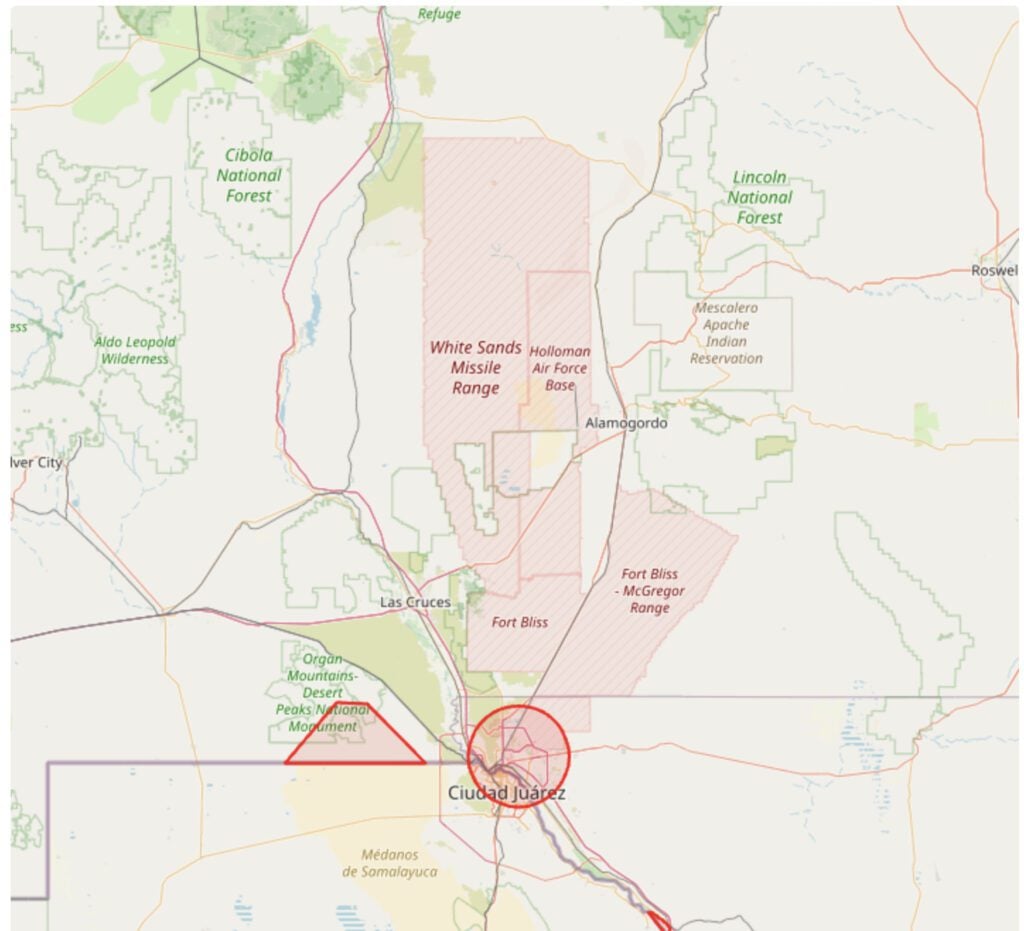
The FAA announced yesterday evening that the airspace over El Paso, Texas would close for 10 days due to a national security threat. This morning, they announced that the threat was eliminated and that commercial flights are clear to resume, and that the threat was from a drone incursion by a drug cartel. Sean Duffy, US Secretary of Transportation, said that the Pentagon and FAA had shut the airspace to deal with a drug cartel drone or drones. “The threat has been neutralized, and there is no danger to commercial traffic in the region.”
The airspace closure, according to airlines, was the result of potential coordination issues between the Pentagon and its counter-drone technology and the risk assessment of that technology on commercial aviation. While the situation was quickly resolved, there has been no public explanation as to why safety concerns were resolved so quickly, particularly given the 10 day shut-down announcement.
A similar 10-day temporary flight restrictions for security reasons remains in place for Stanta Teresa, New Mexico, which is 15 miles from the El Paso airport. We have not yet heard whether this area will also be cancelled. The area near El Paso contains several military facilities and restricted areas, and threats to those installations have national security implications.
Unfortunately, we may never know more about the potential threat to commercial aviation from drug cartels. Typically, airspace used by commercial aircraft is typically only closed in war times or threats of war. In this case, it may have been a war on drugs rather than a war with Mexico that shut the airspace temporarily.
What we Know and Don’t Know
We do know that drug cartels have utilized drones to deliver drugs over the US border. We also know that cartels use drones for surveillance to determine where border security forces are active.
What we don’t know is how these drones have become a threat to commercial aviation. Are we looking at a drone swarming situation in which overwhelming numbers of drones are launched simultaneously, for attack or distraction?
We don’t know whether cartel drones have been weaponized and could be used to attack border security personnel. We also don’t know if cartels planned to attack airspace used by commercial aircraft to create distractions and discord among first responders.
We don’t know whether anti-drone technology from military bases north of El Paso airport traversed the same airspace as commercial aircraft in their counter-attack.
We also don’t know if the response to a drone attack could in itself provide a threat to nearby aircraft. A new “Discombobulator” was utilized in the capture of President Maduro in Venezuela that apparently caused many systems to fail. Could that have been used here, and for safety, commercial traffic kept away?
The Bottom Line
There are a lot of questions that we may never learn about this situation due to national security concerns. If a major drone attack was thwarted and the solution to defend against a new type of warfare works, great! We don’t need to know the specifics, but be thankful that it works.
If however, it doesn’t work, there is still some work to be done. But given the rapid cancellation of the threat, it appears that the former rather than the latter is the case, and congratulations are in order.
Views: 61
About The Author


Take AirInsight for a Test Flight
7 days full access — premium analysis and the complete data model library — for $1. No commitment.
Start My Test Flight →