adani embraer
Since the Adani/Embraer MoU was announced, reactions have been varied and mostly positive. Perhaps too positive at this stage. The key issue is whether, when, and where a FAL would be located.
The possibility of Embraer, the Brazilian regional aircraft manufacturer, setting up a fixed-wing Final Assembly Line (FAL) in India to boost the Indian government’s Make in India plans brightened on Tuesday.
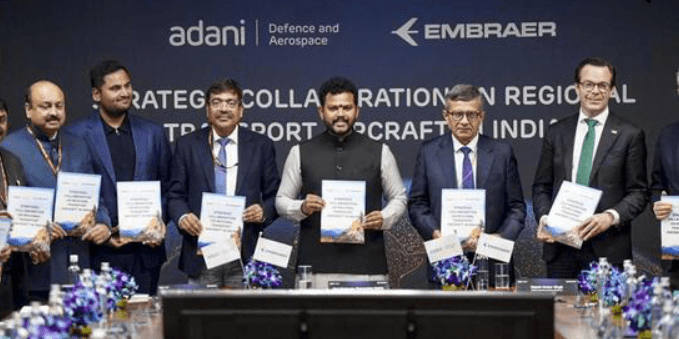
Embraer and Adani Defence & Aerospace, a leading player in India’s aerospace and defence, and the flagship company of Adani Enterprises Ltd, signed a MoU to develop an integrated regional transport aircraft ecosystem in India.
“The companies aim to collaborate on opportunities in aircraft manufacturing, supply chain, aftermarket services, and pilot training,” the two companies said in a joint statement issued to the media post the announcement.
Arjan Meijer, President and CEO, Embraer Commercial Aviation, added that India is a pivotal market for Embraer, and this partnership combines our aerospace expertise with Adani’s strong industrial capabilities and commitment to indigenisation “Together, we will evaluate the most viable, advanced and efficient solutions in support of India’s RTA ambitions, and their potential for implementation,” he said. The word “evaluate” is crucial and easily overlooked in the excitement of the moment.
Commenting on the MoU, Jeet Adani, Director, Adani Defence & Aerospace, added that regional aviation is the backbone of economic expansion. “With initiatives like UDAN (Regional Air Connectivity Scheme of the Indian government) transforming air connectivity across Tier 2 and Tier 3 cities, the need for an indigenous regional aviation ecosystem has become critical.”
Major details of the investment are still elusive
However, details of which of the 36 states and union territories, which constitute the Union of India, the FAL will come up, how much the investment in the plant and machinery is to be made, by when the plant will go online, and when the “make in India” aircraft will start flying were not immediately known.
The potential of an FAL has become the focal point of the announcement. Everyone on the Indian side wants it because it is likely to serve as the foundation stone for the UDAN project. That word “evaluate” becomes the lynchpin. The onus will be on India to move from evaluation to construction. Embraer does not have anything to prove – it has the capabilities and will not take any unnecessary risks. The interest is there, but so is the caution.
The news of the possible tie-up, which was announced today, was first reported by the Times of India on January 8 this year. The Times of India is the largest English daily in India.
Media FAL Speculation
There has been talk in the Indian media that the Embraer FAL could come up either in Gujarat, the home state of Mr Narendra Modi, the Indian Prime Minister, and Gautam Adani, the promoter of Adani Group, or in Andhra Pradesh. Kinjarapu Ram Mohan Naidu, the Union Civil Aviation Minister, is from Andhra Pradesh.
The construction of an FAL is the jewel for India. The downstream skilled jobs and local supply chain it would create are of great interest and attraction. You can expect the MoU signers to carefully plot their next moves. States will end up chasing an FAL, just as they do in other countries; South Carolina spent years winning the 787 FAL. It was worth it. Boeing recently announced a $1 billion expansion.
The focus on the potential FAL is entirely rational.
Presentation makes the case for an Indian FAL
The two companies pointed to several reasons as to why now is the best time for the tie up including the fact that India is the world’s third -largest aviation market which has grown from having just 14 airports in 2014 to having 162 airports last year and is projected to have 350-400 airports by 2047 while the number of commercial flights has increased from around 400 in 2014 to double by 2025 and is expected to touch 2359 by 2047 while passenger numbers are expected to touch around 1.3 billion in 2047 from 103 million in 2014.
Another reason is that the country’s per capita seat availability is the lowest in the world at 0.13 domestic seats per capita, while in Vietnam it is 0.42, in China 0.56, and in the US 3.09, one slide pointed out.
The slide further adds that the tie up for the Regional Transport Aircraft is not An “aviation programe —it is an industrial strategy” adding that the collaboration will set up one of the largest Regiobal Aeerospace Ecosystems.
It further states that regional aviation does not follow development – it ignites it
A FAL fulfils a long desire of the Indian Government
In June last year, while speaking at the IATA AGM in Delhi, Narendra Modi, the Indian Prime Minister, called on global aviation companies to go beyond manufacturing and invest in aircraft and component design in India, highlighting the country’s liberal investment climate and fast-growing aviation ecosystem.
“I request all aviation players to implement Design in India along with Make in India,” Modi said, speaking at the IATA summit. “For the world’s leading aviation companies, India presents an excellent opportunity for investment.”
Previous aviation MoUs have not taken off
India has a history of aviation MoUs not taking off. For example, in 2017, the Indian low-cost carrier SpiceJet entered into an MoU. The airline is in talks with Japan’s Setouchi Holdings Inc. to buy about 100 amphibious Kodiak planes that can land anywhere, including on water, gravel, or in an open field. The deal was valued at about $400 million. But now nothing is mentioned of this project.
Government incentives for local FAL Orders
The Indian government is reportedly considering providing incentives to airlines that order from a potential Embraer FAL in India. Details of the incentives are yet to be worked out, officials said. In June last year, Embraer officials told the Indian media that it would increase sourcing from India and could even set up a local FAL.
Embraer bullish on prospects in India
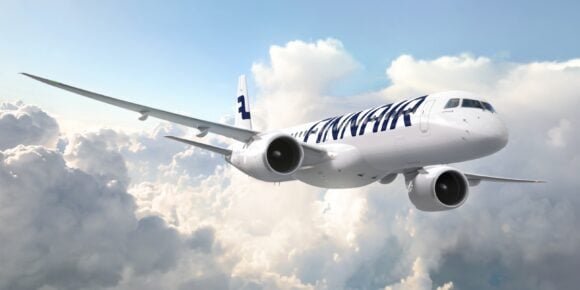
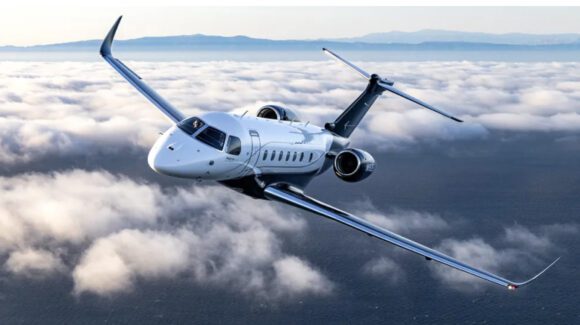
Officials of the Brazilian company have been bullish on the Indian market. The Brazilian aircraft manufacturer has a presence in the civilian airspace through Star Air, a regional airline. But its aircraft are also flown by defence forces in India and are a popular business jet.
Embraer is also set to be in talks with IndiGo and Air India to sell its E2 jets in India. IndiGo and Air India control over 80 percent of the domestic aviation market in India.
Adani Group’s presence includes Indian airports
The Adani Group is the largest private-sector airport operator in India, with operations at eight airports in Mumbai and at the newly opened Navi Mumbai. It also has a presence in energy and utilities, transport and logistics, and sports, among others. At the moment, the Airports Authority of India, a state-run enterprise, operates the majority of the over 100 civilian airports in India.
Embraer’s Indian presence
Embraer has a growing footprint and long history in India, with nearly 50 Embraer aircraft and 11 aircraft types currently operating across commercial, defense, and business aviation. Embraer aircraft operated by the Indian Air Force include the Legacy 600 and the ‘Netra’ AEW&C aircraft, both based on the Embraer ERJ145 platform. Star Air operates a fleet of 13 E175 and ERJ145 aircraft.
Views: 372
About The Author


Take AirInsight for a Test Flight
7 days full access — premium analysis and the complete data model library — for $1. No commitment.
Start My Test Flight →