

Rafael Schwarzman, IATA Regional Vice President for Europe, announced at the IATA Annual General Meeting (AGM) in Rio de Janeiro that jet fuel surged past 40% of total airline operating expenses (OpEx). This cost escalation, combined with a marginal 0.8% regional air traffic growth in April and an annual €8 billion structural burden from the EU 261 passenger rights framework, compressed airline unit margins across the continent.
The organization analysis reveals that European carriers reallocated their Available Seat-Kilometers (ASK) toward intra-European short-haul routes to mitigate geopolitical airspace closures and restricted long-haul corridors. These geopolitical and economic uncertainties triggered late-booking consumer behavior, forcing airlines to deploy targeted promotional fares to stabilize load factors in underperforming network segments.
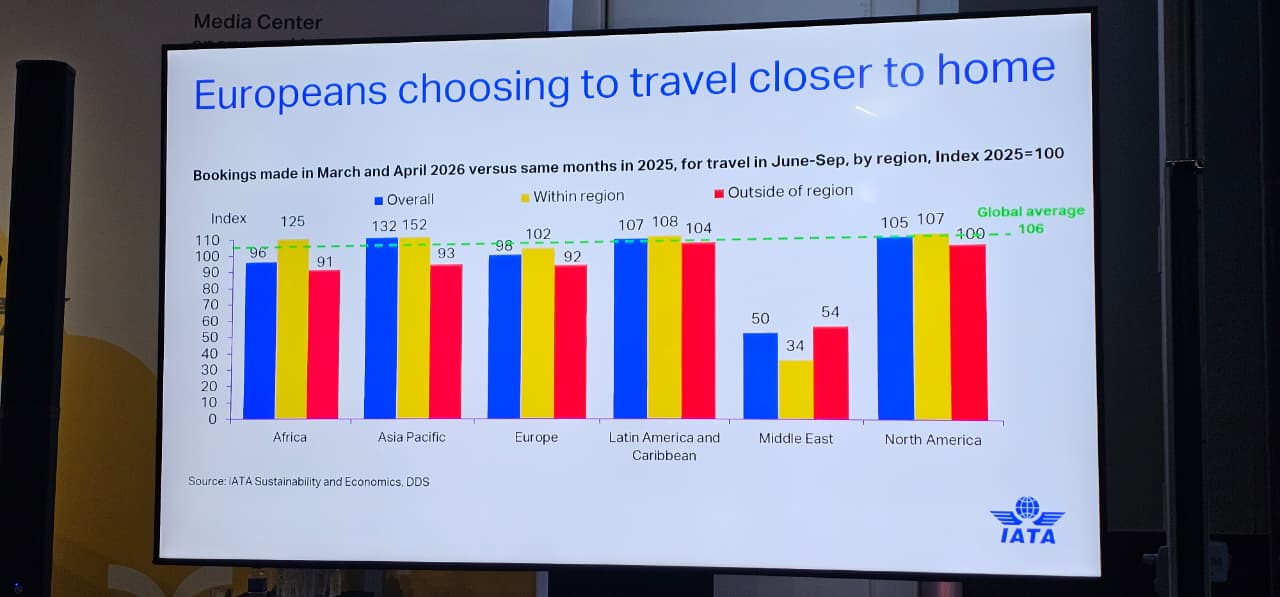
The imminent rollout of the European Union Entry-Exit System (EES) presents a critical threat to ground operations and slot utilization at congested Mediterranean hubs. Border processing baselines will increase from 20 seconds to 90 seconds per passenger, multiplying ground delays in Spain, Portugal, Italy, Greece, and Belgium, IATA said.
The post-Brexit legal status of British nationals amplified border congestion risks at these primary leisure gateways during peak summer waves. IATA demanded that member states maximize border staffing and unify the deployment of the EES mobile application to avoid systemic ground delays.
Fiscal Asymmetries, Infrastructure Charges, and CASK Inflation
The ongoing political deadlock between the European Parliament and the Council over the revision of EU 261 sustained a financial penalty equivalent to €10 per transported passenger. The current three-hour delay threshold incentivized premature flight cancellations over operational delays, as carriers lacked the capacity to mitigate exogenous air traffic management (ATM) bottlenecks, which doubled over the past decade. Schwarzman advocated for a five-hour delay threshold to realign the framework with contemporary operational realities.
National fiscal strategies diverged sharply across Europe, impacting regional airline competitiveness and market entry. While Sweden abolished its passenger tax and Germany implemented marginal reductions, France and the Netherlands enacted steep tax hikes. The Dutch policy caused tax increases of up to 140% on specific routes, restricting traffic growth to 2% over the last decade compared to the 16% European Union average.
Hub infrastructure costs aggravated unit cost baselines. Aeronautical charges at Amsterdam Schiphol Airport doubled relative to 2019 levels, despite a temporary 10% discount applied after a previous 33% increase. Concurrently, environmental mandates under ReFuelEU forced carriers to purchase Sustainable Aviation Fuel (SAF) at a price premium up to five times higher than conventional jet fuel. IATA continues to campaign for a global Book and Claim accounting framework to inject liquidity into the SAF credit market and decouple physical supply constraints from emission reduction accounting.
Views: 112