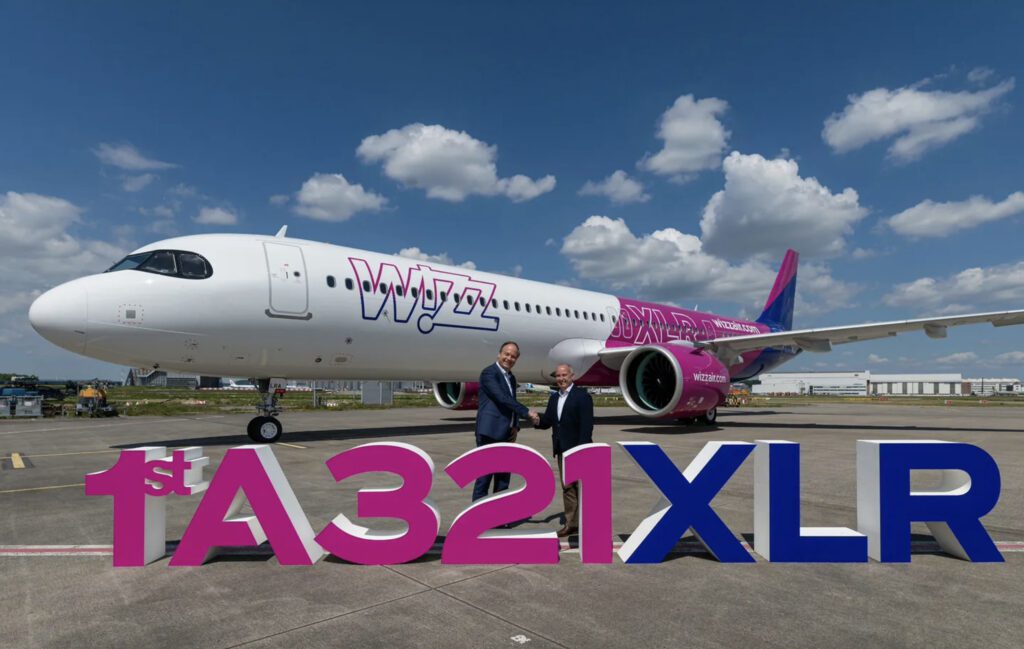
Until last November, Wizz Air was perceived to be a strong believer in the Airbus A321XLR and its ultra-long-range capabilities. But since the carrier slashed its orders from 47 to just 11, the -XLR is becoming just another variant in the fleet. In its Q3 FY26 earnings presentation on January 29, Wizz’s top management event hinted at selling on the five remaining aircraft still on order.
Airbus advertises the A321XLR as the Extra Long Range, with a 8.700km/4.700nm range that can open up new point-to-point routes. As such, the type is operated by Iberia and Aer Lingus on routes that would be too thin for widebodies.
Wizz Air intended to follow the same philosophy and ordered 47 XLRs, of which quite a few would be placed with Wizz Air Abu Dhabi. But Wizz reviewed its strategy, closed down the subsidiary last September, and renegotiated its delivery schedule with Airbus in November. Only 11 XLRs remained in the backlog while the rest were converted to standard A321neos, “the best aircraft in the segment”, according to CEO Jozsef Varadi. Six are now in the fleet; the other five should join in the next eight months.
Misconception
Wizz Air operates the A321XLR between London Gatwick and Jeddah and Medina, and is very happy with the performance and yields that these routes to Saudi Arabia are generating. But that doesn’t mean that the XLR works only fine on routes like this, said Varadi. “I think there is a bit of a misconception on the XLR. You think that the XLR has to be long-haul, but it doesn’t have to be.”
“We looked at the unit economics of the A321neo, the A321XLR, and the A321ceo. The ceo is an inferior aircraft compared to the XLR in terms of unit economics. So if you operate the XLR as a normal A321neo operation and take it on a short to medium-haul flight, it delivers better economics than the A321ceo. It is inferior to the A321neo because of the weight penalty (because of the higher MTOW due to the rear centre tank – RS), but this is marginal.”
“We don’t have to force ourselves into long routes or unproductive, almost long-haul operations. We simply operate the XLR as an A321neo, and you will get a lot of the economic benefits from that. And it is far superior to the Boeing 737/MAX or the A320neo that we are currently operating.”
“So no stress about the XLR. We don’t have to make stupid decisions just because we have an aircraft like the XLR. Of course, if we find the appropriate commercial and financial opportunities to deploy the XLR as an XLR, we will do it as we are doing it from London Gatwick to Jeddah and Medina. Those routes are significantly exceeding expectations, but we don’t have to fly XLRs as XLRs and operate them just as A321neos. Varadi said later on: “We will not take risks on our financial performance. Either we are convinced this will be a profitable route from day one, or we are not doing it if we can’t find it.”
Ian Malin, the outgoing Chief Financial Officer, who has been promoted to the role of Chief Commercial Officer from February 1, clarified that Wizz Air has no intention to launch scheduled services to the US. Its recent application with the Department of Transportation is just for charter flights during the upcoming Football World Cup and has nothing to do with Wizz looking for new markets to deploy the XLRs. “There is nothing more to it.”
Flexibility
Speaking more about financing the five remaining XLRs. Malin said that this is still on the table. “How they will be financed will be a timing issue. Sale and leasebacks are part of it, but we may end up financing those XLRs. Financing allows us the flexibility to terminate the deals sooner if we decide that we no longer need the XLRs and move them on to a different operator.” If Wizz were to take that decision, that would mean a drastic change in its fleet strategy.
For now, Varadi is happy with the fleet plan. Wizz Air recently took delivery of the 250th aircraft and will get to 256 by the end of this financial year in late March. The fleet grows to 271 aircraft in FY27, with growth slowing down to 273 in FY28 as more A321ceos are coming out of lease. The fleet number grows to 299 in FY29 and 334 in FY30, including 315 A320neos, 11 A321XLRs, and 6 A320neos. This is well below the 424 in the original fleet plan of last June, when it guided 382 A321neos and 34 XLRs, 6 A320neos, and the last two A320ceos.
Views: 481
About The Author

Take AirInsight for a Test Flight
7 days full access — premium analysis and the complete data model library — for $1. No commitment.
Start My Test Flight →