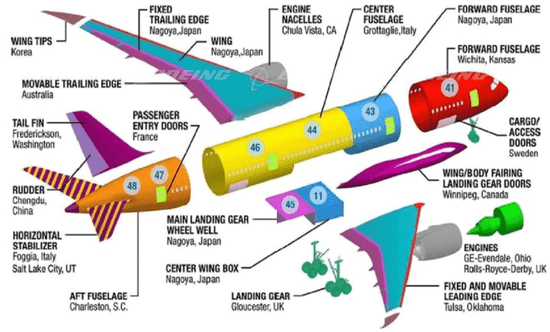
Just when you think it’s safe to go back in the water, you hear that music - da-da, da-da, dum de dum de dum - and suddenly Jaws reappears. It certainly seems that way with the most recent Boeing “quality escapes” and the fact that their planned rate growth is pushed further to the right by the FAA. Airbus is continuing its planned production ramp-up, and ironically, the Boeing slow down could help suppliers having difficulties with critical parts to improve delivery performance to Airbus. When trouble hits the duopoly, one of the players is likely to hurt more than the other. One of the major selling points for the MAX was availability a couple of years earlier than Airbus models. But the recent Alaska Airlines decompression incident forced the FAA to intervene and cap Boeing’s production ramp until their quality system can be improved. So what can we expect in 2024? Our outlook for Boeing is for a static 737 MAX production rate of no more than 38 per month for the remainder of the year as the FAA restricted planned rate increases, and could potentially slow or even shut production as quality system reviews warrant modifications and employee training and transition. Our outlook for Airbus is the opposite, with the company working with the supply chain to increase the production rates at its four A320neo family assembly lines. The net result will be that key suppliers to both companies, given a choice, will focus resources on Airbus rather than Boeing production. While Boeing retains a substantial order volume within the supply chain, it no longer has market leadership from which to threaten or dictate supplier actions, including capital expenditures and growth plans. Recovery from the pandemic has been difficult for the supply chain, particularly in hiring and training employees. It takes one to two years for an employee to “get up to speed”, particularly for items like castings that require an experienced eye during the production process. Employees hired post-pandemic in 2022 are just now reaching the experience level for unsupervised work and consequently, the ability to regain full production capacity. So just when the OEMs thought it was becoming safe to increase production rates, the quality monster has taken another bite out of Boeing. Boeing asked vendors to plan for rates of 42 (1H23) and 47 (2H23) in 2024, and now it appears that it will not be higher than 38. Will Boeing take its planned supply chain deliveries, or only the FAA approved rate? Given the severity of Boeing’s quality issues, we doubt that they can honor the initial commitment levels in 2024, and will reduce supplier deliveries to match current (FAA approved) production rates. Once again, Boeing will pull the rug out from under its suppliers. We have been looking the Boeing supply chain for several years. The Bottom Line How many “never again” circumstances can Boeing have before its credibility with the supply chain is gone? How many times can Boeing reduce its uptake of planned quantities and then leave suppliers with production rate guidance that fails to materialize? We’ve had several suppliers indicate that they are re-thinking whether they want to continue to participate in future Boeing programs under the current terms and conditions, given their experience with the 787, 777X and MAX. This will be the most interesting fall-out from the current situation at Boeing, as virtually every program in recent years has moved to the right with delays. Currently, Boeing has the most of the power in the supply chain relationship. But if suppliers join forces, and refuse to agree to current contract terms for new programs, could that change the balance of power in the future? Think about RTX as an example, if it refuses Boeing's terms and others side with RTX. We do not expect to see a “supplier’s union” emerging. But we do expect suppliers to be concerned about having to spend capital to ramp-up capacity and then see that capacity wither from volatile production rates. This may become a critical negotiating point for Boeing’s next narrow-body. The fallout for Boeing may be that it no longer is in the driver’s seat for supplier negotiations as the supply chain to evolves. We expect suppliers, reeling from programs that consistently fail to meet promised time lines, might no longer share program risks without OEM performance penalties for failure to perform on-time or purchase products at planned production rates.