

Guest Post by Timothy O’Neil-Dunne.
For thirty years, I have had a nagging suspicion that one of the airline industry’s biggest stories was hiding in plain sight inside the U.S. Department of Transportation’s Form 41 data. Not in the glamorous stuff. Not in load factors, ancillary revenue, premium cabins, or Wall Street earnings calls. In the boring stuff. Expense lines.
The industry loves to tell a neat story about what happened after 1995. Travel agent commissions were capped, then effectively eliminated. The internet arrived. Distribution became “efficient.” Airlines learned how to sell directly to consumers. Technology would remove friction. Costs would fall. Profitability would improve.
And yes — profits did improve. Massively.
But service did not improve. In many cases, it deteriorated. Seat pitch shrank. Staffing shrank. Human support vanished. Airports became self-service warehouses. Consumers became unpaid labor operating kiosks, apps, and websites themselves.
So the obvious question becomes: where exactly did all the money go?
The charts below tell a very uncomfortable story.
For years, airlines insisted that travel agency commissions were the villain. In 1995, passenger commissions represented roughly 40% of the Services Purchased bucket. By the early 2000s, the majors detonated the traditional agency model by capping and then eliminating base commissions altogether.
And the collapse is stunning.
By 2025, commissions are below 5%.
Officially.
But here is the problem. Distribution costs did not disappear. They simply moved somewhere else.
That is where things start getting murky.
At exactly the same moment airlines were slashing agency commissions, they became dependent on entirely new digital toll collectors. Google. Search advertising. SEO. SEM. Metasearch. Credit card processors. Massive outsourced technology contracts. Payment systems. Data brokers. Revenue optimization platforms. Customer acquisition engines. Cloud infrastructure. Digital marketing ecosystems.
This was not disintermediation. It was reintermediation.
The travel agent was simply replaced by Silicon Valley.
And yet, when you examine the Form 41 P6 data. Advertising does not explode as you would expect. Communication costs do not explode. The specifically identified categories remain relatively modest.
Instead, one category quietly mutates into a monster.
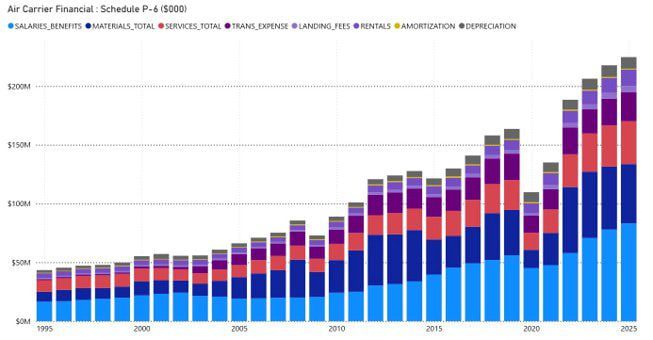
“Other Services.” In 2025, it was a $26.7 billion monster, driving Total Services into the third-largest cost category.

It has become the industry’s favorite accounting junk drawer.
What used to be a miscellaneous line item has become the single dominant component of airline services expense. Today, it represents roughly 60% of the entire Services bucket. That is extraordinary.
Not 10%.
Not 20%.
Sixty percent.
At that point, it is no longer a residual category. It is the category.
And that should concern everybody.
Because once a catchall bucket becomes this large, the transparency of the reporting system begins to collapse. The entire purpose of standardized reporting is to allow analysts, investors, regulators, labor groups, and consumers to understand where money is actually flowing.
Instead, we now have tens of billions of dollars sitting inside an accounting fog bank.
The official explanations sound harmless enough. Legal fees. Technical contractors. Outsourced services. IT consulting. Cybersecurity. Bank charges. Processing fees. Housekeeping. Security services. Interchange costs.
Fine.
But if these are now among the highest structural costs in commercial aviation, they deserve to be broken out separately and properly disclosed.
That is what any normal materiality standard would require.
If a category exceeds 5% of a major cost base, accountants usually begin questioning whether it needs clearer disclosure. Once it approaches 10% of total operating expenses, it becomes impossible to argue it is merely “miscellaneous.”
Yet that is exactly where we are now.
The really uncomfortable possibility is this: airlines may have successfully shifted enormous distribution and customer acquisition costs into categories the public no longer associates with selling air travel.
Remember what the original commission system actually did. Travel agents handled customer acquisition, servicing, ticket changes, comparison shopping, itinerary construction, education, and problem resolution. Airlines paid visibly for that work through commissions.
Today, airlines still pay for customer acquisition. Heavily.
But now they pay Google.
They pay card processors.
They pay technology integrators.
They pay cloud vendors.
They pay digital advertising exchanges.
They pay data companies.
They pay outsourced support vendors.
They pay consultants.
They pay system intermediaries.
The intermediary did not disappear. The intermediary changed clothes.
Meanwhile, consumers were told the internet would make travel cheaper and simpler. Instead, we got dynamic pricing, endless upsell screens, deteriorating service, impossible call-center wait times, and an ecosystem in which airlines simultaneously reduced labor costs while outsourcing increasing portions of the passenger experience to third parties and automation layers.
And somehow all of this supposedly became “efficiency.” The charts expose something even more important.
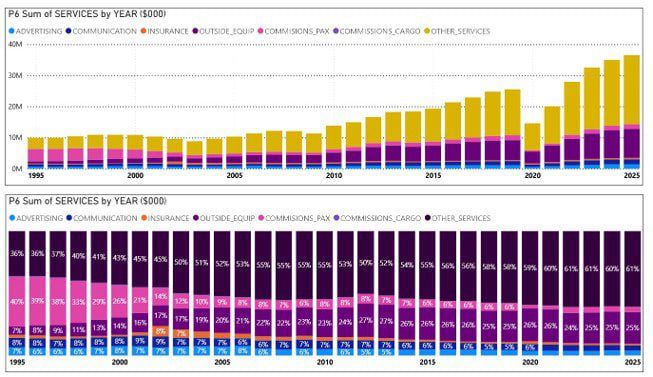
The growth accelerates after 2010.
That matters because this is precisely when Big Tech fully captured travel discovery. Google Flights. Meta advertising. SEO wars. Mobile app ecosystems. Programmatic advertising. Loyalty optimization. Personalization engines. Algorithmic yield management.
Airlines did not escape distribution economics. They became trapped inside a new digital distribution tax regime.
Only now are the costs less visible.
The irony is brutal.
For decades, airlines argued that travel agents were too expensive because commissions were transparent. Everyone could see them. Everyone could calculate them.
Today, the replacement cost structure is largely opaque.
And opacity matters.
Because opaque cost structures weaken accountability. They make it harder to understand real profitability. Harder to evaluate efficiency claims. Harder to assess market concentration. Harder to know whether consumers actually benefited from digitization at all.
That last point may be the most important.
Consumers were promised that removing intermediaries would lower costs and improve service.
Instead, the industry removed human intermediaries, replaced them with digital gatekeepers, reduced service levels, and somehow ended up with a giant “Other Services” bucket consuming an ever larger share of the cost base.
That should make everyone pause.
Especially regulators.
Especially investors.
Especially airlines themselves.
PACI
The most recent public release from Airlines for America (A4A) is dated January 16, 2026. It covers data through the end of 2025. A4A has a KPI named PACI (Passenger Airline Cost Index). It is a quarterly cost index that tracks changes in the price of inputs used by U.S. passenger airlines over time.
Unlike simple CASM (Cost per Available Seat Mile), which can be distorted by changes in productivity, load factor, or aircraft size, the PACI is designed to isolate pure input price changes. It acts as a cleaner measure of inflation in airline operating costs.
PACI Professional Services Index has shown significant upward pressure over the same period, reflecting rising prices for consulting, legal, technical, and outsourced services. This aligns with (and helps explain) the ballooning catchall in the raw Form 41 data.
Much of the post-pandemic surge in Line 28 appears to be driven by higher prices and a greater volume of professional/outsourced services (IT modernization, cybersecurity, regulatory/compliance work, credit card processing, etc.).
The PACI provides independent corroboration that the catchall isn’t just growing due to inflation in big-ticket items like fuel or labor — there’s real cost escalation in the “miscellaneous services” bucket. This strengthens the argument that Line 28 has outgrown its usefulness as a residual category.
Bottom Line
When a miscellaneous category becomes one of the largest expense pools in the industry, it stops being accounting administration and starts becoming an economic story.
And right now, that story does not look remotely as clean as the industry would like people to believe.
Views: 298
Good insight. Well-meant feedback: I would prefer if your articles weren’t written with AI or if you’d at least remove the typical AI tropes and wordings, like this:
Not x.
Not y.
But z.
Thanks