

Here’s our latest monthly US air traffic review. You’ve seen the news and read the opinions. Here’s the data to help you form your own view on how the market is doing. This is an update to our previous note through 1Q26.
Domestic
This model tracks TSA passenger numbers and flights. It has two pages; please view both. Remember to click the double-headed arrow at the bottom right for an optimized view on your monitor. The data is current through May 17. So we’re about halfway through May, and it looks like this month could top the same month last year. That fits the profile of the past few months.
- US domestic traffic remains largely on track. No big swings either way. Even with fares up, people are flying. This seems to support the Delta view that demand for flying is relatively inelastic and can be priced higher.
- The market has carried on as if Spirit Airlines were never there. No hiccups, no big disruption. The competing carriers closed the little vacuum overnight, it seems.
International
This market tends to be more impacted by politics than US domestic travel. Fares are also considerably higher, translating into a much more elastic demand curve.
Let’s start with two charts showing net traffic flows. Green means arrivals exceed departures. The left table is for US passengers, and the right table is for non-US travelers.
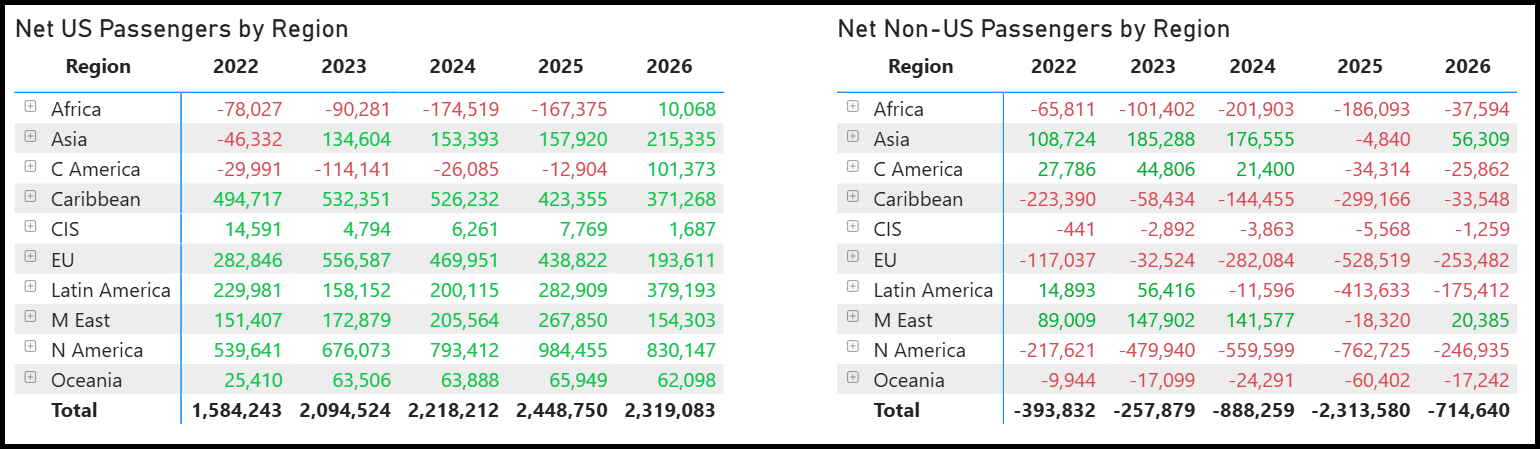
- US travelers show robust arrivals, whereas non-US travelers show robust departures.
- Among non-US travelers, the green in 2026 is driven by Chinese and UAE visitors.
- So, a mixed market overall, yet slightly greener in 2026 than in 2025 among non-US travelers. Crucially, no big swings either way.
Now, let’s break down these markets into the top 15 countries. The patterns follow the tables above.
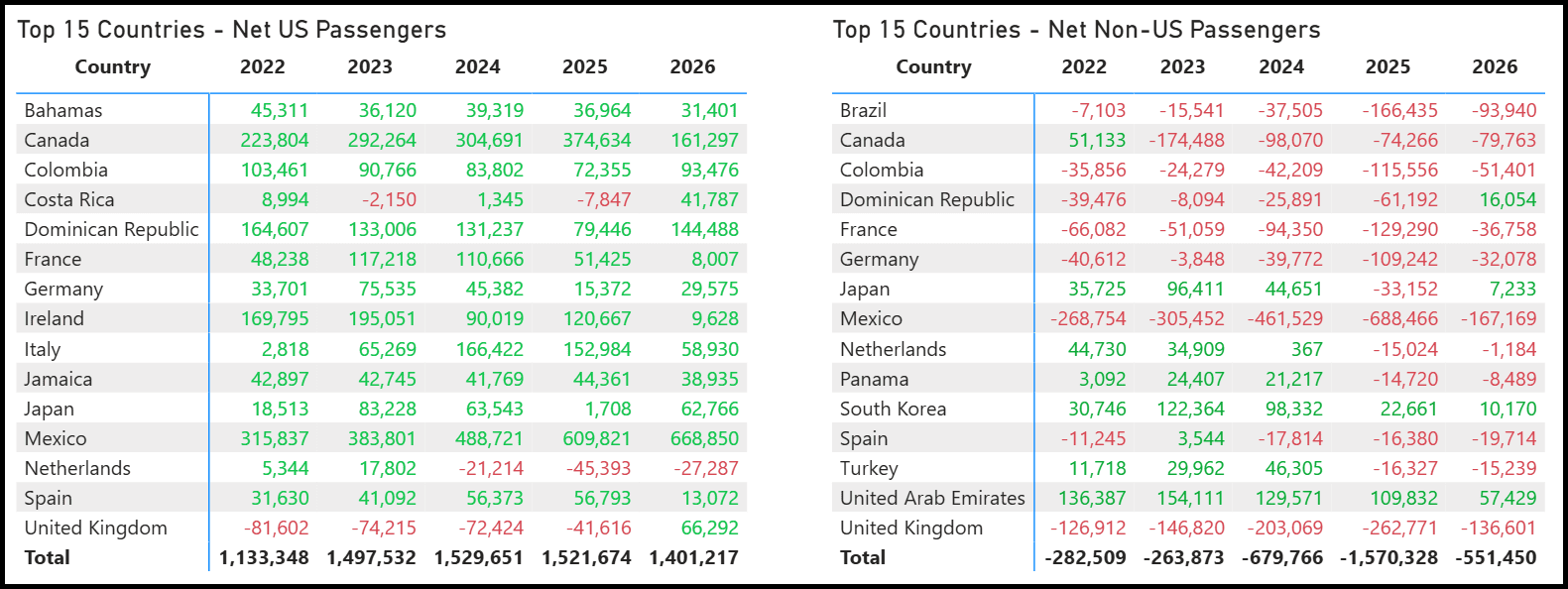
- Among US travelers, the Netherlands remains a soft market. But the UK has picked up and swung rather significantly, given the short period into 2026.
- Among non-US travelers, slightly more green, with the Dominican Republic and Japan moving into the green. If we factor in that about a third of the year is done, it looks like 2026 might see ~1.5 million more departures than arrivals, as in 2025.
- A slightly more positive picture among the Top 15 markets.
Here’s another look at these key markets from a load factor perspective. These are the Top Ten markets. The red dot highlights the peak, and the sparklines show the trend over the period.
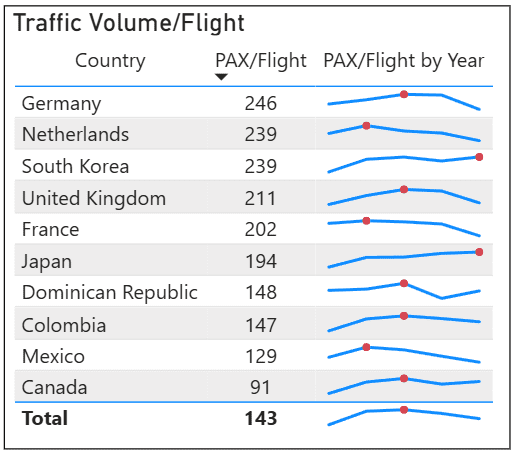
- South Korea and Japan are at their highest points. Good news for the airlines serving those markets.
- Europe looks soft, and the Netherlands trend confirms what we saw above.
- Mexico and Canada are mainly driven, as opposed to flying, markets. And note that the Canadian trend has turned up.
Bottom Line
The data does not support any extreme narrative.
US domestic demand remains remarkably stable. Despite higher fares and persistent economic concerns, passengers continue to fly at levels comparable to, and potentially above, last year. The disappearance of Spirit Airlines as a meaningful market force created surprisingly little disruption. Capacity adjusted quickly, suggesting the US domestic market remains structurally resilient and highly consolidated.
International markets are more nuanced. Political rhetoric and macroeconomic uncertainty are clearly influencing travel patterns at the margin, particularly in parts of Europe. Yet the data does not point to a collapse in demand. Instead, it suggests selective softness offset by strength elsewhere, notably in parts of Asia and among certain inbound markets.
The bigger takeaway may be that airline executives and social media commentary are both overstating the swings. The numbers point to a market that continues to normalize after the extraordinary volatility of the post-pandemic recovery period and the current Middle East conflict.
Airlines would probably prefer stronger pricing power internationally and more consistent premium demand across Europe. But the current data still describes a healthy market — one characterized more by moderation than instability.
Views: 150