

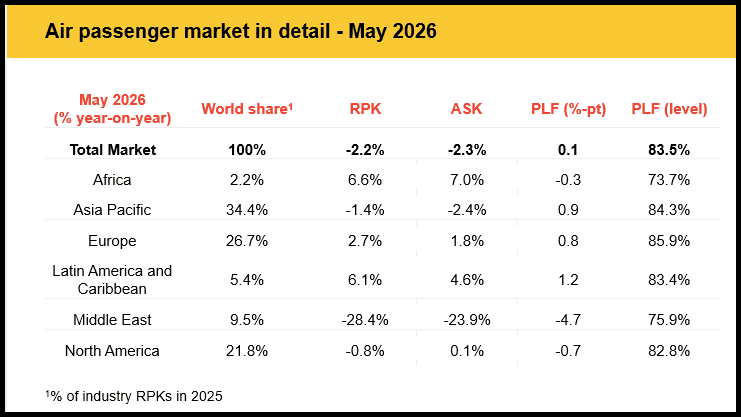
This morning, IATA announced that, in its data for May 2026, global passenger demand:
- Total demand, measured in revenue passenger kilometers (RPK), was down 2.2% compared to May 2025. Excluding the Middle East, demand grew by 0.7%. Total capacity, measured in available seat kilometers (ASK), decreased 2.3% year-on-year. The load factor was 83.5% (+0.1 ppt compared to May 2025), a record high for May.
- International demand fell 1.6% compared to May 2025. Excluding the Middle East, demand grew by 3.1%. Capacity was down 2.4% year-on-year, and the load factor was 83.7% (+0.7 ppt compared to May 2025).
- Domestic demand contracted 3.1% compared to May 2025. Capacity decreased 2.1% year-on-year. The load factor was 83.0% (-0.8 ppt compared to May 2025).
The announcement came with this chart.
For the US, here’s a look at both domestic and international traffic for additional perspective.
Domestic
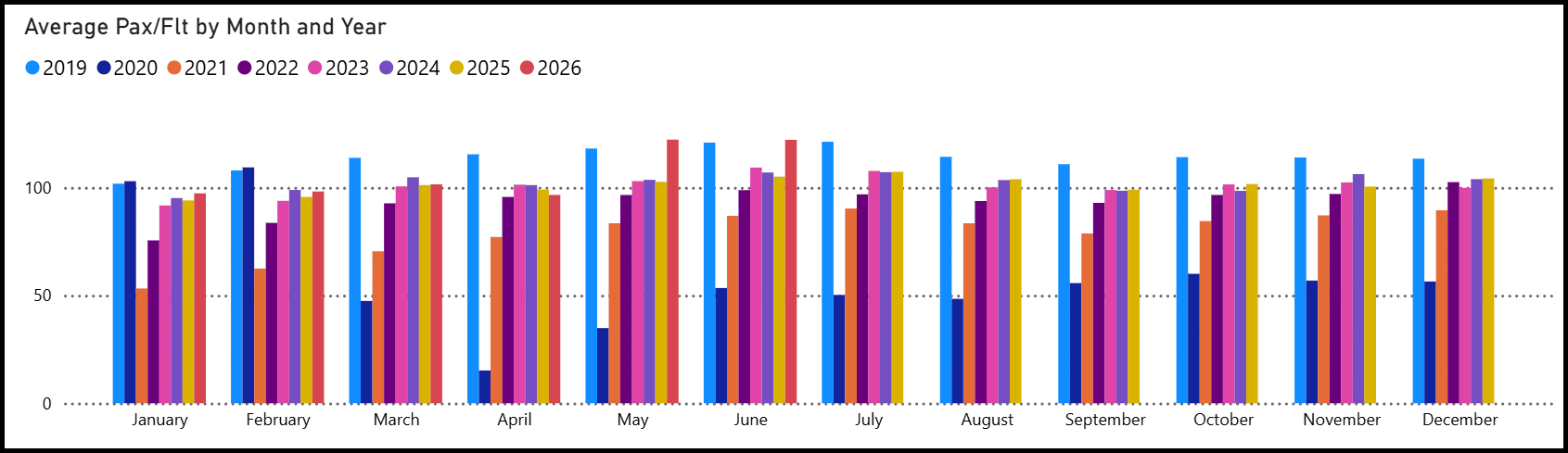
This chart tells us the US domestic market is in rude health. Notice that May and June are both at the same level as last seen in the ‘golden year’ of 2019.
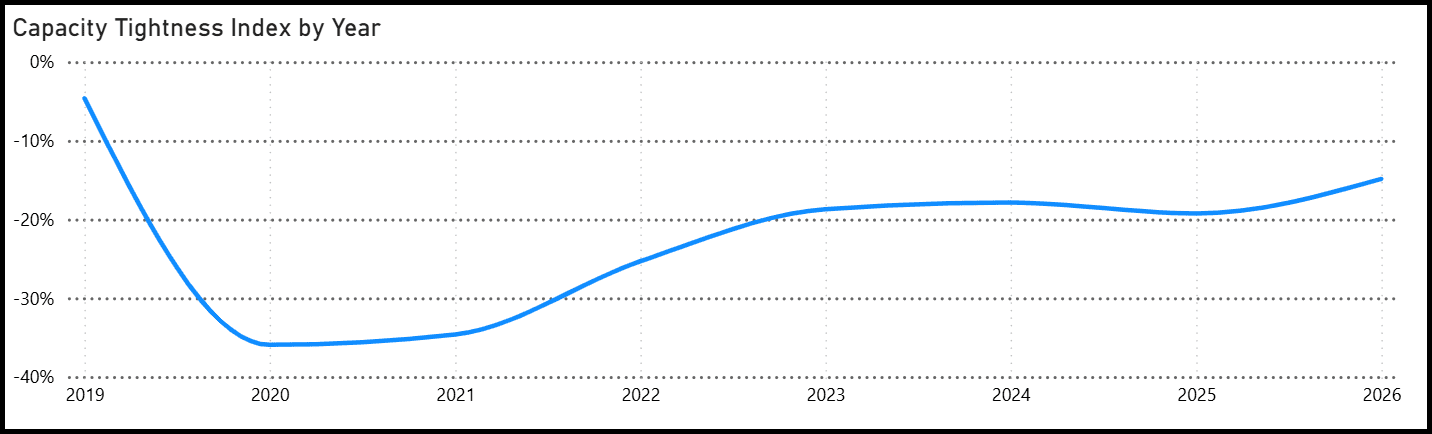
More support is shown here. Capacity is tightening (demand growing faster than supply). Traffic is increasing more than the number of flights/seats. This often signals higher load factors, potential yield strength, or risk of turning away passengers. This index is clawing its way back from the pandemic.
International
The key question is about market growth. This chart answers that unequivocally.
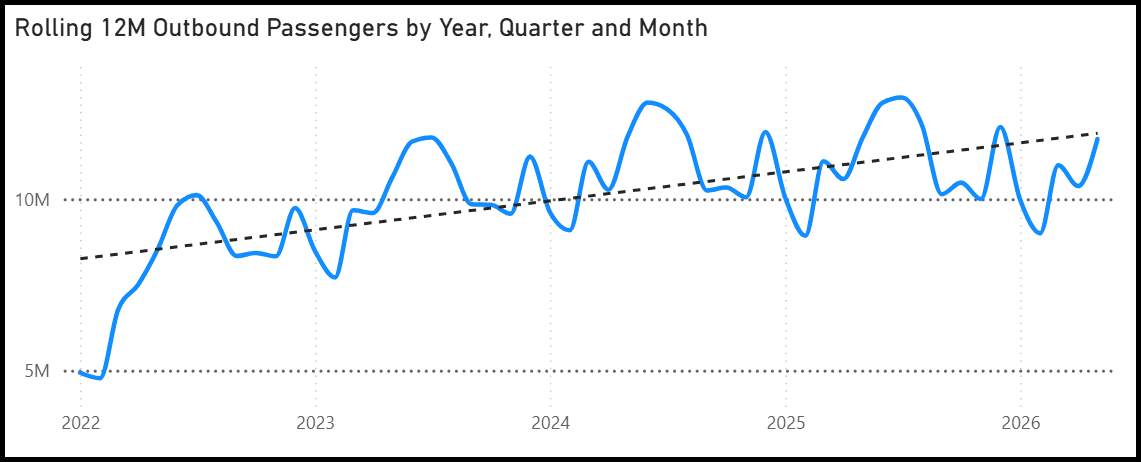
Now to add a data twist, and this reveals very interesting insights.
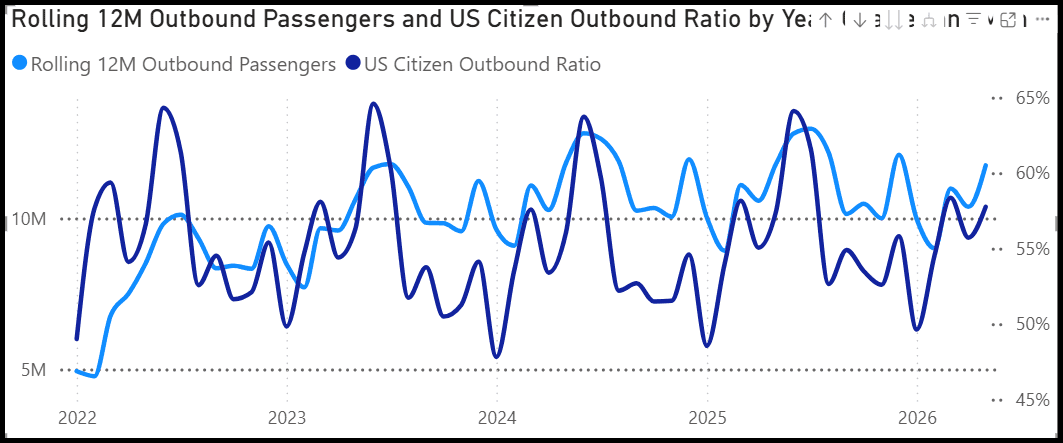
This shows that the initial waves of market growth (the steep climb of the light blue volume line) were driven by American consumers traveling abroad on leisure trips. Every winter, that ratio dropped down to around 47%–50% as Americans stayed home, showing a highly volatile, leisure-dependent market.
The summer peak in 2025 didn’t reach the heights of previous years, yet the overall rolling volume (light blue line) continued to climb to record highs. This proves that the growth we are seeing in 2026 is no longer just a “revenge travel” phenomenon driven purely by US passport holders. Instead, inbound and international point-of-sale traffic has returned.
The market has matured into a much healthier, diversified, and sustainable growth phase. The demand base is wider, meaning airlines aren’t just relying on American vacationers to fill seats; international travelers are actively utilizing US outbound capacity to return home or transit through US hubs.
Of course, the 2026 phenomenon might be the impact of the World Cup. This is almost certainly distorting traffic flows now. We’ll get a better look next month as the data catches up.
Views: 93