

AirAsia X, the Malaysia-based low-cost carrier with operations throughout Southeast Asia, signed a firm order with Airbus for 150 A220 aircraft, with options for 150 additional aircraft. That is the largest single order for the A220 in the program’s history and reflects AirAsia’s growth strategy of using smaller aircraft to serve smaller but profitable markets with “right-sized” aircraft. Airbus disclosed in its May Orders & Deliveries list that AirAsia X has cancelled its order for 15 A330-900s.
AirAsia is Growing
AirAsia X currently operates a large fleet of Airbus A320 family aircraft, as well as A330 twin-aisle aircraft, for long-haul operations. The carrier has just completed the restructuring of several AirAsia-branded carriers into a single operation under AirAsia X Berhad, resulting in a single legal entity, AirAsia Group, owned by Capital A Group. The group now operates a fleet of 253 aircraft following the merger of five short-haul AirAsia-branded airlines and the AirAsia X long-haul operation.
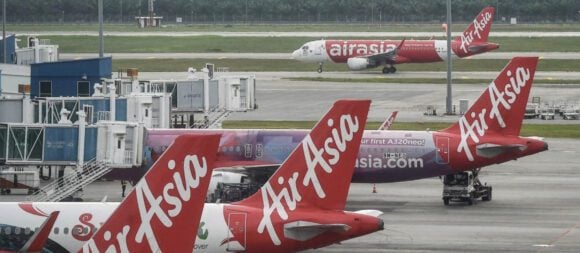
AirAsia X plans to grow to 600 aircraft within the next decade and already has an order for 50+20 Airbus A321XLR long-haul aircraft. The carrier plans to retire its A330-300 aircraft by 2031 as the carrier focuses on narrow-body low-cost operations spanning Asia, the Middle-East, Europe and Africa.
Commenting on the historic order, Bo Lingam, Group CEO of AirAsia Group, said, “AirAsia has spent more than two decades making the world smaller. We built Malaysia into the world’s top low-cost carrier hub, and we opened up air travel to millions of people across Asia who had never flown before. This plane gives us the ability to build the biggest and densest network, serving as a vital tool for efficiency. Its range of up to 7 hours opens up entirely new possibilities, and allows us to match right-sized capacity to demand and give our guests the flexibility to fly whenever they want through increased frequencies. We have democratized travel in Asia by opening up routes that were never feasible before, and now we are going to do it for the world.”
Tony Fernandes, CEO of Capital A and Advisor to AirAsia Group, stated, “In an environment of high fuel prices and volatility, the answer is not to stand still, it’s to double down on efficiency. This aircraft materially improves our fuel burn and trip costs, strengthening our resilience regardless of where the cycle goes. We never waste a crisis at AirAsia- we make bold decisions at the right moment, not the easiest moment. This order reflects our long-term discipline and the scale of our ambitions. The A220 is the perfect tool for our next phase of growth, allowing us to build the world’s first true low-cost network carrier.
Beyond the airlines, this agreement strengthens the broader ecosystem we have built in Capital A, from cargo, MRO to digital businesses, and will create real jobs and opportunities in the markets we fly to. Our partnership with Airbus spans more than two decades and has been central to everything we have achieved. Today is another milestone in that journey, and there are many more to come.” “We have built AirAsia by making bold decisions at the right moment, not the easiest moment. This order reflects our long-term discipline and the scale of our ambitions.”
Currently, AirAsia X operates in Malaysia, Thailand, Indonesia, the Philippines, and Cambodia, and runs the long-haul AirAsia X. The carrier has consistently been named the world’s best low-cost airline by SkyTrax for the last 16 years. The A220 will primarily be used for smaller cities that can still be profitably served with smaller aircraft that match traffic demand. AirAsia’s expansion strategy has significant room for growth, as the carrier plans to open new bases in Bahrain, Vietnam, Laos, Brunei, and Myanmar. Several of those markets could effectively use the A220 on smaller-city routes.
AirAsia is facing headwinds from high fuel prices and potential future shortages resulting from the closure of the Straight of Hormuz, as well as more limited fuel hedging than some competitors. Nonetheless, the growth strategy outlined by CEO Tony Fernandez is moving forward. By 2035, AirAsia is planning to serve 175 destinations in Asia, Africa, the Middle East, and Europe.
The Airbus A220
The A220 is an effective small aircraft aimed to serve cities one step below the mainline A320 and 737 family aircraft serving trunk routes. The aircraft is fuel-efficient, using the Pratt & Whitney Geared Turbofan (GTF) engines, which offer a 20% improvement over the prior generation.
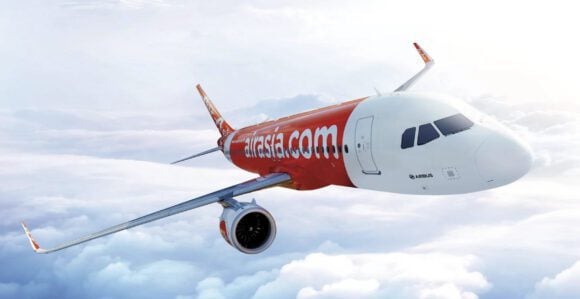
“The A220 will provide an optimal platform for AirAsia, combining low operating costs with the range that will enable the carrier to open new routes across Asia and beyond,” said Lars Wagner, CEO Commercial Aircraft at Airbus. “Airbus and AirAsia teams have been working tirelessly to reach this landmark agreement, which is fully aligned with the airline’s new network strategy.”
The A220 family, with two models, the 115-seat A220-100 and larger 145-seat A220-300, provides Airbus with a competitor in the crossover market between 70-80-seat regional aircraft and the 170-seat A320neo and 737 MAX8 trunk liners. AirAsia is the launch customer for the 160-seat version of the -300. This variant requires two additional overwing emergency exits. It was officially offered to customers last year, but was already developed by Bombardier for the CS300.
The A220 began life as the Bombardier C Series, and that program was acquired by Airbus when Bombardier lacked the financial resources to successfully ramp up operations. The A220 competes with the Embraer E195-E2, which has, of late, won several competitions over Airbus. With Air Asia, one of Airbus’s largest customers (its current 253-aircraft fleet is all Airbus), it has more flexibility in negotiating multi-aircraft-type deals, while Embraer is limited to a single type.
The Deal
Details of the deal include a firm order for 150 A220-300 aircraft, plus 150 options. This is the largest order in the history of the A220 program, which has now won 1.109 orders for both variants. This bodes well for bringing the program closer to break-even and profitability. At the ceremony, Tony Fernandes indicated that AirAsia is very interested in the proposed larger A220-500 variant currently on the drawing board and would order 150 more if that program were launched. “If you build it, AirAsia will buy 150”, he told Lars Wagner, CEO of Airbus Commercial Aircraft, at the signing ceremony in Mirabel. Given additional interest from several airlines, we expect Airbus to launch that program and the upcoming Farnborough Air Show in July.
The A220 program, which began as the Bombardier C Series but was sold to Airbus in 2018, has government support, with Federal, Provincial, and Local-level investments as minority owners in the program, recognizing prior economic development support. The program turning profitable would help recover that prior aid, while supporting thousands of jobs in Quebec. The Right Honorable Prime Minister of Canada, Mark Carney, and the Honorable Christine Frechette, Premier of Quebec, were in attendance, underscoring the importance of this order to the local economy.
The Bottom Line
With A220s for the international market being assembled in Mirabel, Quebec, and those for the United States market in Mobile, Alabama, this is a huge win for the Greater Montreal area economy. Airbus originally planned to ramp production of the A220 to 14 per month in 2026, but revised this last year. It will now get to 13 a month in 2028 as more time is needed to integrate the work packages that Airbus bought from Spirit AeroSystems last year. This will enable Airbus to quickly deliver A220s to AirAsia, with the first aircraft due for delivery in 2028.
This is also good news for Quebec taxpayers, as the government holds a 25 percent equity interest in the A220 program through Investissement Quebec. In February, the fair value of Canada’s $2.1 billion investment in the program was reduced to zero. A major boost to the program from this order will not only create Quebec jobs but also bring the program closer to profitability. This is a positive development for AirAsia, Airbus, Canada, and Quebec, and a strong endorsement for the A220 program.
Competitively, the potential A220-500 is critical. The competing Embraer 195-E2 is much longer than the A220 and would have difficulty being stretched to 160-180 seats, and a stretch model would provide Airbus the ability to right-size aircraft from 110-180 seats using the A220 platform, while focusing A320 family operations on the A321, which itself has a backlog of more than 5,000 aircraft. The 150 options may be the tipping point for launching a new variant.
Views: 827
Excellent report, with accurate and detailed info.