
The Spirit Airlines/US Government story seems to keep percolating. There has been bipartisan opposition to this deal, and for good reasons. There is nothing more frightening than hearing these words, “I’m from the government, and I’m here to help.”
This morning, the IAM union put out this statement: Richie Johnsen, Air Transport General Vice President of the IAM Union (International Association of Machinists and Aerospace Workers), North America’s largest airline union, issued the following statement regarding potential federal relief for Spirit Airlines:
“Spirit Airlines workers, including IAM ramp service employees, are the backbone of this airline and a lifeline for millions of travelers who depend on affordable air service.
“Every day, our members help make air travel accessible for working families, students and communities who rely on Spirit to stay connected. When Spirit flies, more Americans have access to affordable air travel.
“The IAM Union strongly supports federal relief for Spirit Airlines, but it must come with clear, enforceable protections for workers, just like the CARES Act’s Airline Payroll Support Program. That means no furloughs, no layoffs, and no shifting the burden onto the very people who keep this airline running.
“We’ve seen this model work before. Protecting workers also protects service. Keeping experienced aviation workers on the job ensures reliability, safety and the affordability passengers count on.
“IAM Union members at Spirit, and all frontline aviation workers, did not cause this crisis. They should not be the ones forced to pay the price. Any federal assistance must prioritize protecting jobs, preserving pay and benefits, and maintaining the affordable air service that millions of Americans rely on.
“The IAM Union stands ready to work with policymakers to ensure any relief package puts workers and passengers first.”
Fair enough – the loss of jobs is going to hurt a lot of people. But think it through some more.
The Case for Capitalism
- There are ~14,000 people at Spirit Airlines to worry about. Saving the airline helps them. But at a cost to 168 million taxpayers (2025).
- Saving Spirit means lower fares in certain markets. And the airline has already abandoned 18 cities.
- Saving Spirit impacts the rest of the industry, though. Why should Spirit be helped and thereby burden other, better-managed and run airlines?
- The airline business is a system with economic reach far beyond its operating silo. Remember what happened during the pandemic? Airlines cut back, and the whole travel industry went into meltdown. Estimates are that 3.5 million jobs were lost. Savign Spirit introduces risk into an already delicate system.
- How about Chapter 11, again? The fact that Spirit Airlines has been through it multiple times doesn’t make it irrelevant—it tells you something more important: the business model may be structurally fragile under current conditions. That doesn’t make Chapter 11 irrelevant—it makes it revealing.
- Crucially, Chapter 11 allocates pain within the private sector—creditors, lessors, labor, and equity. A bailout shifts that burden to the public—taxpayers.
Ultimately, we have a tradeoff between public policy, which is inevitably political, and private capital. Economic history generally favors private capital, but aviation has never been a purely market-driven industry. Where private capital has been less successful, you will find some political interference. It’s notable that even after the Airline Deregulation Act of 1978, the airline industry still behaves more like a strategic utility with market features than a pure free market. As we’ve seen several times, aviation is already a hybrid system, so intervention isn’t abnormal. It’s just this time, singling out one airline is very different.
The Other Shoe
That’s one view. How about the other side? Let’s go over some scenarios.
The government might argue that, in 2024, the Department of Justice blocked the JetBlue-Spirit merger specifically to protect the “Spirit Effect”—the proven phenomenon in which fares drop across all airlines when a budget carrier enters a route. Ironically, having blocked the private-capital merger solution, the government now faces the “death” of the competitor it claimed to be saving. If Spirit liquidates, the remaining “Big Four” gain even more pricing power, potentially leading to a net loss for the 168 million taxpayers through higher airfares rather than a one-time bailout cost.
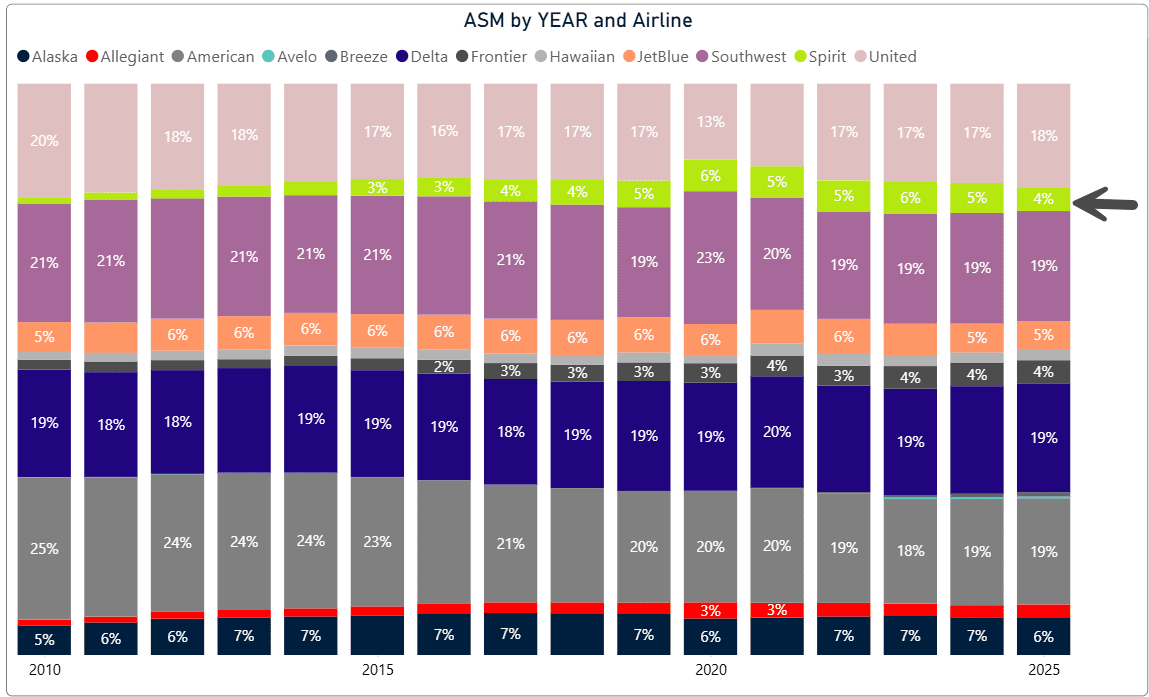
How about the “Spirit Effect”? It isn’t just cheaper tickets on Spirit—it disciplines everyone’s pricing. If Spirit Airlines disappears, legacy carriers don’t just gain share; they gain pricing latitude across entire route networks. That could impose a recurring cost on consumers that exceeds the cost of a one-time bailout. The arrow points to Spirit’s market share, which is under 5%. The ULCC effect is real, but it is replicable via Frontier Airlines and others. The risk is not permanent loss of competition—it is a temporary disruption while capacity and pricing adjust. Losing Spirit is a timing challenge and not a permanent issue.
However, one has to recognize how public policy got us here. The government blocked a private solution to preserve competition. That decision now risks eliminating the very competitor it sought to protect. The result is a policy whiplash: antitrust enforcement on one hand, industrial policy on the other—pulling in opposite directions.
Spirit holds some of the most valuable “real estate” in aviation, like slots at capacity-constrained airports like LaGuardia and Newark. If Spirit goes under, those slots are likely to be swallowed by the legacy carriers through bankruptcy auctions. The government may view a “bridge loan” or equity stake as a way to keep those slots in the hands of a low-cost entity, preventing a permanent monopoly in key metro markets.
The current discussion in Washington has taken a turn toward economic nationalism. President Trump’s recent comments about a “taxpayer-funded takeover” suggest a model closer to the 2009 GM bailout: floating the idea of the government taking an equity stake, stabilizing the airline, and then reselling it at a profit once oil prices stabilize. This transforms the bailout from a “gift” to an “investment” (in the political narrative), complicating the “burden on the taxpayer” argument if the government eventually breaks even or profits. On the other hand, if current management can’t make the airline work, does the government have other talent with better skills?
Moreover, airlines are structurally less stable than, say, the automobile industry. Timing exits is harder because the airline industry is cyclical. That means, political pressure will distort exit decisions. So the real question isn’t “could taxpayers profit?” but: will policymakers behave like disciplined investors? You know the answer to that question.
Then there’s the systemic risk vs. isolated failure: if Spirit fails, it’s not just 14,000 airline jobs; it’s the regional airports (like Fort Lauderdale or Myrtle Beach) where Spirit represents 20–30% of traffic. A sudden Spirit liquidation could bankrupt airport authorities or local tourism boards, creating a “mini-pandemic” economic shock in specific geographic hubs. This case assumes others won’t step into the breach overnight. Given the opportunity, Frontier, Avelo, and Breeze, to mention three, are indeed likely planning for exactly this outcome. The concern is likely overstated. At worst, there might be some short-term dislocation of air service. The US has a mature and highly competitive airline market. It probably will move faster than most people expect.
While a Spirit collapse could hit specific regions (e.g., leisure-heavy airports) hard and fast, bailout costs are diffuse and often partially recoverable. That asymmetry matters politically and economically. Those 14,000 jobs have multiplier effects—on airport vendors, tourism, and maintenance contractors. But political incentives shouldn’t override long-term economic outcomes.
Bottom Line
This isn’t just a question about one airline. The real question isn’t whether Spirit should be saved—it’s whether public policy should substitute for a market outcome that regulators themselves helped shape. If the answer is yes, then we’re no longer just managing an airline—we’re managing the consequences of our own interventions.
Views: 178