

[UPDATED – The overlooked E175. We got some feedback that deserves a refresh of this story]
Hawaiian, part of Alaska Airlines Group, faces a challenge. Its inter-island service hammers aircraft, and its 717s are aging faster in Hawaii than anywhere else. This concern has been around for years. And there’s still no ideal solution for Hawaiian, because its requirements are unique. That makes the replacement choice a set of unique tradeoffs.
The Core Problem
Alaska Air Group’s 19 Boeing 717s have an average age of ~24 years and operate exclusively on inter-island routes — short-stage, high-cycle operations that no other carrier in the world replicates at this intensity. These 717s operate up to 16 daily segments, accumulating takeoff and landing cycles far exceeding those seen in mainland or long-haul operations. The FAA recently issued a binding directive requiring repetitive inspections of the upper lock link assembly for cracking — a direct consequence of that cycle intensity.
What Alaska Has Said
Alaska CFO Shane Tackett acknowledged these 717s need replacement but hinted at something beyond a simple 737 MAX substitution: “Is there a different sort of purpose-built short-stage length, high-cycle aircraft that could live in Hawaii better than the 737?” That’s a remarkable statement — Alaska has a deep Boeing relationship and a large MAX order book, yet its own CFO is questioning whether the MAX is the right tool for inter-island Hawaii.
He’s not wrong. Understanding inter-island stage lengths is important. Typical inter-island flights last 30-50 minutes. Hawaiian operates roughly 170 daily inter-island flights — some corridors run every 30 minutes at peak. Very high cycles in a corrosive environment are perfect for aging aircraft.
- Honolulu–Maui: ~100 miles
- Honolulu–Kauai: ~103 miles
- Honolulu–Kona: ~163 miles
- Honolulu–Hilo: ~216 miles
- Maui–Kona; ~100 miles
- Maui–Hilo: ~120 miles
Aircraft Options
737 MAX 7 — the closest-sized Boeing product to the 717, now in final certification phases with 2Q26 approval expected. Alaska’s argument for fleet commonality is strong. But the MAX 7 is optimized for range, not high-cycle short-stage operations. It carries more seats than Hawaiian needs on thinner inter-island routes and costs more to operate per cycle than purpose-built alternatives. It is quite simply ‘too much airplane.’
Airbus A220-100 — a frequently cited replacement candidate, offering 125 seats, high commonality with modern systems, and a design that handles frequent pressurization cycles well. The problem: Hawaiian is now part of the Alaska Air Group, which is deeply aligned with Boeing. An A220 order would introduce a third narrowbody type across the combined group — A321neo, MAX, and A220 — which adds maintenance and training complexity. The odds don’t favor this selection. The size match is reasonable. The fleet politics are not.
Embraer E190-E2 — the closest size match to the 717 at roughly 110 seats, with Embraer’s proven high-cycle credentials from other regional operations. The E2 is also gaining momentum. Embraer has a significant existing relationship with Alaska (E175). The E190-E2 is the right size and offers way more range than needed. That extra range capability means added weight. Embraer won’t modify its aircraft for ~20 orders. But the E175 is something worth evaluating.
The upper table lists fuel burn, and the lower table lists Air Ops costs per seat hour.
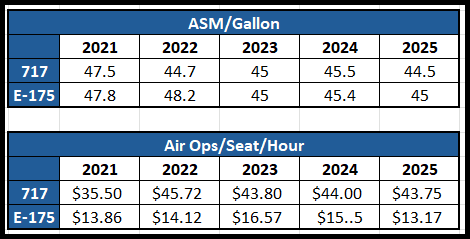
In terms of fuel burn, there’s little daylight between the two. Given the stages, this is perhaps the lesser of the issues. The high cycles, though, drive up operating costs. The lower table shows the E-175 at significantly lower costs than the 717. That difference is important. The E-175 has 41% fewer seats, and that is also a significant consideration.
Hawaiian’s 717 load factor in 2023 was 74% and has risen slowly; in 2025, it averaged 78%. These 717s are typically carrying 96 passengers per flight. That’s 20 more than an E-175 can manage. The E-175s are subject to the Scope Clause. Switching to E-175s at Hawaiian is not a panacea, but certainly not out of the question. After all, what better option is there? Moreover, Alaska operates 89 of them, so there is a deep understanding of its capabilities. Increasing the inter-island fleet may be the simplest way to go.
ATR 72 – this is a non-obvious solution. The stages are realistic for a slower turboprop. These aircraft are smaller than the 717, but most certainly are not ‘too much airplane’ as the others clearly are. Hawaiian operated ATR turboprops on Molokai and Lanai routes until 2021 — the inter-island turboprop concept has been tried and abandoned once already. Whether Alaska would revisit it on a larger scale is an open question. That said, this option should not be dismissed, as it is worth considering. But it is not a better option than the E-175.
The Timing Reality
Alaska has indicated it will keep the 717s for approximately 5 more years, with replacement deliveries likely to begin in 2029-2030. That means a fleet decision is probably being made internally right now — and whoever wins the order will need to demonstrate high-cycle durability credentials, not just seat economics. Indeed, this market demands something as hardy as the 717 with state-of-the-art economics. Nothing like the 717 exists and likely won’t exist by 2030. But the future is less murky than it looked before we consider the E-175.
Bottom Line
The “purpose-built” comment from Alaska’s CFO is the thread worth noting. It opens the door to the ATR, E-175, E190-E2, and A220 as contenders over the MAX 7. The aircraft Hawaiian ideally needs isn’t currently in production. But then running an airline often means making do with what you have.
The 717’s replacement isn’t just a fleet decision. It’s a market gap that Boeing can’t really compete in. Airbus has a solution, but there are obvious hurdles. It looks like the E-175 is the most realistic option.
Views: 1438
Alaska certainly does have an Embrear relationship as Horizon Air, an Alaska subsidiary flies Embraer. Due to that relationship, the Embrear 190 is a logical answer size wise and is a proven high cycle aircraft.
Plugging in smaller 737s makes no sense.
Business is run by common sense, the total cost of ownership, benefit to the clients and to the corporation, ie. Embraer is the right choice
Have the courage to take politics to take a “flying” leap and do the right thing for the clients and for the company. Politics feathers always get ruffled but can get folded back into place, not the same with revenue dollars.
It’s interesting to note that in the Canary Islands, which are virtually identical to Hawaii in terms of distance between islands, the two interisland airlines, Binter Canarias and CanaryFly, both use ATR-72s, and very effectively at that. Hawaiian residents have a strong preference for jet aircraft, but the difference between an ATR and an E-175 cabin is minimal, and flight times would be similar. The biggest issue is that the ATR’s cargo area is too short to carry longboards (surfboards), which is actually a huge concern in Hawaii. Perhaps ATR could design a special edition of the ATR-72 with extra space for surfboards?