

The Banks’ View
Five major banks — UBS, Deutsche Bank, Morgan Stanley, Bank of America, and Jefferies — all lifted price targets on American Airlines within days of each other. The specific moves: UBS raised its AAL target to $21 with a Buy rating, Morgan Stanley to $24 with an Overweight rating, Deutsche Bank to $18 with a Buy rating, Jefferies to $15 with a Hold rating, and Bank of America to $16 with a Neutral rating.
Bank of America specifically points to strong US airline demand, sharply higher ticket prices, lower fuel costs, and flat capacity as the conditions enabling the re-rating, but cautioned that upside depends on airlines maintaining capacity discipline into peak summer.
Deutsche Bank went furthest, calling American Airlines one of a small group of US carriers expected to earn returns above their cost of capital, generate free cash flow, and pay down debt even through a geopolitically driven 2026 downturn. That’s a significant statement — it frames AAL not as a recovery trade but as a durable cash generator.
UBS highlighted that airlines should guide 3Q profits above expectations, thanks to strong demand and lower jet fuel prices. Fuel costs dropping from the $4.24/gallon April peak is now showing up in analyst models and stock price targets, exactly as you forecast.
This is the financial market confirmation of your macro thesis. Your Hormuz piece said jet fuel relief would be a Q4 story on P&Ls — Wall Street is now pricing it into Q3 guidance expectations.
The Data
Our internal metrics reinforce this re-rating:
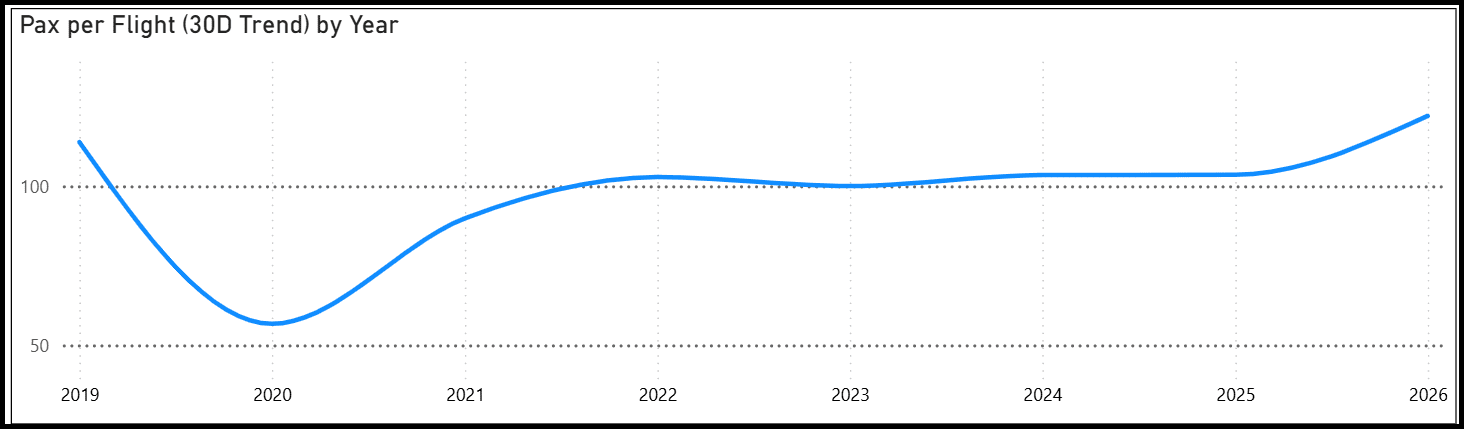
- Pax per Flight (30-day trend) has broken higher in 2026, reaching ~106 passengers per flight — above the 100–102 plateau seen from 2022 through mid-2025. This reflects improved throughput per departure: higher load factors, up-gauging, and demand outpacing capacity growth.
- Biz vs Leisure Ratio remains leisure-heavy, but the gap between the two segments has narrowed significantly in 2025–2026. Leisure led the post-COVID recovery, but the market is maturing — business travel is no longer lagging as dramatically.
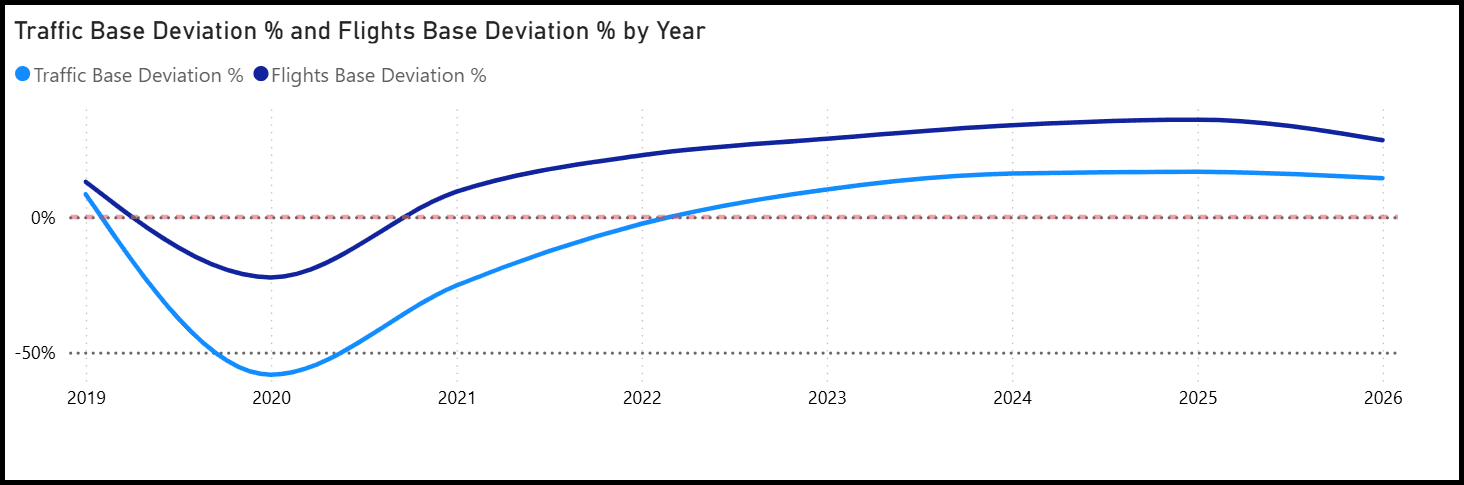
- Traffic vs Capacity tells the clearest story. Total traffic has recovered to 15–18% above 2019 levels, while capacity additions have been more measured. The result is a tighter market in 2026, as evidenced by our Capacity Tightness Index turning upward.
Supporting Charts
When the 30-day moving average of passengers per flight drops over a full-year period, it tells you that the structural density of flights is thinning out. Even as total passenger volume hits record highs in the news, airlines are flying slightly less-dense aircraft blocks on average across their networks.
2023–mid-2025: Plateau around 100–102 pax/flight. Industry stabilization with normalized load factors. 2025–2026: Clear upward break. The 2026 average so far is ~106 pax/flight (higher than the prior plateau), which matches the rising trend on the chart. This signals improved passenger throughput per departure — either higher load factors, larger aircraft, or demand outpacing capacity growth.
Here’s another chart to consider. Leisure led the recovery and became the dominant force post-COVID. Business travel has been lagging for years (classic “corporate travel is back, but not fully” narrative). In 2025–2026, the gap between business and leisure growth has largely closed. This suggests the market is maturing — leisure is no longer dramatically outpacing business.
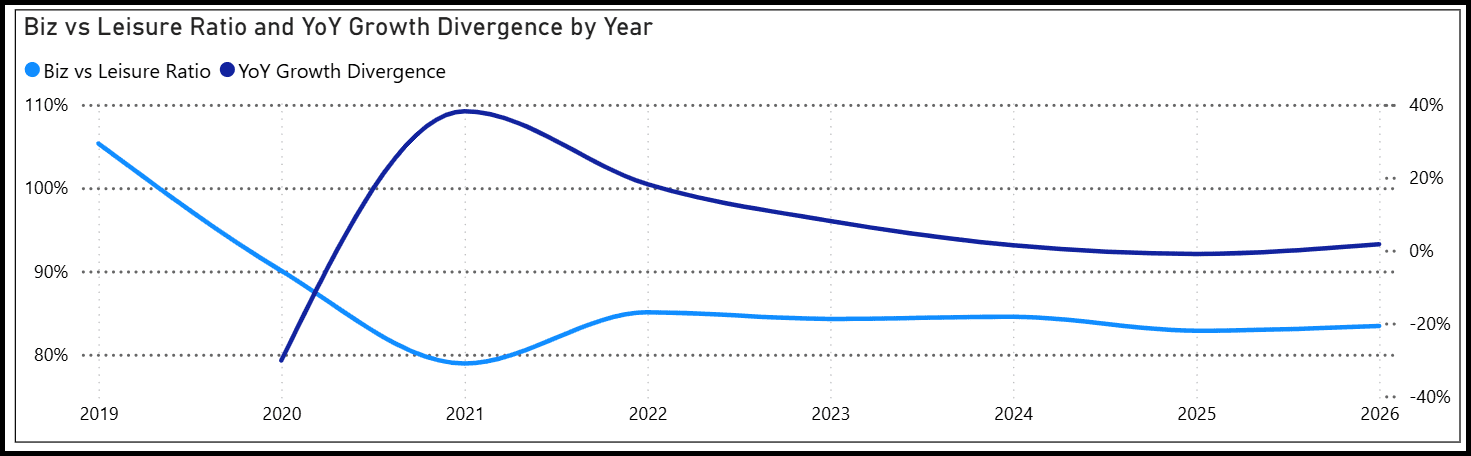
The recent uptick in Pax per Flight is likely driven more by strong overall demand than by a major shift back toward business travel. Airlines may be benefiting from high leisure volumes filling seats, but premium/business cabin yields could still be under pressure if the mix hasn’t fully normalized.
Here’s our third chart, which signals:
- Flights recovered faster and more aggressively than traffic initially.
- Since 2022, traffic has been exceeding capacity, which is exactly why the Pax per Flight metric has been rising.
- Full Recovery Achieved: Total traffic volume has not only recovered from COVID but has also been running 15–18% above 2019 levels in recent years.
- Stabilization Phase: The line has flattened nicely since 2023. This suggests the industry has entered a new normal rather than continued explosive growth.
- 2026 Nuance: The very slight downtick at the end is worth watching — it could be seasonal, due to capacity constraints, or an early sign of moderation. But it’s still strongly positive.
And our last chart. The market is tightening in 2026. Airlines have been adding capacity ahead of demand for several years, but traffic is now catching up (or even pulling ahead in recent months. This matches the upward trend we see in Pax per Flight.
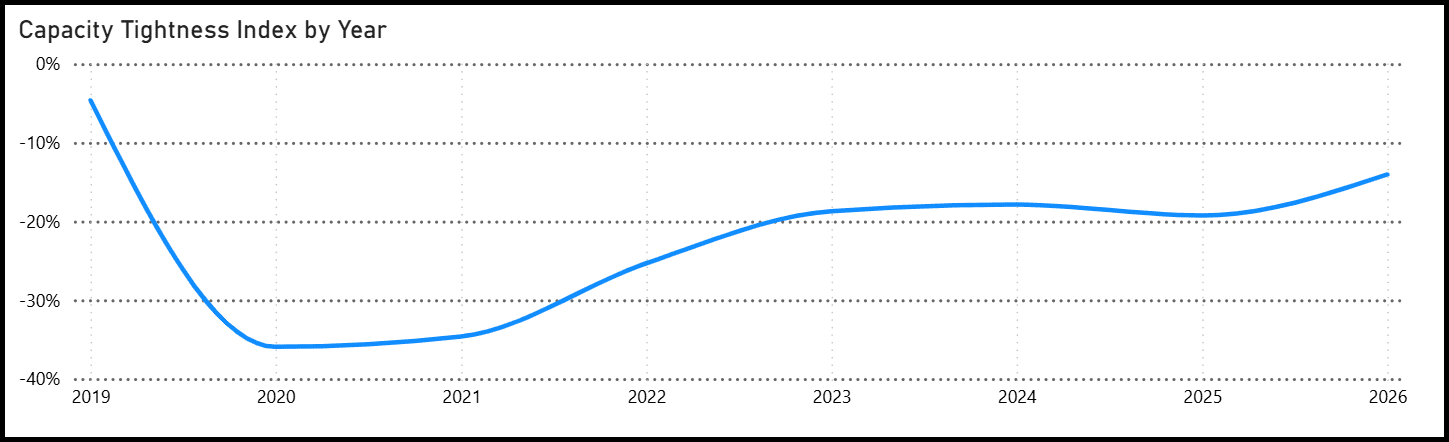
- Positive for yields/load factors: Tighter capacity should support higher average passengers per flight and better pricing power.
- Risk if demand slows: Less buffer than in previous years.
- Explains recent behavior: The combination of high traffic recovery + more disciplined capacity growth is driving the efficiency gains visible in the other charts.
Bottom Line
Wall Street is increasingly confident that U.S. airlines — led by disciplined capacity and falling fuel costs — are entering a phase of structurally higher profitability and cash generation. The combination of elevated passenger volumes and rising passengers per flight is creating a favorable operating environment.
The key risk remains execution: if capacity discipline slips, the current tailwinds could fade. But for now, the data and the banks are aligned.
Views: 123