

PR:
SAS today announced the largest investment in the company’s history, marking a significant step in the airline’s long-term ambition to strengthen connectivity between Scandinavia and the world. Up to 40 Airbus widebody aircraft underscore SAS’ long-term commitment to enhancing Scandinavia’s global connectivity and competitiveness.
“For 80 years, SAS has connected Scandinavia with the world and the world with Scandinavia. Today, we are investing in the next chapter of our story,” said Anko van der Werff, President & CEO of SAS.
“This is the largest investment in our company’s history and a clear signal of our confidence in the future. At the same time, the analysis we are presenting today demonstrates the broader value of international access. Strong global links create opportunities for businesses, support jobs, attract investment, and strengthen competitiveness across our region.”
The investment comprises up to 40 Airbus widebody aircraft, combining new Airbus A330-900neo aircraft with additional Airbus A330-300 aircraft secured to support near-term growth ahead of the arrival of the new fleet. The Airbus order represents the highest-value aircraft order ever placed by SAS, with a total list price of over USD 10 billion.
Together, these investments will support the continued development of SAS’ long-haul network, enhancing the airline’s ability to connect Scandinavia with key international markets in the decades ahead.
Today’s announcement follows last year’s record order for 55 Embraer E195-E2 regional aircraft. Together with the ongoing renewal of the Airbus A320neo fleet, these investments represent the most significant modernization of the SAS fleet in decades, delivering substantial improvements in fuel efficiency, noise performance, and customer experience.
New analysis highlights substantial job creation and GDP growth by 2030
Alongside the fleet announcement, SAS today presented a new analysis of the potential socio-economic impact of significant expansion at Copenhagen Airport towards 2030. The report quantifies, for the first time, the potential value that expanded international access through SAS’ planned growth could create for Denmark, the Öresund region and Scandinavia.
The analysis shows that if SAS’ planned growth is realized, it will support an additional 25,000 jobs and contribute DKK 25 billion to GDP by 2030. This will increase the total number of jobs supported by SAS to 64,000 and raise its total contribution to GDP to DKK 66 billion. In addition, the planned growth will support approximately 4,000 new jobs in Southern Sweden.
The findings highlight the importance of international aviation as a driver of economic activity, competitiveness, and long-term prosperity. While centered on Copenhagen Airport, the benefits extend across Denmark, the Öresund region and Scandinavia through stronger access to global markets, improved mobility and increased economic activity.
SAS is committed to ensuring that future growth is delivered with sustainability at its core. To support this ambition, SAS is also signing a Memorandum of Understanding with SkyKraft today to explore the potential development of e-SAF as part of the long-term transition towards more sustainable aviation.
The announcement comes as SAS celebrates its 80th anniversary. Since its founding in 1946, SAS has played a central role in connecting Scandinavia to international markets, enabling trade, tourism and cultural exchange while supporting economic development across the region.
Copenhagen is at the heart of that mission. As SAS’ global hub, it serves as the primary gateway between Scandinavia and the world, connecting travelers, businesses and communities across the region with destinations throughout Europe, North America, Asia and beyond. Strengthening the hub expands access to international markets, supports trade and tourism, attracts investment and creates opportunities across the wider Scandinavian economy.
The new Airbus A330neo aircraft will support SAS’ future long-haul operations, while additional capacity secured for the coming years will support continued network development and demand growth. Together, these investments provide flexibility to meet future demand, strengthen international reach, and support SAS’ ambition to combine growth with continued progress in operational efficiency and sustainability. This includes continued collaboration with industry partners to accelerate the development of renewable aviation fuels, including e-SAF.
“Strong international access is a competitive advantage,” said Anko van der Werff.
“In a world where investment, talent and opportunity move across borders, well-connected regions are best positioned to succeed. By investing in our future and strengthening our ability to connect Scandinavia with the world, we are helping create lasting value across Denmark, the Öresund region and Scandinavia as a whole.”
Notes:
- This order is significant. Let’s look at the details.
- SAS confirmed an order for up to 40 Airbus widebody aircraft worth more than $10 billion at list prices — it is an all-A330 deal. Specifically: 18 firm A330-900neo orders with options for 10 more, plus 12 A330-300s to support near-term growth ahead of the new aircraft’s arrival.
- Even though Boeing ‘was in the race’, SAS now sits inside an Air France-KLM-led ownership group, which increased its stake to 60.5% by acquiring holdings from Castlelake and Lind Invest. Because SAS already operates an all-Airbus long-haul fleet, including A350S and older A330S, Airbus was likely to be favored.
- The selection of A330-300s as interim lift suggests that Airbus cannot produce sufficient A330-900s to meet SAS’ schedule. That’s a tell. Airbus wants to accelerate the A330neo program and has been trying to do this for some time. The A330 program is their best-selling widebody. The recent order uptake might signal that the time Airbus has been waiting for, the A330ceo’s replacement, has arrived at last. Watch for A330neo production increases – if the supply chain can deliver. This chart is the reason for our question mark in the title. Deliveries dipped in 2020-2021, climbed in 2025, and 2026 is already on track to reach a new high.

AirInsight - The focus on the A330 and the absence of the A350 is also a tell. SAS clearly does not need/want aircraft with that capacity and range. The six they have meet their needs for now, although the airline has two more on order.
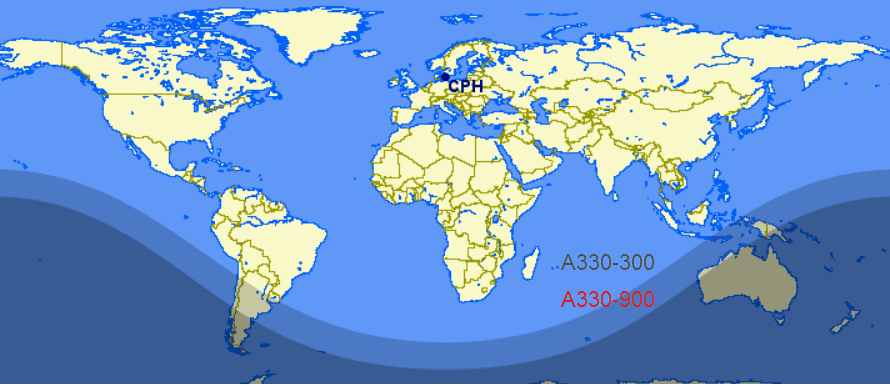
- The A330 focus means SAS is looking at long-haul markets where ~300 seats is the sweet spot. The A330-900 offers just over 7,000 NM range. The following range chart illustrates this well. From Copenhagen, the A330-900 serves nearly every potential market. The six A350s (+ two on order) can serve the rest. By the way, this chart is also a clear example of why the A330-900 has a great future – it can do almost any city pair.

- With no new pilot training required, SAS can easily move to the new model. That cost is not insignificant. They already have Rolls-Royce as an engine supplier, so although it’s a new engine, the support network is established.
- The decision therefore looks like an obvious one. It’s low risk and effective. And it is likely to be copied by several European airlines.
Views: 246