

We spent two days with Embraer in São José dos Campos last week. It was the most upbeat visit there to date.
Last Friday, more good news came from Greece — the Greek Parliament approved the purchase of three C-390s. The KC-390 is rapidly becoming the standard NATO military freighter. As the KC-390 replaces the C-130, it signals that a non-US solution is desirable. Embraer took the media on a KC-390 flight to the program FAL. Embraer also gave the media a short flight on a soon-to-be-delivered E195-E2. It had the special ‘new airplane’ smell and is a remarkably quiet ride, even in the flightdeck.
Part of the day included briefings and an update from Francisco Gomes Neto, Embraer’s CEO. Here’s his presentation. It’s about as upbeat a briefing as we’ve heard. Backlog is great, orders have kept rolling in, and some campaigns look encouraging. Embraer has never looked better.
Q&A
There were two questions from Q&A that we want to share. The first was from Jon Ostrower, who asked about future Embraer programs. Notice the calibrated response. Embraer has clear views on programs and the risk they carry. They won’t be drawn into any chatter about what comes next. Harvesting is acceptable, but one has to plant for the next crop.
This does not mean they aren’t studying new ideas. They are. Here’s a comment from Embraer’s Head of Innovation Design, Denis Silveira, talking about exactly that. More than one speaker mentioned Embraer’s track record of development and an unmatched record of program certifications over the last decade. This is more than a trend; it’s how they work. The question therefore begs itself: What’s coming next, and when will they discuss it openly? They won’t say anything, but you can be sure something is going on.
The following question, from your correspondent, focuses on eTaxi and the E175. It may have caught Mr. Neto off guard.
Here’s the backstory to the question. Cirium analysis shows taxi operations account for 5–20% of total flight-cycle fuel use and CO2 emissions. ICAO engine studies show HC and CO emissions (g/kg) are 16× higher per minute during taxi than in-flight due to cooler combustion temperatures and the fact that jet engines are optimized for flight operations, not for ground idle.
That is why an eTaxi solution is something every commercial aircraft operator should consider.
The biggest beneficiary is regional flying, and the high costs it creates. Our analysis of US DoT data suggests that regional flights cost twice as much per seat as single-aisle flights. The E175 is the most numerous Embraer commercial jet in service, with most operating in the US. So the impact of eTaxi on this fleet is significant – very significant.
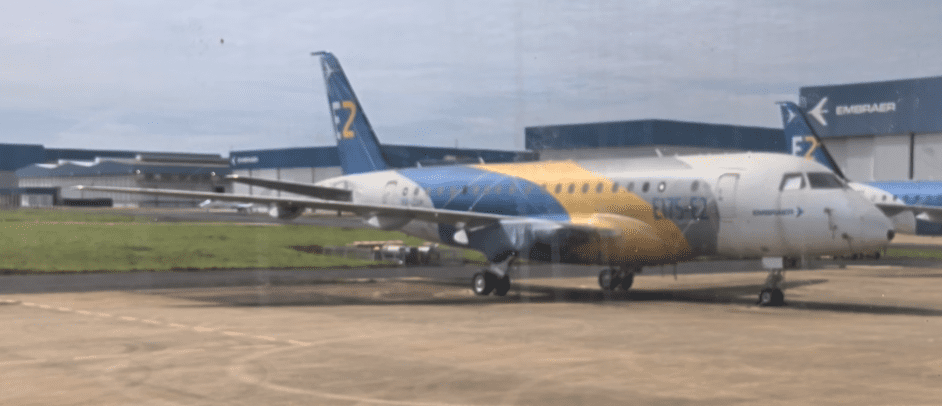
Moreover, a major US airline estimates savings of nearly $400,000 per aircraft per year on its E175 fleet. Given the Scope Clause’s limits and the lack of new regional aircraft technologies on the horizon, eTaxi becomes the default solution. Given that the E175-E2 is frozen (see picture above), it becomes highly attractive if an eTaxi solution can offer double-digit cost reductions in flight ops. This is a crucial technology for Embraer, as the big three US majors and SkyWest are looking into it.
Bottom Line
Embraer has recovered from the Boeing merger debacle. The image below reflects the kama of that event.
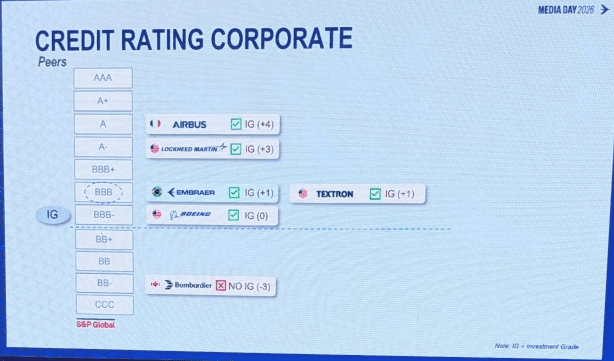
Not only has Embraer recovered, but it has also done so better than Boeing.
Even with the muted response to what comes next at Embraer, it is clear that currently the OEM is riding high. That said, industry history teaches that ‘currently’ is always a short period. What they do next is what everyone is waiting for.
Views: 430