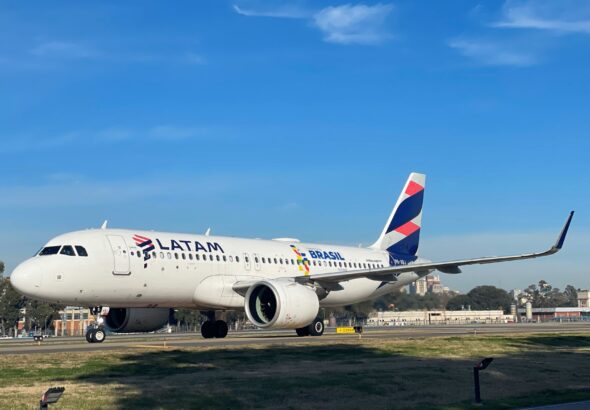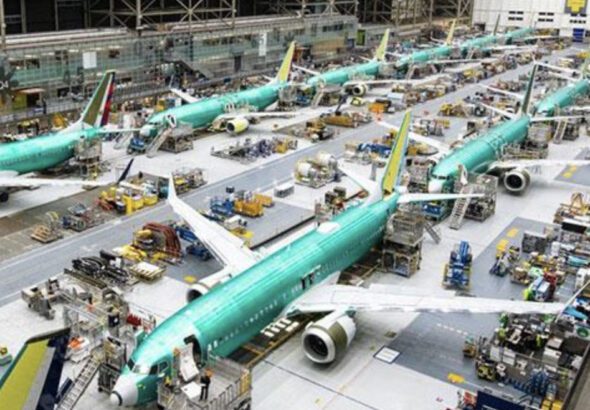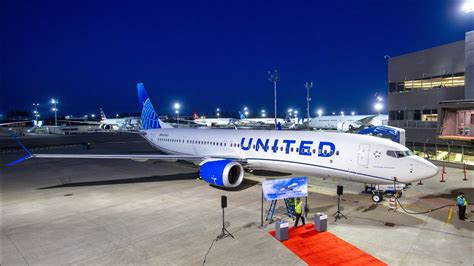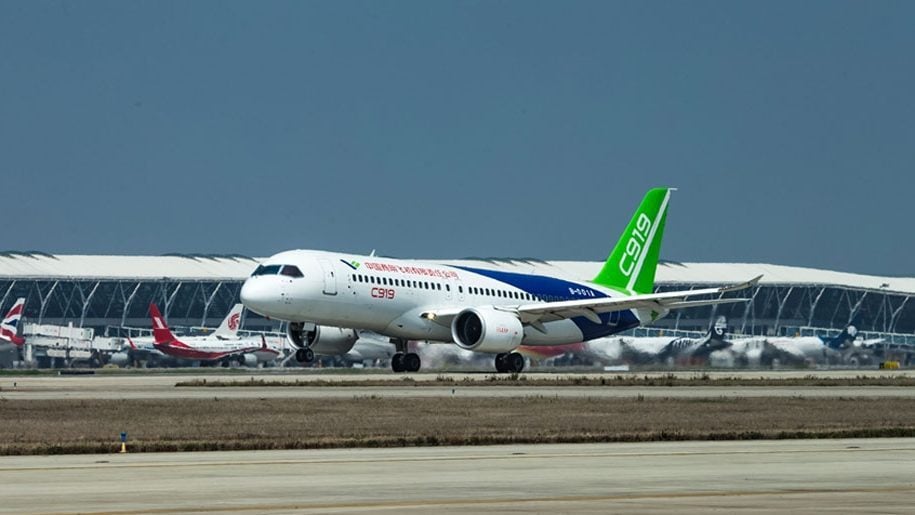
The NEO and MAX have taken the market by storm. Customers seem to be willing to stand in line – even though the 787 and A380 programs taught that sometimes one can order too early. Yet the desire for fuel efficient workhorses appears inelastic. Continue reading
Al-Li an alternative to CFRP
Alcoa announced today that it is expanding its aluminum lithium (Al-Li) capacity and capabilities at three locations to meet growing aerospace demand for its newest alloys. These alloys, introduced last year and now patented, allow OEMs to build dramatically lighter and lower-cost airplanes compared to composite alternatives.
This news is important when looking at what OEMs are doing developing ever lighter airplanes. Airbus (A350) and Boeing (787) have selected the CRFP route whereas Bombardier has gone the Al-Li route for its CS. Alcoa believes its product offers less risk to OEMs than CFRP. While CFRP is well known in military use, it has been used less on commercial airplanes until quite recently.
ALCOA further states that its new technologies:
- lower the weight of an airplane by up to 10% vs. composite-intensive planes;
- lower the cost to manufacture, operate and repair planes by up to 30% vs. composite-intensive planes, and at significantly lower production risk;
- allow for a 12% increase in fuel efficiency, on top of the 15% from new engines; and
- deliver passenger comfort features equivalent to composite-intensive planes, such as higher cabin pressure, large windows and higher humidity.
The last two items deserve special attention. Offering this much in fuel savings is highly significant and then being able to allow for larger windows (like on the 787) and better cabin pressure/humidity is compelling.
Big airplane sales mean big engine sales
This morning CFM provided the following PR: “CFM International (CFM) had a record year in 2011, logging orders for 1,500 commercial, military and spare CFM56 engines and commitments for 3,056 LEAP engines for a combined value of $51.7 billion at list price.
As the company logs record commitments, CFM is also achieving record production rates for the CFM56 product line. The company has built more than 1,000 engines per year since 2006, and the rate has grown steadily. In 2011, CFM delivered more than 1,300 engines, the highest rate in the industry, compared to 1,250 engines built in 2010. Current plans are to reach more than 1,600 engines per year by 2014.”
This is what a great year looks like.
Cathay Pacific Adds to its A350-900 order
Cathay announced it was adding to its existing A350XWB order by committing for six additional -900s. The airline now has 36 A350s on order plus two more committed via pre-arranged 12 years leases. These six aircraft are scheduled for delivery in 2016-17.
The selection of this airplane is important because Cathay Pacific is also a significant 777-300ER customer. The A350-900 falls between the 777-200 and 777-300 in size, with 314 seats, falling between the 301 and 365 capacities of the competing 777 models. The forthcoming A350XWB-1000, at 350 seats, will be closer to the 777-300ER, and could represent a potential replacement for that aircraft in the future.
This is certainly an interesting development, given that Boeing will be introducing its revised 777-8 and 777-9 shortly after that timeframe, although it is not expected that the re-engined version of the 777 will fully match the economics of the much lighter, heavily composite A350XWB.
Airlines that operate the 777 are typically very pleased with the airplane, which has been among Boeing’s best products. Cathay has been a particularly happy customer of the 777-300ER. Boeing’s revised 777-8 and -9 models will no doubt continue to build on the success of their -300ER, and we expect the 777-9 to be larger than the existing 777-300ER to improve seat-mile economics.
Cathay has ordered 71 777s so there is no doubting its current commitment to the airplane. But ordering the new technology A350XWB could mean a key conquest for Airbus in the large wide-body twin segment. It appears Cathay is planning on standardizing on the A350-900, and possibly the A350-1000 in the future, for the 300-350 seat segment.
Bombardier CSeries gets another sale
Bombardier Aerospace announced today that Geneva-based PrivatAir has placed a firm order for five CS100 airliners and has taken options on an additional five CS100 aircraft. PrivatAir was founded more than 30 years ago and operates a large fleet of commercial and business aircraft to provide private charter and private airline services. Its specialized services include exclusively business class flights on behalf of several major network airlines.
PrivateAir has experience with both the A320 and 737 families in all business class service for various airlines. 
The capabilities of the CS100 to use short runways, like London City, opens up intriguing possibilities of what this news might entail.
UK to look at Thames Estuary Airport plan
An airport at the Thames Estuary has moved a step closer with confirmation the UK government would hold a consultation into the proposals. Having ruled out expansion at the existing airports in the south of England, the government is seeking ways to ensure the UK maintains its position as an aviation hub. London’s airports have been forbidden to grow by adding runways. Anyone who has flown through Heathrow knows how crowded it is.
The estuary idea, first championed by London mayor Boris Johnson, faces many hurdles. The fact the idea is being given any consideration after being dismissed at first is good news. UK deputy prime minister Nick Clegg is thought to be opposed to the idea and environmental campaigners have attacked the plan, claiming local birdlife would be endangered. Chancellor of the exchequer George Osborne did not rule out the plan in 2011 during his Autumn Statement.
There is more information on the estuary proposal here.
Airbus claims Top Spot for 2011
Sending out this chart today, Airbus claims to be the winner in the annual orders race once again. When taking a more detailed look at the numbers, note that just over 85% of these sales are for the A320. The A330 is another bright spot at 6.3% of orders. The A380 accounted for 1.3% of annual sales – a number that understates the value of these sales.
Overall single aisle sales accounted for 91% of sales. The A321 saw a good jump in orders of 109 – but this is only 7.4% of single aisle orders. The A318 saw a net -3 while the A319 scored 19 orders. Clearly the big story here is the success of the neo. Without doubt 2011 was the year of the neo.
In the twin aisle segment (A330, A340 A350) the A340 had no orders, and while the A330 did well, the A350 had a net loss of 31. Among the A350 cancellations the A350-900 saw 61% of the cancellations. The increase in A380 orders should have been much better – there were 29 orders but ten cancellations.
Airbus has 12 new customers on its list. That’s a 19% growth in customer base.
When looking at deliveries Airbus provided the following chart.
Of the deliveries, 78.8% were single aisle – compare this to the 91% among the orders. The A320 accounted for 73% of deliveries compared to 85.9% of orders. Clearly the A320 is Airbus’ “bread and butter” program. The A330 generated 87 deliveries (16%) and the A380 26 (5%). We anticipate Airbus will at least match the A320 and A330 deliveries in 2012, but do better on A380 deliveries.
ETS deployment spurs carbon credit sales
Reuters reports EU airlines are buying up carbon credits on the cheap. Recently carbon credit prices have dropped to about half what they were trading at a year ago. This move is quite different from other non-EU airlines; whose reaction has either to join the lawsuits or, in the case of China, to refuse to pay them. The most extreme case has been AirAsia X which simply withdrew from the market because the ETS, fuel prices and other costs were too much.
Interestingly Ryanair announced it would charging customers €0.25 per leg to offset the ETS fee. The airline thinks its 2012 ETS bill will be around €20 million – equivalent to just under 80 million passengers for 2012. Meanwhile Lufthansa said it would need to pass on €130 million in ETS costs to its customers. In 2011 Lufthansa carried 90.2 million passengers (group figure). This means the airline needs an ETS offset of approximately €1.44 per passenger assuming they carry the same numbers in 2012.
As EU airlines move on the slump in carbon credit prices, hedging much as they do on fuel, prices are likely to firm. In the meantime we are now able to define with more clarity what the impact will be for travelers. Certainly, given some of the onerous taxes and levies (the UK APD being the worst), the ETS offset fee is not going to be high enough to hurt air travel. At the moment at least.
Which makes the current non-EU airline position seem more about fighting EU laws than anything else. Given the EU’s determination to enforce the new rule, airlines may have to simply swallow their pride and buy credits to offset ETS charges. Of course ETS costs per passenger are low now. As soon as the airlines start to get on board, we suspect the EU will increase the ETS to test how much revenue they can squeeze out of travelers. No government can resist seeing how hard it can squeeze any gold egg laying goose. And in doing so, the EU risks getting the airline industry even more irritated. But the EU has demonstrated its deaf ear before.
All cracked up
The A380 crack news is overblown and it is important to source the loudest voices. It happens that the most vociferous voices are in Australia. Take a look at these two sources; link 1 and link 2. Given the state of relations between Qantas and some of its unions, is there any wonder where the noise is coming from?
The union’s attempt to induce some sort of panic is not a good idea at all. The A380 has weathered a far more frightening event (QF32) than hairline cracks. Calling for the grounding of the A380 fleet worldwide is disingenuous; this demand is a spurious attempt at creating a media frenzy.
There were no calls for grounding Boeing 737s after cracks (real big ones, not hairline) appeared. That ramped up checks on the fleet were needed was not argued; repairs were made and the planes continue to provide sterling service. No crew will board a plane they feel is “unsafe”. If the crews fly, so should you. Don’t buy into any loud pontifications. Especially ones seeking media coverage.
Outlook for Aerospace in 2012
It is the time of year for prognostication. In that tradition, AirInsight will boldly go where all pundits have gone before – but with better accuracy. With our psychic powers in full swing, here are our fearless predictions for 2012:
1. The world will not end – the Mayan calendar was carved on a stone of a certain size, and they ran out of space. Period.
2. Yes, we will see increasing amplitude in climate, natural disasters, and even the location of limited wars and revolutions, with Syria and Iran currently the most likely candidates. But political change will limit the impact of the powers that be today.
3. We will see interim solutions to the Eurozone crisis, as well as the US dollar, as governments and central banks join forces to salvage the financial system and limit future derivatives and risky behavior. We may go back to investing in whole aircraft again, rather than A,B, and C tranches of bundled EETCs and derivatives, if regulators have the intestinal fortitude to increasingly limit derivative instruments. We believe they will, especially with housing assets.
4. Aircraft manufacturers will increasingly become financiers of last resort – constraining capital for important R&D initiatives and new product development.
5. The business aviation recovery will begin, albeit quite slowly, but business jets and turboprops will increase sales in 2012.
6. The new generation of fuel efficient aircraft engines and high fuel prices fueled by political instability will force Boeing, Airbus, Bombardier and Embraer to increase production capacity to meet new demand. New NB aircraft will be sold out thru 2022 by YE 2012.
7. Just as when jets replaced turboprops, some relatively young narrow bodies with older engines will become economically obsolete at a young age, causing some residual value issues for leasing companies and financial institutions. One can’t assume a 25 year economic life any longer for a new A320 or 737NG delivered in 2012.
8. With American in Chapter 11 bankruptcy, expect the America West management team of USAirways to make a run at American, further consolidating the US legacy carriers.
9. The EU emissions trading scheme will continue to be controversial for the foreseeable future, and will likely impact some Airbus orders for China in retaliation, as well as provoke retaliatory actions by the US Congress in the US — which could negatively impact the Eurozone recovery. Brussels hasn’t awakened to reality yet, and likely won’t until the Euro collapses, and the British celebration haunts the continent.
OVERVIEW
2011 was a boffo year, with record orders at Airbus and outstanding orders for Boeing’s 777-300ER. Had Boeing’s 737 MAX commitments become orders by year end, Boeing would have had a boffo year, too. With the expectation that these commitments will become converted to orders this year, Boeing should easily become more even with Airbus. Having been bolstered by some 1,500 neo orders last year, sales can be expected to slow this year because delivery positions are now well out to the end of the decade.
With cargo statistics beginning to soften dramatically toward the end of last year, this usually is a leading indicator of softening passenger traffic. Might this also depress orders? We’ll see.
But in the USA, the New United Airlines is expected to place an order for 150-200 single-aisle aircraft. Proposals from Airbus and Boeing were due in December. The Old United has a large aging fleet of A319s/A320s and Boeing 757s and a smaller fleet of launch-customer 767-200s. This is going to be a big catch, and it will be interesting to see if Airbus can convince United’s new Boeing-centric Continental Airlines management that it should win at least some of the order. Now that Boeing has the MAX to compete with the neo, the competition is much more even than had it been neo vs 737NG.
This will be an important year to watch for Airbus and the A350 development and for Bombardier and the scheduled first flight of the CSeries. This will be an important year for Boeing and whether it can efficiently ramp up production of the 787 and if it can complete on a timely basis all the rework on those nearly three dozen 787s sitting around Paine Field in Everett.
Here is a company-by-company rundown.