The reaction to American’s recent fleet order was not positive from the financial analyst community. They have valid concerns regarding the firm’s financials. But in typical fashion, MIT Researcher Bill Swelbar decided to take contrarian view and look at the order from a positive viewpoint. He provides his take on his blog. Take a look at the comments section below for more insight on the order. Bill understands where the financial analysts are coming from but thinks one should take a longer view and see the positive side of the order and its potential for helping the airline improve its operating costs rather quickly as the new planes arrive.
737RE Survey Results
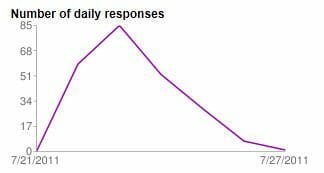
As the chart illustrates, the survey has pretty much run its course. As of this writing, we have 233 responses. Recognizing this is not a scientific survey we also need to accept the responses come from a primarily qualified audience given this site’s traffic sources. So we would tend to consider these results as worthy for consideration. Let’s look at each question.
Over 60% of respondents believe the 737RE will be an economic success for Boeing. This is good news for the firm and with such a strong response one wonders why Boeing did not make the decision to do the re-engine sooner? Respondents clearly feel confident in the airplane and Boeing’s ability to make it work. Given the iterations of the 737 since 1967 this is understandable.
2017 is when most respondents see the 737RE entering service. American, as first customer, expects its first 737RE’s in 2018. Given OEM program delays this is a sensitive issue. But the RE, depending on just how many changes Boeing decides to go for, should be considerably less complex than the NSA. Rumors of a 787 style flightdeck and obviously accommodating the bigger engines are the main changes. The 737 already has wing 4% larger than the A320 which helps provide 9% more fuel. Boeing’s 737 wing is said to be up to 5% more efficient than that on the A320. So we would expect Boeing to ensure wing advantages are maintained even with newer, bigger/heavier engines.
Having discussed the 737′s advantages in its wing, it is interesting to see that nearly 60% of respondents (who we assume know of the 737′s wing) still do not see the 737RE being more economically efficient than the A320neo. This could be due to Airbus removing one toilet in back of the cabin, and adding a row of seats, plus the fact that the neo will not need to compromise its fan diameter for either of the two engines offered. We may also be seeing here the expectation that Airbus will improve the A320 wing somewhat to close the gap with the 737. Moreover, Airbus could make use of newer materials to reduce the neo’s weight – the A320 is supposedly heavier than the 737.
This question obviously is an attempt to understand market reaction to the evolving situation now that we have an neo vs. RE world. We see nearly half the respondents believing the RE will not be helpful to Boeing’s market share. 47% of respondents think Boeing’s market share will decrease.
The result in this chart needs to be contrasted with the previous one. Here 53% of respondents do not see existing 737 customers switching away from Boeing. Yet in the previous chart suggests Boeing will not lose market share. Doing a cross-tabulation of these two questions provides some additional insight.
Among respondents who believe that Boeing customers will switch, two thirds also believe neo will be more economically efficient. Among respondents who think Boeing customers will not switch, fewer believe (still over 50% though) the neo will be more economically efficient. Interestingly, among the non-switch respondents, the number who believe the RE will be economically competitive with neo is 57% greater than those who do nor think the RE will be as economically competitive.
We hope you enjoyed this poll.
About those ticket taxes
Two senators wrote to Richard Anderson, CEO of Delta Air Lines and chairman of the Air Transport Association. The letter addresses the ticket taxes which airlines are still collecting even though the partial shutdown means the government is not collecting that money.
“Although this policy may increase your bottom line in the short term, we are afraid it will have long-term repercussions for the industry,” wrote Senator Jay Rockefeller, chair of the Transportation Committee, and Senator Maria Cantwell, chair of the Aviation Subcommittee. “We urge the nation’s airlines to put all of the profits that they are making from the lapse of the aviation taxes into an escrow account so they can be transferred back into the AATF (Airport and Airway Trust Fund) when Congress reinstates the taxes. We have heard from airlines for many years, these fees, all of which are passed onto the consumer, depress the demand for air travel,” the senators wrote. “We are left to conclude that your previous assertions were incorrect about the impact of taxes and fees on the industry.”
The US government is not currently collecting a 7.5% sales tax on US air tickets and a 7.5% sales tax on the purchase of frequent flyer miles. Taxes on jet fuel are also reduced. During this lapse the US government is losing $200m in tax revenues per week.
Kestrel Chooses Honeywell for New Turboprop

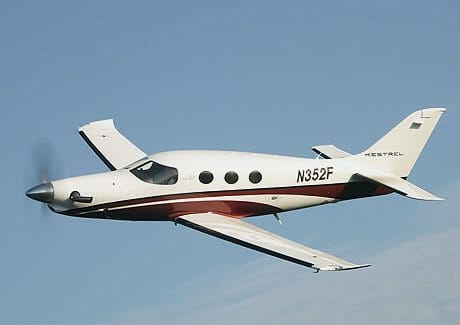
Kestrel Aircraft has chosen the Honeywell TPE 331-14 engine for its new turboprop aircraft currently under development. Kestrel is headed by Alan Klapmeier, former CEO and founder of Cirrus Design.
For this application, Kestrel will utilize a version of the engine de-rated from the normal 1,760 shp to only 1,000. This should provide wide margins for takeoff and climb performance, as well as improve maintenance costs, since the engine will be working at only slightly more than half its full capacity. The TPE-331 was selected over the Pratt & Whitney Canada PT-6.
Kestrel recently located its headquarters and manufacturing facilities at the former Brunswick Naval Air Station in Brunswick, Maine, and anticipates a strong market for the aircraft, which will be priced between $2.5-$3 million per copy.
IAG orders A330
Airbus just announced an order from International Airlines Group (IAG). This firm order of eight A330s for Iberia’s fleet follows the preliminary MoU signed earlier this year. General Electric (GE CF6-80E1) engines have been selected as well. It appears the -300 model is the version acquired. Willie Walsh, IAG chief executive, said: “The A330s will be more cost effective and fuel efficient than the aircraft that they replace with improved environmental performance”. He does not state which airplanes these A330s are replacing but it would seem they will replace A340s. The A330s will be the only widebody twin in Iberia’s fleet.
The A330 continues to serve Airbus very well and, for now, is the only game in its segment.
737RE Poll – prelim results
Note this survey is not scientific. That said, this site’s traffic is highly focused in terms of traffic sources. Our readers are typically from within the industry. Therefore as much as we need to start with a disclaimer, we also want to say that what we see in the results is not something to ignore. The opinions are worth noting at the very least.
As of this writing, there are 210 responses. In a perfect world, with a random sample of responses, this response rate should provide a confidence level of between 6% and 7% given site traffic since we posted the poll on Friday. With that backdrop, here is what readers have shared so far.